%matplotlib inline
from d2l import torch as d2l
import math
from safetensors.torch import load_file
import tiktoken
from tiktoken.load import data_gym_to_mergeable_bpe_ranks
import time
import torch
from torch import nn
from torch.nn import functional as F11.3 Generation and the KV Cache
The generate method of Section 11.2 reruns the full forward pass over the history for every new token. This section measures the resulting cost and introduces the KV cache. Because causal attention prevents past states from depending on future tokens, the keys and values already computed for the prefix can be stored and reused. Caching makes the dominant dense-layer work linear in the generated length. (Attention itself still reads the whole growing cache at every step, so its cumulative cost stays quadratic, a term that is real but subdominant at the sizes we run.) Caching also converts a compute problem into a memory problem, so the second half of this section analyzes its storage cost. We derive the cache-size formula and check it against the allocator, see why generating tokens is bound by memory bandwidth while reading a prompt is bound by arithmetic, and then shrink the cache three ways: sharing keys and values across heads (MQA and GQA), compressing them to a low-rank latent (the idea behind MLA), and bounding the context with a sliding window and retaining the attention sink. The experiments use the d2l.GPT class of the previous section, including GPT-2, which supplies the phenomena that our one-minute character models are too small to show.
%matplotlib inline
from d2l import jax as d2l
from flax import nnx
import jax
from jax import numpy as jnp
import math
import optax
from safetensors import numpy as safetensors_numpy
import tiktoken
from tiktoken.load import data_gym_to_mergeable_bpe_ranks
import time
11.3.1 From Recompute to Cache
Start with the accounting. A forward pass of a model with \(N\) parameters over \(t\) tokens costs about \(2Nt\) floating-point operations — every parameter participates in one multiply–add per token — plus the attention score work of Section 10.5, which is quadratic in \(t\) but subdominant at the model sizes we run here. Naive generation calls this forward pass once per token, over a history that grows by one each step: producing \(T\) tokens after a prompt costs roughly \(\sum_{t} 2Nt \approx N T^2\) operations, quadratic in the length of the text; of the logits it computes, all but the last row is thrown away.
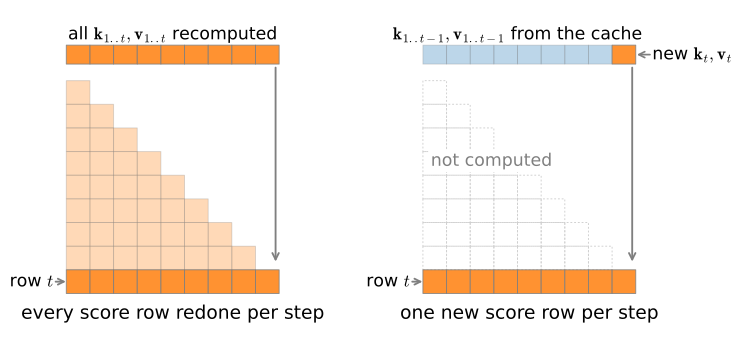
Almost all of that work is literally repeated. At step \(t\) the model needs, in every layer, the attention output for one new query \(\mathbf{q}_t\) against the keys and values \(\mathbf{k}_{1..t}, \mathbf{v}_{1..t}\). The causal mask guarantees that positions \(1, \ldots, t-1\) never see position \(t\), so their hidden states — and therefore their keys and values — are the same at step \(t\) as they were at step \(t-1\). A KV cache stores a per-layer buffer of all keys and values computed so far, and at each step run the transformer on one token, appending its \(\mathbf{k}_t, \mathbf{v}_t\) to the buffer and attending against the whole of it. Figure 11.3.1 contrasts the two schedules. The cost of a cached step is one forward pass over a single token, about \(2N\) operations, independent of \(t\).
11.3.1.1 The Cached Forward Pass
Two details need care. First, positions: RoPE rotates queries and keys by their absolute position, so the attention step must know where in the sequence its tokens sit — the _rope helper of d2l.GPT always counted from zero, and we now need an offset. (A learned position table needs the same offset, one line in the model forward.) Second, the interface: the step receives only the new tokens plus the cache, instead of the whole history.
We extend the CausalAttention of Section 11.2 with a forward_step that reads and grows a per-layer cache, held as a dictionary of two tensors that we concatenate onto. Two cases arrive here: prefill, where the whole prompt enters at once into an empty cache and the mask must be causal, and decode, where a single token attends to everything stored. These are the only two shapes the step supports — appending a multi-token chunk to a non-empty cache would need an offset causal mask that the is_causal flag cannot express, so the assert below refuses the combination.
Growing a tensor by one slot per step is unsuitable for JAX because every new length creates a new shape and triggers a fresh XLA compilation. The naive generate of Section 11.2 already solved this problem once, by allocating the token buffer at its final size and overwriting it. The cache follows the same discipline, and it is exactly how production JAX serving works: preallocate K and V buffers of shape (layers, batch, max_len, heads, head_dim), write each step’s keys and values into their slots with dynamic_update_slice, and mask attention so that queries only see filled positions. The function compiles once for the prompt shape and once for the single-token step, and the decode loop then reuses that compilation at every step. Static shapes enable the compiled path in this setting.
def rope(x, offset=0):
    """Rotary rotation of x at absolute positions offset, offset+1, ..."""
    d = x.shape[-1]
    pos = offset + torch.arange(x.shape[-2], dtype=torch.float32,
                                device=x.device)
    inv_freq = 10000.0 ** (-torch.arange(0, d, 2, device=x.device) / d)
    theta = pos[:, None] * inv_freq[None, :]
    cos, sin = torch.cos(theta), torch.sin(theta)
    x1, x2 = x[..., 0::2], x[..., 1::2]
    return torch.stack([x1 * cos - x2 * sin,
                        x1 * sin + x2 * cos], -1).flatten(-2)

@d2l.add_to_class(d2l.GPT.CausalAttention)
def forward_step(self, X, cache):
    """Attention for the new tokens X against cached keys and values."""
    B, T, D = X.shape
    assert not (cache and T > 1), \
        'chunked append to a non-empty cache is unsupported ' \
        '(is_causal would misalign the mask)'
    q, k, v = self.W_qkv(X).chunk(3, -1)
    q, k, v = (u.reshape(B, T, self.num_heads, -1).transpose(1, 2)
               for u in (q, k, v))
    offset = cache['k'].shape[2] if cache else 0
    if self.rope:
        q, k = rope(q, offset), rope(k, offset)
    if cache:
        k = torch.cat([cache['k'], k], dim=2)
        v = torch.cat([cache['v'], v], dim=2)
    # contiguous(): at prefill k and v are still views into the fused QKV
    # projection, and caching a view would pin the whole 3x-wide buffer
    cache['k'], cache['v'] = k.contiguous(), v.contiguous()
    # Prefill (T > 1, empty cache) needs the causal mask; a single decoded
    # token (T = 1) attends to the entire cache
    Y = F.scaled_dot_product_attention(q, k, v, is_causal=(T > 1))
    return self.W_o(Y.transpose(1, 2).reshape(B, T, D))
def rope(x, offset=0):
"""Rotary rotation of x at absolute positions offset, offset+1, ..."""
d = x.shape[-1]
pos = offset + jnp.arange(x.shape[1])
inv_freq = 10000.0 ** (-jnp.arange(0, d, 2) / d)
theta = pos[:, None] * inv_freq[None, :]
cos = jnp.cos(theta)[:, None, :] # broadcast over heads
sin = jnp.sin(theta)[:, None, :]
x1, x2 = x[..., 0::2], x[..., 1::2]
return jnp.stack([x1 * cos - x2 * sin,
x1 * sin + x2 * cos], -1).reshape(x.shape)
def init_cache(model, batch_size, max_len):
"""Preallocated K and V buffers, one slab per layer."""
attn = model.blks[0].attention
head_dim = attn.W_o.in_features // attn.num_heads
shape = (len(model.blks), batch_size, max_len, attn.num_heads, head_dim)
return jnp.zeros(shape), jnp.zeros(shape)The model-level step walks the blocks the way d2l.GPT.forward does, handing each block’s attention its cache; a generate_cached then repeats the sampling loop of Section 11.2, prefixed by a single prefill call, with each subsequent step feeding in one token.
@d2l.add_to_class(d2l.GPT)
@torch.no_grad()
def forward_cached(self, X, caches):
    """Forward for new tokens only, extending one cache per block."""
    offset = caches[0]['k'].shape[2] if caches[0] else 0
    H = self.token_emb(X)
    if self.pos == 'learned':
        H = H + self.pos_emb(torch.arange(offset, offset + X.shape[1],
                                          device=X.device))
    for blk, cache in zip(self.blks, caches):  # pre-norm arrangement
        H = H + blk.attention.forward_step(blk.norm1(H), cache)
        H = H + blk.ffn(blk.norm2(H))
    return F.linear(self.norm(H), self.token_emb.weight)

@d2l.add_to_class(d2l.GPT)
@torch.no_grad()
def generate_cached(self, prefix, num_tokens, temperature=1.0, top_k=None):
    """Sample as generate does, but never recompute the prefix."""
    device = next(self.parameters()).device
    caches = [{} for _ in self.blks]
    ids = list(prefix)
    X = torch.tensor(prefix, device=device)[None]
    for _ in range(num_tokens):
        logits = self.forward_cached(X, caches)[0, -1] / temperature
        if top_k is not None:
            cutoff = torch.topk(logits, top_k).values[-1]
            logits[logits < cutoff] = -torch.inf
        ids.append(int(torch.multinomial(F.softmax(logits, -1), 1)))
        X = torch.tensor([ids[-1]], device=device)[None]
    return ids
@nnx.jit
def cached_forward(model, ks, vs, X, t):
"""Logits for the last of the new tokens X at positions t, t+1, ...;
writes their keys and values into the cache slots at those positions."""
B, T = X.shape
H = model.token_emb(X)
if model.pos == 'learned':
H = H + model.pos_emb(t + jnp.arange(T))
mask = (jnp.arange(ks.shape[2])[None, :]
<= (t + jnp.arange(T))[:, None])[None, None]
for i, blk in enumerate(model.blks): # pre-norm arrangement
attn, Y = blk.attention, blk.norm1(H)
q, k, v = jnp.split(attn.W_qkv(Y), 3, axis=-1)
q, k, v = (u.reshape(B, T, attn.num_heads, -1) for u in (q, k, v))
if attn.rope:
q, k = rope(q, t), rope(k, t)
# Callers must keep t + T <= max_len: an out-of-range write does
# not fail here -- dynamic_update_slice clamps its start index
# silently. (t is traced under jit, so generate_cached asserts.)
ks = jax.lax.dynamic_update_slice(ks, k[None], (i, 0, t, 0, 0))
vs = jax.lax.dynamic_update_slice(vs, v[None], (i, 0, t, 0, 0))
Y = jax.nn.dot_product_attention(q, ks[i], vs[i], mask=mask)
H = H + attn.W_o(Y.reshape(B, T, -1))
H = H + blk.ffn(blk.norm2(H))
return model.token_emb.attend(model.norm(H))[:, -1], ks, vs
@d2l.add_to_class(d2l.GPT)
def generate_cached(self, prefix, num_tokens, seed=0, temperature=1.0,
top_k=None):
"""Sample as generate does, but never recompute the prefix."""
assert len(prefix) + num_tokens <= self.max_len, 'cache overflow'
ks, vs = init_cache(self, 1, self.max_len)
logits, ks, vs = cached_forward(self, ks, vs,
jnp.asarray(prefix)[None], jnp.array(0))
ids, key = list(prefix), jax.random.key(seed)
for t in range(len(prefix), len(prefix) + num_tokens):
l = logits[0] / temperature
if top_k is not None:
l = jnp.where(l < jnp.sort(l)[-top_k], -jnp.inf, l)
key, sub = jax.random.split(key)
ids.append(int(jax.random.categorical(sub, l)))
logits, ks, vs = cached_forward(self, ks, vs,
jnp.asarray([[ids[-1]]]),
jnp.array(t))
return ids11.3.1.2 Same Logits, Measured
Caching should preserve the model’s logits. We compare the cached path against the full forward pass on both positional schemes: prefill sixteen tokens, then decode one at a time, and stack the resulting logits against those of a single whole-sequence call.
device = d2l.try_gpu()
for pos in ('rope', 'learned'):
    torch.manual_seed(0)
    model = d2l.GPT(vocab_size=97, num_hiddens=128, num_heads=4,
                    num_blks=3, pos=pos).to(device).eval()
    x = torch.randint(0, 97, (1, 48), device=device)
    with torch.no_grad():
        full = model(x)
    caches = [{} for _ in model.blks]
    outs = [model.forward_cached(x[:, :16], caches)]
    for t in range(16, 48):
        outs.append(model.forward_cached(x[:, t:t + 1], caches))
    err = (torch.cat(outs, 1) - full).abs().max()
    print(f'{pos}: max |full - cached| = {err:.2e}')
rope: max |full - cached| = 3.65e-07
learned: max |full - cached| = 3.32e-07with jax.default_matmul_precision('highest'):
for pos in ('rope', 'learned'):
model = d2l.GPT(vocab_size=97, num_hiddens=128, num_heads=4,
num_blks=3, pos=pos, rngs=nnx.Rngs(0))
model.eval()
x = jax.random.randint(jax.random.key(1), (1, 48), 0, 97)
full = model(x)
ks, vs = init_cache(model, 1, 64)
logits, ks, vs = cached_forward(model, ks, vs, x[:, :16],
jnp.array(0))
outs = [logits]
for t in range(16, 48):
logits, ks, vs = cached_forward(model, ks, vs, x[:, t:t + 1],
jnp.array(t))
outs.append(logits)
err = jnp.abs(jnp.stack([o[0] for o in outs]) - full[0, 15:]).max()
print(f'{pos}: max |full - cached| = {err:.2e}')rope: max |full - cached| = 6.59e-07
learned: max |full - cached| = 7.75e-07(We pin matrix multiplications to full fp32 for the comparison, as in Section 10.5: by default they run in TF32 on this hardware, which perturbs the two computation orders differently at the \(10^{-4}\) level and would obscure the fact that they are the same computation.)
The cached and full computations agree to floating-point rounding. We next time a single generation step at growing context length on a GPT-2-sized instance of our class — 124M parameters, untrained, since arithmetic does not care what the weights are. The naive step is a full forward pass over \(n\) tokens; the cached step is a forward pass over one token against a cache of length \(n-1\).
torch.manual_seed(0)
model = d2l.GPT(vocab_size=50257, num_hiddens=768, num_heads=12,
                num_blks=12, max_len=4096).to(device).eval()
print(f'{sum(p.numel() for p in model.parameters()) / 1e6:.1f}M parameters')

def timeit(f, reps=10):
    f()                             # warm up
    torch.cuda.synchronize()
    t0 = time.time()
    for _ in range(reps):
        f()
    torch.cuda.synchronize()
    return (time.time() - t0) / reps

lengths, t_naive, t_cached = [512, 1024, 2048, 4096], [], []
with torch.no_grad():
    for n in lengths:
        x = torch.randint(0, 50257, (1, n), device=device)
        t_naive.append(timeit(lambda: model(x)[:, -1]) * 1e3)
        caches = [{} for _ in model.blks]
        model.forward_cached(x[:, :-1], caches)   # a cache of length n-1
        one = x[:, -1:]
        # copy the dicts so every timed call extends the same-length cache
        t_cached.append(timeit(lambda: model.forward_cached(
            one, [dict(c) for c in caches])) * 1e3)
        print(f'n={n:5d}: naive {t_naive[-1]:6.2f} ms/token, '
              f'cached {t_cached[-1]:5.2f} ms/token')
d2l.plot(lengths, [t_naive, t_cached], 'context length', 'ms per token',
         legend=['naive', 'cached'], xscale='log', yscale='log')
123.6M parameters
n= 512: naive 10.12 ms/token, cached 9.77 ms/token
n= 1024: naive 15.22 ms/token, cached 9.83 ms/token
n= 2048: naive 33.74 ms/token, cached 9.79 ms/token
n= 4096: naive 77.45 ms/token, cached 11.91 ms/token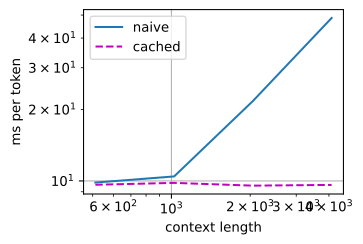
model = d2l.GPT(vocab_size=50257, num_hiddens=768, num_heads=12,
                num_blks=12, max_len=4096, rngs=nnx.Rngs(0))
model.eval()
n_params = sum(p.size for p in jax.tree.leaves(nnx.state(model, nnx.Param)))
print(f'{n_params / 1e6:.1f}M parameters')

@nnx.jit
def naive_step(model, buf, t):
    """The step inside the naive generate: a full forward pass."""
    return model(buf)[0, t - 1]

def timeit(f, reps=10):
    f().block_until_ready()         # warm up (and compile)
    t0 = time.time()
    for _ in range(reps):
        f().block_until_ready()
    return (time.time() - t0) / reps

lengths, t_naive, t_cached = [512, 1024, 2048, 4096], [], []
for n in lengths:
    buf = jnp.zeros((1, n), dtype=jnp.int32)
    t_naive.append(
        timeit(lambda: naive_step(model, buf, jnp.array(n - 1))) * 1e3)
    ks, vs = init_cache(model, 1, n)
    one = jnp.zeros((1, 1), dtype=jnp.int32)
    t_cached.append(timeit(lambda: cached_forward(
        model, ks, vs, one, jnp.array(n - 1))[0]) * 1e3)
    print(f'n={n:5d}: naive {t_naive[-1]:6.2f} ms/token, '
          f'cached {t_cached[-1]:5.2f} ms/token')
d2l.plot(lengths, [t_naive, t_cached], 'context length', 'ms per token',
         legend=['naive', 'cached'], xscale='log', yscale='log')
123.6M parameters
n= 512: naive 30.69 ms/token, cached 10.92 ms/token
n= 1024: naive 15.12 ms/token, cached 10.78 ms/token
n= 2048: naive 51.64 ms/token, cached 10.72 ms/token
n= 4096: naive 75.21 ms/token, cached 11.08 ms/token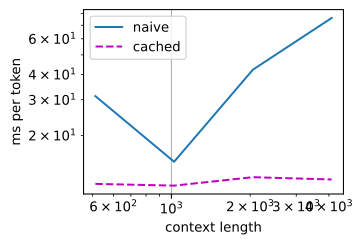
Read the plot from the right. At long contexts the naive step grows roughly linearly with \(n\), as \(2Nn\) arithmetic says it must, while the cached step stays flat; at a context of four thousand tokens the gap in our runs is six- to sevenfold, and it widens with every further doubling of context. At short contexts the two curves merge — below about a thousand tokens this model is so small that a step of either kind is dominated by launching a dozen blocks’ worth of GPU kernels, not by computing. The cache is not a constant-factor optimization: it removes a term that grows with context. A measurable latency reduction appears once that term is large relative to kernel-launch and other fixed overheads. End to end, the effect on generate is what the per-step curve promises:
prefix = list(range(3584))
for name, gen in (('naive ', model.generate),
                  ('cached', model.generate_cached)):
    torch.manual_seed(0)
    gen(list(range(8)), 8)          # warm up
    torch.manual_seed(0)
    torch.cuda.synchronize()
    t0 = time.time()
    gen(prefix, 256)
    torch.cuda.synchronize()
    dt = time.time() - t0
    print(f'{name}: 256 tokens after a 3584-token prompt: {dt:4.1f}s '
          f'= {256 / dt:5.1f} tokens/s')
naive : 256 tokens after a 3584-token prompt: 19.1s = 13.4 tokens/s
cached: 256 tokens after a 3584-token prompt: 4.3s = 59.5 tokens/sprefix = list(range(3584))
for name, gen in (('naive ', model.generate),
('cached', model.generate_cached)):
t0 = time.time()
gen(prefix, 256, seed=0)
dt = time.time() - t0
print(f'{name}: 256 tokens after a 3584-token prompt: {dt:4.1f}s '
f'= {256 / dt:5.1f} tokens/s')naive : 256 tokens after a 3584-token prompt: 28.4s = 9.0 tokens/s
cached: 256 tokens after a 3584-token prompt: 12.7s = 20.2 tokens/sSeveral times faster at this prompt length, with the naive quadratic growing worse from here and the cached line staying put. Production serving systems generate this way; “time to first token” is our prefill call, and “tokens per second” is the cached decode loop.
More than twice as fast at this prompt length — each timing includes one XLA compilation for its shapes, so the steady-state gap is larger still, as the per-step curve above shows. Production serving systems generate this way; “time to first token” is our prefill call, and “tokens per second” is the cached decode loop.
11.3.2 Memory Required by the KV Cache
The cache consumes GPU memory. Each of the \(n_\textrm{layers}\) layers stores one key and one value vector of dimension \(n_\textrm{kv} \cdot d_\textrm{head}\) per token, so a batch of \(b\) sequences of length \(n\) holds
\[ \textrm{cache bytes} \;=\; 2 \cdot n_\textrm{layers} \cdot n_\textrm{kv} \cdot d_\textrm{head} \cdot n \cdot b \cdot (\textrm{bytes per element}), \tag{11.3.1}\]
where the leading 2 counts K and V and \(n_\textrm{kv}\) is the number of key-value heads (equal to the number of query heads, for now: the next section breaks that equality). For our GPT-2-sized model in fp32 that is \(2 \cdot 12 \cdot 12 \cdot 64 \cdot 4\) bytes \(= 72\) KiB per token: at a context of 4096 the cache holds 288 MiB, more than half the size of the 124M-parameter model itself. Scale the formula up to a modern deployment — dozens of layers, contexts in the hundreds of thousands, batches of concurrent users — and the cache, not the weights, is what fills the accelerator; the exercises make this concrete for a 70B model. Formulas should be checked, not trusted:
for n in (1024, 2048, 4096):
    caches = [{} for _ in model.blks]
    torch.cuda.synchronize()
    torch.cuda.empty_cache()
    base = torch.cuda.memory_allocated()
    model.forward_cached(torch.randint(0, 50257, (1, n), device=device),
                         caches)
    torch.cuda.synchronize()
    measured = torch.cuda.memory_allocated() - base
    formula = 2 * 12 * 12 * 64 * n * 4
    print(f'n={n}: allocator grew {measured / 2**20:6.1f} MiB, '
          f'formula says {formula / 2**20:6.1f} MiB')
n=1024: allocator grew 72.0 MiB, formula says 72.0 MiB
n=2048: allocator grew 144.0 MiB, formula says 144.0 MiB
n=4096: allocator grew 288.0 MiB, formula says 288.0 MiBks, vs = init_cache(model, 1, 4096)
formula = 2 * 12 * 12 * 64 * 4096 * 4
print(f'cache buffers: {(ks.nbytes + vs.nbytes) / 2**20:.0f} MiB, '
f'formula says {formula / 2**20:.0f} MiB')cache buffers: 288 MiB, formula says 288 MiBThe allocator’s growth matches Equation 11.3.1 to within a rounding error — what remains allocated after a prefill is exactly the cache tensors. That exactness took one deliberate line: forward_step stores contiguous() copies, because the freshly projected keys and values are views into the fused QKV buffer, and caching a view keeps the whole three-times-wider buffer alive. In an early draft of this cell the allocator reported twice the formula, and that line is how the gap was closed; measuring memory is how such quiet leaks are found.
In JAX the check is almost circular, and that is itself the lesson: the fixed-size discipline allocates the full cache up front, so Equation 11.3.1 is not a prediction about hidden allocator behavior but the literal size of two arrays you created. A serving configuration that does not fit fails at initialization, not mid-request.
11.3.2.1 Prefill Is Compute-Bound, Decode Is Memory-Bound
Why obsess over the size of a buffer that merely sits in memory? Because at generation time it does not sit — it moves. Every decoded token must read every cached key and value once, and, more importantly, must read every parameter of the model once: that is what “a forward pass over one token” means. The useful lens is arithmetic intensity: FLOPs performed per byte of memory traffic. A decode step performs about \(2N\) FLOPs and moves at least the \(4N\) bytes of fp32 weights plus the cache, an intensity below one FLOP per byte. A prefill over \(n\) tokens performs \(2Nn\) FLOPs against the same weight traffic (the weights are read once and reused for every token in the batch of positions), an intensity roughly \(n\) times higher. A modern GPU is balanced at far higher intensities (an RTX 4090 delivers up to about \(83\) TFLOP/s of fp32 compute but only about \(1\) TB/s of memory bandwidth, a ridge near 80 FLOPs per byte), so prefill lands comfortably compute-bound while single-stream decode cannot even in principle keep the arithmetic units busy: it is a memory-bandwidth workload (Pope et al. 2023). The two phases of one generate call live on opposite sides of the roofline.
N = sum(p.numel() for p in model.parameters())
with torch.no_grad():
    x = torch.randint(0, 50257, (1, 2048), device=device)
    t_prefill = timeit(
        lambda: model.forward_cached(x, [{} for _ in model.blks]), reps=5)
    caches = [{} for _ in model.blks]
    model.forward_cached(x, caches)
    one = x[:, :1]
    t_decode = timeit(
        lambda: model.forward_cached(one, [dict(c) for c in caches]))
print(f'prefill: 2048 tokens in {t_prefill * 1e3:4.0f} ms = '
      f'{2048 / t_prefill:6.0f} tokens/s')
print(f'decode:  one token in {t_decode * 1e3:6.2f} ms = '
      f'{1 / t_decode:6.0f} tokens/s')
cache = 2 * 12 * 12 * 64 * 2048 * 4
flops, moved = 2 * N, 4 * N + cache
print(f'decode intensity: {flops / 1e6:.0f} MFLOP / {moved / 1e6:.0f} MB '
      f'= {flops / moved:.1f} FLOP/byte (GPU ridge is near 80)')
print(f'prefill intensity: about {flops * 2048 / moved:.0f} FLOP/byte')
print(f'bandwidth ceiling for decode: about '
      f'{1.0e12 / moved:.0f} tokens/s')
prefill: 2048 tokens in 37 ms = 54992 tokens/s
decode: one token in 13.93 ms = 72 tokens/s
decode intensity: 247 MFLOP / 645 MB = 0.4 FLOP/byte (GPU ridge is near 80)
prefill intensity: about 784 FLOP/byte
bandwidth ceiling for decode: about 1550 tokens/sN = n_params
x = jnp.zeros((1, 2048), dtype=jnp.int32)
ks, vs = init_cache(model, 1, 2048)
t_prefill = timeit(
lambda: cached_forward(model, ks, vs, x, jnp.array(0))[0], reps=5)
one = jnp.zeros((1, 1), dtype=jnp.int32)
t_decode = timeit(
lambda: cached_forward(model, ks, vs, one, jnp.array(2047))[0])
print(f'prefill: 2048 tokens in {t_prefill * 1e3:4.0f} ms = '
f'{2048 / t_prefill:6.0f} tokens/s')
print(f'decode: one token in {t_decode * 1e3:6.2f} ms = '
f'{1 / t_decode:6.0f} tokens/s')
cache = 2 * 12 * 12 * 64 * 2048 * 4
flops, moved = 2 * N, 4 * N + cache
print(f'decode intensity: {flops / 1e6:.0f} MFLOP / {moved / 1e6:.0f} MB '
f'= {flops / moved:.1f} FLOP/byte (GPU ridge is near 80)')
print(f'prefill intensity: about {flops * 2048 / moved:.0f} FLOP/byte')
print(f'bandwidth ceiling for decode: about '
f'{1.0e12 / moved:.0f} tokens/s')prefill: 2048 tokens in 32 ms = 64685 tokens/s
decode: one token in 12.14 ms = 82 tokens/s
decode intensity: 247 MFLOP / 645 MB = 0.4 FLOP/byte (GPU ridge is near 80)
prefill intensity: about 784 FLOP/byte
bandwidth ceiling for decode: about 1550 tokens/sThe measurement shows that this model reads a two-thousand-token prompt at tens of thousands of tokens per second and then generates at under a hundred — nearly three orders of magnitude apart, on identical hardware, running identical layers. Note also the gap between our measured decode rate and the bandwidth ceiling the arithmetic promises: a Python loop that launches every kernel of every block for each token incurs overheads that production engines reduce with compiled decode loops and CUDA graphs. Nevertheless, decode speed is set largely by the bytes moved per token, including weights and cache. Reducing the cache can therefore increase decode speed, permit longer contexts, or support more concurrent users.
11.3.3 Sharing Keys and Values across Heads
Look again at Equation 11.3.1: the factor \(n_\textrm{kv}\) is the number of key-value heads, and nothing in the attention mechanism forces it to equal the number of query heads. Queries do the asking; keys and values are the library being consulted. Multi-query attention (MQA) keeps all \(H\) query heads but a single shared key-value head (Shazeer 2019), shrinking the cache by a factor of \(H\) at a usually slight cost in quality. Grouped-query attention (GQA) interpolates: \(H_{kv}\) key-value heads, each serving a contiguous group of \(H / H_{kv}\) query heads (Ainslie et al. 2023). Figure 11.3.2 shows the sharing patterns. GQA with \(H_{kv} = H/4\) to \(H/8\) is close to the universal choice of current open models — Llama 3 runs 32 query heads against 8 key-value heads, Mistral 7B the same (Grattafiori et al. 2024; Jiang et al. 2023).

11.3.3.1 A Pluggable Implementation
GQAAttention below generalizes the causal attention of Section 11.2: W_q still produces \(H\) query heads, but W_k and W_v produce only \(H_{kv}\) heads, and the fused kernel broadcasts each key-value head across its query group (in PyTorch via enable_gqa; the JAX kernel accepts grouped shapes natively). We keep the (queries, keys, values, valid_lens) call shape of d2l.MultiHeadAttention, so the class drops into d2l.TransformerBlock’s attn_factory hook, and with rope=True into d2l.GPT as well; that hook is the seam Section 11.1 built for exactly this purpose. Setting \(H_{kv} = H\) recovers standard multi-head attention exactly.
class GQAAttention(nn.Module):
    """Causal multi-head attention with num_kv_heads shared KV heads."""
    def __init__(self, num_hiddens, num_heads, num_kv_heads, bias=False,
                 rope=False, causal=True):
        super().__init__()
        assert num_hiddens % num_heads == 0
        assert num_heads % num_kv_heads == 0
        self.num_heads, self.num_kv_heads = num_heads, num_kv_heads
        self.head_dim = num_hiddens // num_heads
        self.rope, self.causal = rope, causal
        self.W_q = nn.Linear(num_hiddens, num_hiddens, bias=bias)
        self.W_k = nn.Linear(num_hiddens, num_kv_heads * self.head_dim,
                             bias=bias)
        self.W_v = nn.Linear(num_hiddens, num_kv_heads * self.head_dim,
                             bias=bias)
        self.W_o = nn.Linear(num_hiddens, num_hiddens, bias=bias)

    def _rope(self, x):  # the rotation of d2l.GPT, kept self-contained
        d = x.shape[-1]
        pos = torch.arange(x.shape[-2], dtype=torch.float32,
                           device=x.device)
        inv_freq = 10000.0 ** (-torch.arange(0, d, 2, device=x.device) / d)
        theta = pos[:, None] * inv_freq[None, :]
        cos, sin = torch.cos(theta), torch.sin(theta)
        x1, x2 = x[..., 0::2], x[..., 1::2]
        return torch.stack([x1 * cos - x2 * sin,
                            x1 * sin + x2 * cos], -1).flatten(-2)

    def forward(self, queries, keys, values, valid_lens=None):
        B, T, D = queries.shape
        q = self.W_q(queries).reshape(B, T, self.num_heads, -1)
        k = self.W_k(keys).reshape(B, -1, self.num_kv_heads, self.head_dim)
        v = self.W_v(values).reshape(B, -1, self.num_kv_heads,
                                     self.head_dim)
        q, k, v = (u.transpose(1, 2) for u in (q, k, v))
        if self.rope:
            q, k = self._rope(q), self._rope(k)
        mask, causal = None, self.causal
        if valid_lens is not None:      # mask padding (and causality)
            S = k.shape[2]
            if valid_lens.dim() == 1:
                valid_lens = valid_lens[:, None].expand(B, T)
            mask = (torch.arange(S, device=q.device)[None, None, :]
                    < valid_lens[:, :, None])[:, None]
            if causal:
                i = torch.arange(T, device=q.device)[:, None]
                j = torch.arange(S, device=q.device)[None, :]
                mask = mask & (j <= i + S - T)
            causal = False
        Y = F.scaled_dot_product_attention(q, k, v, attn_mask=mask,
                                           is_causal=causal,
                                           enable_gqa=True)
        return self.W_o(Y.transpose(1, 2).reshape(B, T, -1))
class GQAAttention(nnx.Module):
"""Causal multi-head attention with num_kv_heads shared KV heads."""
def __init__(self, num_hiddens, num_heads, num_kv_heads, bias=False,
rope=False, causal=True, rngs=None):
rngs = nnx.Rngs(0) if rngs is None else rngs
assert num_hiddens % num_heads == 0
assert num_heads % num_kv_heads == 0
self.num_heads, self.num_kv_heads = num_heads, num_kv_heads
self.head_dim = num_hiddens // num_heads
self.rope, self.causal = rope, causal
self.W_q = nnx.Linear(num_hiddens, num_hiddens, use_bias=bias,
rngs=rngs)
self.W_k = nnx.Linear(num_hiddens, num_kv_heads * self.head_dim,
use_bias=bias, rngs=rngs)
self.W_v = nnx.Linear(num_hiddens, num_kv_heads * self.head_dim,
use_bias=bias, rngs=rngs)
self.W_o = nnx.Linear(num_hiddens, num_hiddens, use_bias=bias,
rngs=rngs)
def _rope(self, x): # the rotation of d2l.GPT, kept self-contained
d = x.shape[-1]
pos = jnp.arange(x.shape[1], dtype=jnp.float32)
inv_freq = 10000.0 ** (-jnp.arange(0, d, 2) / d)
theta = pos[:, None] * inv_freq[None, :]
cos = jnp.cos(theta)[:, None, :]
sin = jnp.sin(theta)[:, None, :]
x1, x2 = x[..., 0::2], x[..., 1::2]
return jnp.stack([x1 * cos - x2 * sin,
x1 * sin + x2 * cos], -1).reshape(x.shape)
def __call__(self, queries, keys, values, valid_lens=None):
B, T, D = queries.shape
q = self.W_q(queries).reshape(B, T, self.num_heads, -1)
k = self.W_k(keys).reshape(B, -1, self.num_kv_heads, self.head_dim)
v = self.W_v(values).reshape(B, -1, self.num_kv_heads,
self.head_dim)
if self.rope:
q, k = self._rope(q), self._rope(k)
mask, causal = None, self.causal
if valid_lens is not None: # mask padding (and causality)
S = k.shape[1]
if valid_lens.ndim == 1:
valid_lens = jnp.broadcast_to(valid_lens[:, None], (B, T))
mask = (jnp.arange(S)[None, None, :]
< valid_lens[:, :, None])[:, None]
if causal:
i, j = jnp.arange(T)[:, None], jnp.arange(S)[None, :]
mask = mask & (j <= i + S - T)
causal = False
Y = jax.nn.dot_product_attention(q, k, v, mask=mask,
is_causal=causal)
return self.W_o(Y.reshape(B, T, -1)), NoneIt honors the block contract, and its parameter count records where the saving comes from: W_k and W_v shrink with \(H_{kv}\) (attention parameters go from \(4d^2\) toward \(2d^2\)), while the cache line of Equation 11.3.1 shrinks in proportion.
X = torch.ones(2, 10, 256)
blk = d2l.TransformerBlock(
    256, num_heads=8,
    attn_factory=lambda: GQAAttention(256, 8, 2, causal=False))
d2l.check_shape(blk(X, torch.tensor([7, 4])), X.shape)
for G in (8, 4, 2, 1):
    attn = GQAAttention(256, 8, G)
    n = sum(p.numel() for p in attn.parameters())
    print(f'H_kv={G}: {n:6d} parameters, '
          f'cache {2 * G * 32 * 4:4d} bytes per token per layer')
H_kv=8: 262144 parameters, cache 2048 bytes per token per layer
H_kv=4: 196608 parameters, cache 1024 bytes per token per layer
H_kv=2: 163840 parameters, cache 512 bytes per token per layer
H_kv=1: 147456 parameters, cache 256 bytes per token per layerX = jnp.ones((2, 10, 256))
blk = d2l.TransformerBlock(
256, num_heads=8,
attn_factory=lambda rngs: GQAAttention(256, 8, 2, causal=False,
rngs=rngs))
d2l.check_shape(blk(X, jnp.array([7, 4])), X.shape)
for G in (8, 4, 2, 1):
attn = GQAAttention(256, 8, G)
n = sum(p.size for p in jax.tree.leaves(nnx.state(attn, nnx.Param)))
print(f'H_kv={G}: {n:6d} parameters, '
f'cache {2 * G * 32 * 4:4d} bytes per token per layer')H_kv=8: 262144 parameters, cache 2048 bytes per token per layer
H_kv=4: 196608 parameters, cache 1024 bytes per token per layer
H_kv=2: 163840 parameters, cache 512 bytes per token per layer
H_kv=1: 147456 parameters, cache 256 bytes per token per layer11.3.3.2 GQA Cache Size and Validation Loss
What does the sharing cost in modeling power? We train the Section 11.2 configuration on the character-level Time Machine at every group count from \(H_{kv} = 8\) (full multi-head) down to \(1\) (MQA), swapping the attention in each block after construction. Because the validation loss of this small model bottoms out within a few hundred steps and then climbs into memorization (Section 11.2), we compare models at their best validation loss over a fixed 600-step budget. Each row below is one fixed-seed run evaluated on the same validation split. This design can reveal differences larger than ordinary run-to-run variation, but it cannot estimate a confidence interval or establish equivalence.
data = d2l.TimeMachine(batch_size=64, num_steps=128, tokenization='char',
                       num_train=100000, num_val=3000)

def val_loss(model, data):
    model.to(device).eval()
    with torch.no_grad():
        losses = [F.cross_entropy(
            model(X.to(device)).flatten(0, 1), Y.to(device).flatten())
            for X, Y in data.val_dataloader()]
    model.train()
    return sum(l.item() for l in losses) / len(losses)

for G in (8, 4, 2, 1):
    torch.manual_seed(0)
    lm = d2l.GPT(len(data.vocab), num_hiddens=256, num_heads=8,
                 num_blks=6)
    for blk in lm.blks:
        blk.attention = GQAAttention(256, 8, G, rope=True)
    optimizer = torch.optim.AdamW(lm.parameters(), lr=1e-3,
                                  weight_decay=0.0)
    best = float('inf')
    for chunk in range(6):
        d2l.train_lm(lm, data, optimizer, 100)
        best = min(best, val_loss(lm, data))
    print(f'H_kv={G}: best validation loss {best:.2f}, '
          f'cache {2 * 6 * G * 32 * 4 / 1024:4.1f} KiB per token')
H_kv=8: best validation loss 1.53, cache 12.0 KiB per token
H_kv=4: best validation loss 1.53, cache 6.0 KiB per token
H_kv=2: best validation loss 1.50, cache 3.0 KiB per token
H_kv=1: best validation loss 1.51, cache 1.5 KiB per tokendata = d2l.TimeMachine(batch_size=64, num_steps=128, tokenization='char',
num_train=100000, num_val=3000)
@nnx.jit
def batch_loss(model, X, Y):
logits = model(X)
return optax.softmax_cross_entropy_with_integer_labels(
logits.reshape(-1, logits.shape[-1]), Y.reshape(-1)).mean()
def val_loss(model, data):
model.eval()
losses = [float(batch_loss(model, jnp.asarray(X), jnp.asarray(Y)))
for X, Y in data.val_dataloader()]
model.train()
return sum(losses) / len(losses)
for G in (8, 4, 2, 1):
rngs = nnx.Rngs(0)
lm = d2l.GPT(len(data.vocab), num_hiddens=256, num_heads=8,
num_blks=6, rngs=rngs)
for blk in lm.blks:
blk.attention = GQAAttention(256, 8, G, rope=True, rngs=rngs)
optimizer = nnx.Optimizer(lm, optax.adamw(1e-3, weight_decay=0.0),
wrt=nnx.Param)
best = float('inf')
for chunk in range(6):
d2l.train_lm(lm, data, optimizer, 100)
best = min(best, val_loss(lm, data))
print(f'H_kv={G}: best validation loss {best:.2f}, '
f'cache {2 * 6 * G * 32 * 4 / 1024:4.1f} KiB per token')H_kv=8: best validation loss 1.52, cache 12.0 KiB per token
H_kv=4: best validation loss 1.52, cache 6.0 KiB per token
H_kv=2: best validation loss 1.55, cache 3.0 KiB per token
H_kv=1: best validation loss 1.50, cache 1.5 KiB per tokenThe cache shrinks eightfold from top to bottom of the table. Each configuration uses one initialization per framework, 600 training steps, and a validation corpus configured with num_val=3000; losses are displayed to 0.01 nat. The rows differ by only a few hundredths, but without repeated seeds this protocol provides no uncertainty estimate or equivalence test. In larger-scale ablations, full MQA incurs a small quality reduction, while GQA at \(H/8\) matches multi-head attention under the protocol of Ainslie et al. (2023) — and an existing multi-head checkpoint can be uptrained into a grouped one for a small fraction of its original compute, which is how GQA spread through the open-model world so quickly.
11.3.4 Compressing the Cache Further
Sharing heads is one axis. This closing section looks at the two other levers deployed systems pull: compressing the width of each cached token further, and bounding the length of what is cached. The second comes with a failure mode that makes it subtle. Our minute-trained character models are too small to exhibit these phenomena, so we probe the real GPT-2, reloading it exactly as in Section 11.2 (weights and tokenizer files are already pinned in d2l.DATA_HUB), along with the raw text of The Time Machine as a 1024-token evaluation passage.
HF_URL = 'https://huggingface.co/openai-community/gpt2/resolve/main/'
d2l.DATA_HUB['gpt2-weights'] = (
    HF_URL + 'model.safetensors',
    '89a76996d7c6ee89b86618a265483aab73e61d50')
d2l.DATA_HUB['gpt2-merges'] = (
    HF_URL + 'merges.txt', '396d4d8ec90cb02f4d56e049e0e4add868bcd943')
d2l.DATA_HUB['gpt2-encoder'] = (
    HF_URL + 'vocab.json', 'f0223209235343bc067d7da838328bced8085ae1')
enc = tiktoken.Encoding(
    'gpt2', explicit_n_vocab=50257,
    pat_str=d2l.BPETokenizer.GPT2_PATTERN,
    mergeable_ranks=data_gym_to_mergeable_bpe_ranks(
        d2l.download('gpt2-merges', '../data/gpt2'),
        d2l.download('gpt2-encoder', '../data/gpt2')),
    special_tokens={'<|endoftext|>': 50256})

gpt2 = d2l.GPT(vocab_size=50257, num_hiddens=768, num_heads=12,
               num_blks=12, max_len=1024, pos='learned', norm='layer',
               act='gelu', pre_norm=True, bias=True)
weights = load_file(d2l.download('gpt2-weights', '../data/gpt2'))
with torch.no_grad():
    gpt2.token_emb.weight.copy_(weights['wte.weight'])
    gpt2.pos_emb.weight.copy_(weights['wpe.weight'])
    gpt2.norm.weight.copy_(weights['ln_f.weight'])
    gpt2.norm.bias.copy_(weights['ln_f.bias'])
    for i, blk in enumerate(gpt2.blks):
        modules = {f'h.{i}.ln_1': blk.norm1, f'h.{i}.ln_2': blk.norm2,
                   f'h.{i}.attn.c_attn': blk.attention.W_qkv,
                   f'h.{i}.attn.c_proj': blk.attention.W_o,
                   f'h.{i}.mlp.c_fc': blk.ffn.W_1,
                   f'h.{i}.mlp.c_proj': blk.ffn.W_2}
        for key, module in modules.items():
            W = weights[key + '.weight']
            module.weight.copy_(W.T if W.ndim == 2 else W)  # Conv1D layout
            module.bias.copy_(weights[key + '.bias'])
gpt2.to(device).eval()

fname = d2l.download(d2l.DATA_URL + 'timemachine.txt', '../data',
                     '090b5e7e70c295757f55df93cb0a180b9691891a')
ids = enc.encode(open(fname).read())[:1024]
x = torch.tensor(ids, device=device)[None]
print(f'{len(ids)} tokens of The Time Machine')
1024 tokens of The Time MachineHF_URL = 'https://huggingface.co/openai-community/gpt2/resolve/main/'
d2l.DATA_HUB['gpt2-weights'] = (
HF_URL + 'model.safetensors',
'89a76996d7c6ee89b86618a265483aab73e61d50')
d2l.DATA_HUB['gpt2-merges'] = (
HF_URL + 'merges.txt', '396d4d8ec90cb02f4d56e049e0e4add868bcd943')
d2l.DATA_HUB['gpt2-encoder'] = (
HF_URL + 'vocab.json', 'f0223209235343bc067d7da838328bced8085ae1')
enc = tiktoken.Encoding(
'gpt2', explicit_n_vocab=50257,
pat_str=d2l.BPETokenizer.GPT2_PATTERN,
mergeable_ranks=data_gym_to_mergeable_bpe_ranks(
d2l.download('gpt2-merges', '../data/gpt2'),
d2l.download('gpt2-encoder', '../data/gpt2')),
special_tokens={'<|endoftext|>': 50256})
gpt2 = d2l.GPT(vocab_size=50257, num_hiddens=768, num_heads=12,
num_blks=12, max_len=1024, pos='learned', norm='layer',
act='gelu', pre_norm=True, bias=True)
weights = safetensors_numpy.load_file(
d2l.download('gpt2-weights', '../data/gpt2'))
gpt2.token_emb.embedding[...] = jnp.asarray(weights['wte.weight'])
gpt2.pos_emb.embedding[...] = jnp.asarray(weights['wpe.weight'])
gpt2.norm.scale[...] = jnp.asarray(weights['ln_f.weight'])
gpt2.norm.bias[...] = jnp.asarray(weights['ln_f.bias'])
for i, blk in enumerate(gpt2.blks):
for norm, key in ((blk.norm1, f'h.{i}.ln_1'),
(blk.norm2, f'h.{i}.ln_2')):
norm.scale[...] = jnp.asarray(weights[key + '.weight'])
norm.bias[...] = jnp.asarray(weights[key + '.bias'])
for linear, key in ((blk.attention.W_qkv, f'h.{i}.attn.c_attn'),
(blk.attention.W_o, f'h.{i}.attn.c_proj'),
(blk.ffn.W_1, f'h.{i}.mlp.c_fc'),
(blk.ffn.W_2, f'h.{i}.mlp.c_proj')):
linear.kernel[...] = jnp.asarray(weights[key + '.weight'])
linear.bias[...] = jnp.asarray(weights[key + '.bias'])
gpt2.eval()
fname = d2l.download(d2l.DATA_URL + 'timemachine.txt', '../data',
'090b5e7e70c295757f55df93cb0a180b9691891a')
ids = enc.encode(open(fname).read())[:1024]
x = jnp.asarray(ids)[None]
print(f'{len(ids)} tokens of The Time Machine')1024 tokens of The Time MachineEach experiment below changes only what happens inside attention, so one helper suffices: a forward pass that walks GPT-2’s blocks exactly as the class does, but lets us substitute the attention computation per block. First a sanity check that the helper with stock attention reproduces the model, and a baseline loss on the second half of the passage (positions 512 onward, so every evaluated token has a long history to draw on).
def forward_blocks(model, X, attn_fn):
    """GPT-2 forward with a pluggable attention computation per block."""
    H = model.token_emb(X) + model.pos_emb(
        torch.arange(X.shape[1], device=X.device))
    for i, blk in enumerate(model.blks):
        A, Y = blk.attention, blk.norm1(H)
        B, T, D = Y.shape
        q, k, v = (u.reshape(B, T, A.num_heads, -1).transpose(1, 2)
                   for u in A.W_qkv(Y).chunk(3, -1))
        H = H + A.W_o(attn_fn(q, k, v, i).transpose(1, 2).reshape(B, T, D))
        H = H + blk.ffn(blk.norm2(H))
    return F.linear(model.norm(H), model.token_emb.weight)

def tail_loss(logits):
    """Mean per-token loss on the second half of the passage."""
    return F.cross_entropy(logits[0, 512:-1], x[0, 513:])

stock = lambda q, k, v, i: F.scaled_dot_product_attention(
    q, k, v, is_causal=True)
with torch.no_grad():
    logits = forward_blocks(gpt2, x, stock)
    print(f'helper vs stock forward: max deviation '
          f'{(logits - gpt2(x)).abs().max():.1e}')
    full = tail_loss(logits)
print(f'full attention: loss {full:.2f}, perplexity {full.exp():.0f}')
helper vs stock forward: max deviation 0.0e+00
full attention: loss 3.58, perplexity 36def forward_blocks(model, X, attn_fn):
"""GPT-2 forward with a pluggable attention computation per block."""
H = model.token_emb(X) + model.pos_emb(jnp.arange(X.shape[1]))
for i, blk in enumerate(model.blks):
A, Y = blk.attention, blk.norm1(H)
B, T, D = Y.shape
q, k, v = (u.reshape(B, T, A.num_heads, -1)
for u in jnp.split(A.W_qkv(Y), 3, axis=-1))
H = H + A.W_o(attn_fn(q, k, v, i).reshape(B, T, D))
H = H + blk.ffn(blk.norm2(H))
return model.token_emb.attend(model.norm(H))
def tail_loss(logits):
"""Mean per-token loss on the second half of the passage."""
return optax.softmax_cross_entropy_with_integer_labels(
logits[0, 512:-1], x[0, 513:]).mean()
stock = lambda q, k, v, i: jax.nn.dot_product_attention(q, k, v,
is_causal=True)
logits = forward_blocks(gpt2, x, stock)
print(f'helper vs stock forward: max deviation '
f'{jnp.abs(logits - gpt2(x)).max():.1e}')
full = tail_loss(logits)
print(f'full attention: loss {full:.2f}, perplexity {jnp.exp(full):.0f}')helper vs stock forward: max deviation 0.0e+00
full attention: loss 3.58, perplexity 3611.3.4.1 Low-Rank Keys and Values
GQA shrinks the cache by storing fewer key-value heads. A different bet: keep all heads, but suppose that a token’s concatenated key and value vectors do not really span the full width they occupy (for GPT-2, \(2 \times 768 = 1536\) numbers), and store only their coordinates in some lower-dimensional subspace. That is the idea behind multi-head latent attention (MLA), the mechanism DeepSeek built its V2 and V3 models around (DeepSeek-AI 2024): a trained projection compresses each token’s keys and values jointly into one latent vector (rank 512, versus tens of thousands of raw KV dimensions, in DeepSeek-V2), the cache stores only the latent, and per-head keys and values are reconstructed by trained up-projections at read time.
We can test the load-bearing assumption — that realized keys and values are approximately low-rank — directly on GPT-2. In each layer we take the actual K and V matrices of our passage, replace them by their best rank-\(r\) approximation (via SVD, jointly across the concatenated KV width of 1536), and run the model with every layer so truncated. This uses an oracle factorization computed on the very sequence being evaluated, so it is an upper bound on what a fixed trained projection could do; MLA’s contribution is making the projection trainable, and handling the one real obstacle: RoPE’s position-dependent rotation does not commute with a shared down-projection, which MLA solves by carrying a small separate rotary component per token. None of that machinery is needed to check the premise:
def lowrank_kv(r):
    def attn_fn(q, k, v, i):
        B, H, T, hd = k.shape
        KV = torch.cat([k.transpose(1, 2).reshape(T, -1),
                        v.transpose(1, 2).reshape(T, -1)], dim=1)
        U, S, Vh = torch.linalg.svd(KV, full_matrices=False)
        KVr = (U[:, :r] * S[:r]) @ Vh[:r]     # best rank-r approximation
        kr = KVr[:, :H * hd].reshape(1, T, H, hd).transpose(1, 2)
        vr = KVr[:, H * hd:].reshape(1, T, H, hd).transpose(1, 2)
        return F.scaled_dot_product_attention(q, kr, vr, is_causal=True)
    return attn_fn

with torch.no_grad():
    for r in (256, 128):
        loss = tail_loss(forward_blocks(gpt2, x, lowrank_kv(r)))
        print(f'rank {r} of 1536 ({1536 // r}x smaller cache): '
              f'loss {loss:.2f}, perplexity {loss.exp():.0f}')
rank 256 of 1536 (6x smaller cache): loss 3.49, perplexity 33
rank 128 of 1536 (12x smaller cache): loss 3.66, perplexity 39def lowrank_kv(r):
def attn_fn(q, k, v, i):
B, T, H, hd = k.shape
KV = jnp.concatenate([k.reshape(T, -1), v.reshape(T, -1)], axis=1)
U, S, Vh = jnp.linalg.svd(KV, full_matrices=False)
KVr = (U[:, :r] * S[:r]) @ Vh[:r] # best rank-r approximation
kr = KVr[:, :H * hd].reshape(1, T, H, hd)
vr = KVr[:, H * hd:].reshape(1, T, H, hd)
return jax.nn.dot_product_attention(q, kr, vr, is_causal=True)
return attn_fn
for r in (256, 128):
loss = tail_loss(forward_blocks(gpt2, x, lowrank_kv(r)))
print(f'rank {r} of 1536 ({1536 // r}x smaller cache): '
f'loss {loss:.2f}, perplexity {jnp.exp(loss):.0f}')rank 256 of 1536 (6x smaller cache): loss 3.49, perplexity 33
rank 128 of 1536 (12x smaller cache): loss 3.66, perplexity 39At rank 256, loss on this one passage changes by less than the displayed precision; at rank 128 it increases. This oracle SVD is fitted to the evaluated sequence, so it neither implements a cache reduction nor shows that one fixed projection would generalize. It establishes only that the realized K/V matrix for this passage admits a low-rank approximation. MLA instead learns a shared projection during training and retains a separate rotary component.
11.3.4.2 Sliding Windows and Attention Sinks
The remaining lever is length: cap the cache at the last \(w\) tokens, evicting the oldest as generation proceeds, and memory is bounded forever — the rolling-buffer form of the sliding-window attention of Section 10.5. Before evicting anything, it is worth asking where a trained model actually sends its attention. We measure the average weight that GPT-2’s queries (from position 64 on) place on the single first token of the sequence:
masses = []
def watch(q, k, v, i):
    scores = q @ k.transpose(-1, -2) / math.sqrt(q.shape[-1])
    j = torch.arange(scores.shape[-1], device=scores.device)
    scores.masked_fill_(j[None, :] > j[:, None],
                        torch.finfo(scores.dtype).min)
    alpha = torch.softmax(scores, -1)
    masses.append(alpha[..., 64:, 0].mean().item())
    return alpha @ v

with torch.no_grad():
    forward_blocks(gpt2, x, watch)
print('mean attention weight on token 0 (uniform would be ~0.003):')
d2l.print_wrapped('  '.join(f'layer {i}: {m:.2f}'
                            for i, m in enumerate(masses)))
mean attention weight on token 0 (uniform would be ~0.003):
layer 0: 0.00 layer 1: 0.01 layer 2: 0.11 layer 3: 0.30 layer 4: 0.32
layer 5: 0.51 layer 6: 0.46 layer 7: 0.57 layer 8: 0.48 layer 9:
0.48 layer 10: 0.45 layer 11: 0.34masses = []
def watch(q, k, v, i):
qh, kh, vh = (u.transpose(0, 2, 1, 3) for u in (q, k, v))
scores = qh @ kh.swapaxes(-1, -2) / math.sqrt(q.shape[-1])
j = jnp.arange(scores.shape[-1])
scores = jnp.where(j[None, :] > j[:, None],
jnp.finfo(scores.dtype).min, scores)
alpha = jax.nn.softmax(scores, axis=-1)
masses.append(float(alpha[..., 64:, 0].mean()))
return (alpha @ vh).transpose(0, 2, 1, 3)
forward_blocks(gpt2, x, watch)
print('mean attention weight on token 0 (uniform would be ~0.003):')
d2l.print_wrapped(' '.join(f'layer {i}: {m:.2f}'
for i, m in enumerate(masses)))mean attention weight on token 0 (uniform would be ~0.003):
layer 0: 0.00 layer 1: 0.01 layer 2: 0.11 layer 3: 0.30 layer 4: 0.32
layer 5: 0.51 layer 6: 0.46 layer 7: 0.57 layer 8: 0.48 layer 9:
0.48 layer 10: 0.45 layer 11: 0.34From the middle of the stack upward, the measured GPT-2 heads assign roughly a third to a half of their attention mass to the first token, far above a uniform reference. Xiao et al. (2024) call such positions attention sinks and interpret them as locations that absorb probability mass when a head has no useful retrieval. Our measurement establishes the weight pattern for one passage; it does not test that functional explanation. The effect of the first token also depends on its value vector, which we have not measured.
Evicting that token, as a rolling buffer of the most recent \(w\) entries would, removes this high-attention position: the discarded mass is renormalized onto tokens the head actively chose not to attend to. StreamingLLM retains the first few tokens in the cache alongside the sliding window (Xiao et al. 2024). We reproduce both the failure and the fix, evaluating our passage with attention restricted to a 256-token window plus a varying number of retained sink tokens:
j = torch.arange(x.shape[1], device=device)
causal = j[None, :] <= j[:, None]
window = causal & (j[:, None] - j[None, :] < 256)
with torch.no_grad():
    for nsink in (0, 1, 4):
        mask = window | (causal & (j[None, :] < nsink))
        loss = tail_loss(forward_blocks(
            gpt2, x, lambda q, k, v, i: F.scaled_dot_product_attention(
                q, k, v, attn_mask=mask)))
        print(f'window 256 + {nsink} sink tokens: loss {loss:.2f}, '
              f'perplexity {loss.exp():.0f}')
print(f'full attention:            loss {full:.2f}, '
      f'perplexity {full.exp():.0f}')
window 256 + 0 sink tokens: loss 8.25, perplexity 3836
window 256 + 1 sink tokens: loss 3.86, perplexity 47
window 256 + 4 sink tokens: loss 3.76, perplexity 43
full attention: loss 3.58, perplexity 36j = jnp.arange(x.shape[1])
causal = j[None, :] <= j[:, None]
window = causal & (j[:, None] - j[None, :] < 256)
for nsink in (0, 1, 4):
mask = window | (causal & (j[None, :] < nsink))
loss = tail_loss(forward_blocks(
gpt2, x, lambda q, k, v, i: jax.nn.dot_product_attention(
q, k, v, mask=mask[None, None])))
print(f'window 256 + {nsink} sink tokens: loss {loss:.2f}, '
f'perplexity {jnp.exp(loss):.0f}')
print(f'full attention: loss {full:.2f}, '
f'perplexity {jnp.exp(full):.0f}')window 256 + 0 sink tokens: loss 8.25, perplexity 3842
window 256 + 1 sink tokens: loss 3.86, perplexity 47
window 256 + 4 sink tokens: loss 3.76, perplexity 43
full attention: loss 3.58, perplexity 36In this passage, windowed attention without retained sink tokens raises perplexity from the mid-thirties into the thousands. Retaining one initial token removes most of this increase, and four retained tokens bring loss within a fraction of a nat of full attention. The comparison supports a sink effect for this checkpoint and passage, but it does not isolate all effects of discarding older context. (Our mask-based experiment keeps original position indices; a real rolling buffer also has to handle positions carefully as entries are evicted, which is an exercise.) Xiao et al. (2024) provide broader experiments on attention sinks, and gpt-oss provides one concrete design with an explicit learned sink logit per head in its sliding-window layers (OpenAI 2025), which frees the first token from double duty.
11.3.4.3 Comparison of Cache-Reduction Methods
For one sequence, the baseline stores \(2L n H_{kv}d_h\) elements. The table uses the same contract for each alternative; constants and auxiliary buffers depend on the implementation.
| method | reduced dimension | stored state | information no longer available | training requirement | evidence used here |
|---|---|---|---|---|---|
| GQA/MQA | KV heads | \(2LnH_{kv}d_h\) | independent K/V projections for every query head | train with sharing or uptrain a checkpoint | fixed-seed character model; cited large-model ablations |
| MLA | width per token | approximately \(Lnr\) plus a rotary component | full K/V coordinates, reconstructed from an \(r\)-dimensional latent | learned compression and reconstruction maps | oracle SVD on one GPT-2 passage; cited trained MLA models |
| sliding window with sinks | cached length | \(2L(w+s)H_{kv}d_h\) for window \(w\) and \(s\) sinks | tokens outside the window and retained sinks | train or adapt for the restricted pattern | one GPT-2 passage; cited StreamingLLM experiments |
| linear attention | token-indexed cache | fixed feature-state matrices, independent of \(n\) | exact softmax attention and tokenwise recall | replace and train the attention mechanism | derivation and toy experiment in Section 10.5 |
Hybrid stacks (Chapter 12) combine recurrent layers with a smaller number of full-attention layers, so only the latter retain a growing tokenwise cache. Beyond the cache proper, the decode-side bandwidth accounting of this section is also what speculative decoding exploits, drafting several tokens with a smaller model and verifying them together in a parallel forward pass (Leviathan et al. 2023). The roofline economics behind that arithmetic are made precise in Section 13.2; the systems-level story of speculative decoding and the serving engines around it belongs to the Language Models part.
11.3.5 Summary
Naive generation repeats a full forward pass for each token and therefore has quadratic dense-layer cost in the generated length. Reusing past keys and values makes this part linear, although attention still reads a growing cache. A cached implementation requires a per-layer key–value buffer and a position offset for RoPE; JAX uses a preallocated, fixed-shape buffer with indexed updates. The cached and uncached implementations agree to numerical precision, and caching gives several-fold faster decoding at long contexts. For a batch of \(b\) sequences, the cache contains \(2 \cdot n_\textrm{layers} \cdot n_\textrm{kv} \cdot d_\textrm{head} \cdot n \cdot b\) elements. Multiplying by the bytes per element gives the tensor storage; this count excludes allocator and metadata overhead. Prefill is compute-bound, whereas decoding is usually memory-bandwidth-bound. GQA reduces storage by sharing keys and values across query heads; in our experiment, reducing eight KV heads to one reduces the cache eightfold, while the fixed-seed validation losses differ by only a few hundredths of a nat. This is not an equivalence test. MLA instead compresses the width of the cache. Sliding windows bound its length; for checkpoints that rely on initial attention sinks, retaining those positions can avoid the loss increase observed in our single-passage test. Linear-attention and hybrid architectures provide further alternatives.
11.3.6 Exercises
- Cost of generation. A model with \(N\) parameters reads a prompt of \(P\) tokens and then generates \(T\) tokens. Count \(2N\) dense-layer FLOPs per token of a forward pass.
- Count the dense-layer FLOPs of a naive schedule that runs a forward pass over the whole history before every new token, and of
generate_cached, which runs one prefill over the prompt and then single-token steps. Evaluate the ratio of the two counts for the end-to-end run of Section 11.3.1.2, with \(P = 3584\) and \(T = 256\). - The end-to-end run is only a few times faster with the cache, far less than this ratio of FLOPs. Explain the difference with the arithmetic intensities of the two kinds of forward pass in Section 11.3.2.1.
- Count the dense-layer FLOPs of a naive schedule that runs a forward pass over the whole history before every new token, and of
- [code] A missing position offset. The cached step of Section 11.3.1.1 rotates the queries and keys of new tokens by their absolute positions.
- Drop the offset from the RoPE rotation of the cached step, so that every decoded token is rotated as if it sat at position 0, and rerun the check of Section 11.3.1.2 for
pos='rope'. Compare the deviation with that of the correct cache. - Take a decoded query at true position \(t\). Determine the relative offset that the faulty cache uses against a prefix key at position \(j\) and against the key of an earlier decoded token. Which information about the decoded tokens does the model lose entirely?
- Make the corresponding mistake for learned positions, so that every decoded token receives the embedding of position 0. Prefill GPT-2 with the first 512 tokens of the passage
x, decode the remaining tokens one at a time, and compare the loss on positions 512 onward, the loss thattail_lossmeasures, for the faulty and the correct cache.
- Drop the offset from the RoPE rotation of the cached step, so that every decoded token is rotated as if it sat at position 0, and rerun the check of Section 11.3.1.2 for
- Cache of a 70B model. Llama-2-70B (Touvron et al. 2023b) has 80 layers and 64 query heads of dimension 128, and it uses GQA with 8 key-value heads. Its weights occupy about 140 GB in 16-bit precision, and its cache is stored in 16-bit precision as well.
- Use Equation 11.3.1 to compute the cache bytes per token, and the context length at which the cache of a single sequence reaches the size of the weights.
- Repeat both computations for the same model with 64 key-value heads, that is, without sharing, and with a single key-value head (MQA).
- The weights are split across two GPUs with 80 GB each. For each of the three configurations, find how many sequences of 4096 tokens fit into the memory that the weights leave free, ignoring activations.
- Shared weight reads. ● Use the roofline model of Section 11.3.2.1: a forward pass takes at least its FLOPs divided by the peak rate of 83 TFLOP/s and at least its bytes moved divided by the bandwidth of 1 TB/s. The weights of
modelare stored in fp32.- Ignore the cache. A forward pass of
modelover \(m\) new tokens reads every weight once, whether the tokens belong to \(m\) sequences of a batch or are \(m\) drafted tokens of one sequence. Find the largest \(m\) for which the pass takes no longer than a single-token step. Explain why this bound makes it cheap to check several drafted tokens in one pass, as speculative decoding does (Leviathan et al. 2023). - Now include the cache, which each of \(b\) sequences at context \(n\) reads separately. Derive the arithmetic intensity of one decode step of
model, counting the attention FLOPs and the cache bytes. Evaluate it at \(n = 2048\) for \(b = 1\) and in the limit \(b \to \infty\), and compare both values with the ridge of about 80 FLOPs per byte. How does the limit change when the \(H\) query heads share \(H_{kv}\) key-value heads?
- Ignore the cache. A forward pass of
- [code] A cached GQA step. Extend the cached forward pass of Section 11.3.1.1 to a
d2l.GPTwhose blocks holdGQAAttentionwithrope=True, built as in Section 11.3.3.2, so that the cache stores only the \(H_{kv}\) key-value heads. Verify for \(H_{kv} = 2\) that the cached logits agree with those of the full forward pass, as in Section 11.3.1.2. - [code] Uptraining to GQA. ● Ainslie et al. (2023) convert a multi-head checkpoint into a grouped one by mean-pooling the key and value projections of the heads in each group, and then continue training for 5 percent of the original number of steps. Apply this recipe to the character model of
Section 11.3.3.2.
- Train the \(H_{kv} = 8\) configuration for 300 steps. Convert it to \(H_{kv} = 2\) by averaging the key and value projections over each group of four consecutive heads, the grouping that
GQAAttentionuses, and measure the validation loss without further training. Repeat the conversion with the first head of each group in place of the average. - Continue training the mean-pooled model for 15 steps. Compare its validation loss with that of the \(H_{kv} = 8\) model after 300 steps and with that of an \(H_{kv} = 2\) model trained from scratch for 315 steps.
- Train the \(H_{kv} = 8\) configuration for 300 steps. Convert it to \(H_{kv} = 2\) by averaging the key and value projections over each group of four consecutive heads, the grouping that
- Absorbed projections. ● In MLA, every token \(j\) of a layer caches one latent vector \(\mathbf{c}_j \in \mathbb{R}^r\), and head \(h\) reconstructs its key and value as \(\mathbf{k}^{(h)}_j =
\mathbf{U}^{(h)}_K \mathbf{c}_j\) and \(\mathbf{v}^{(h)}_j =
\mathbf{U}^{(h)}_V \mathbf{c}_j\), with up-projections \(\mathbf{U}^{(h)}_K, \mathbf{U}^{(h)}_V \in \mathbb{R}^{d_h \times r}\) (DeepSeek-AI 2024). Head \(h\) has the query \(\mathbf{q}^{(h)}_t\) at position \(t\) and the attention output \(\mathbf{o}^{(h)}_t\), and the layer returns \(\sum_h \mathbf{W}^{(h)}_O \mathbf{o}^{(h)}_t\) with \(\mathbf{W}^{(h)}_O \in \mathbb{R}^{d \times d_h}\). Ignore the \(1/\sqrt{d_h}\) scaling of the scores.
- Show that a decode step can compute every score and the layer output from the cached latents alone, without forming any key or value, by folding \(\mathbf{U}^{(h)}_K\) into the query and \(\mathbf{U}^{(h)}_V\) into the output projection.
- With RoPE, in the notation of Section 10.4, the score becomes \((\mathbf{R}_t \mathbf{q}^{(h)}_t)^\top \mathbf{R}_j \mathbf{U}^{(h)}_K \mathbf{c}_j\). Show that folding no longer produces a matrix that is independent of \(j\). MLA therefore appends to every key a rotary part \(\mathbf{R}_j \mathbf{k}^R_j\), where \(\mathbf{k}^R_j \in \mathbb{R}^{d_R}\) is shared by all heads and cached next to \(\mathbf{c}_j\), and it appends a rotary part to every query. Show that the score then splits into a term that admits the folding and a term computed from the cached \(\mathbf{k}^R_j\).
- DeepSeek-V2 uses \(H = 128\) heads with \(d_h = 128\), \(r = 512\), and \(d_R = 64\). For one layer and one cached token, compare the number of cached elements and the FLOPs of the scores and weighted sums of a decode step under multi-head attention with cached keys and values and under MLA with folded projections. How many key-value heads would GQA need for a cache of the same size? What does the ratio of FLOPs to cached elements imply for the decode step of Section 11.3.2.1?
- [code] A fixed low-rank basis.
lowrank_kvfits its rank-\(r\) basis to the passage that it evaluates, so the experiment of Section 11.3.4.1 uses an oracle. A cache that stores \(r\) numbers per token and layer needs a basis that is fixed in advance.- Encode the 1024 tokens of The Time Machine that follow the evaluation passage. Run GPT-2 on this calibration passage, and store for every layer the top \(r\) right singular vectors of the concatenated key–value matrix, computed as in
lowrank_kv. - Evaluate
tail_losson the passagexwith the keys and values of every layer replaced by their projections onto the stored basis, for \(r \in \{512, 256, 128\}\). Compare the losses with those of the oracle at the same ranks.
- Encode the 1024 tokens of The Time Machine that follow the evaluation passage. Run GPT-2 on this calibration passage, and store for every layer the top \(r\) right singular vectors of the concatenated key–value matrix, computed as in
- [code] Sinks as no-ops. Xiao et al. (2024) interpret a sink as the position where a head places attention it does not need. gpt-oss makes this role explicit by giving every head a learned logit \(a_\textrm{sink}\) in the denominator of its softmax (OpenAI 2025). For the query at position \(t\) with scores \(a_{t,0}, \ldots, a_{t,t}\) on the tokens at positions \(0, \ldots, t\), the weight on token \(j\) is \[\alpha_{t,j} = \frac{\exp(a_{t,j})}{\exp(a_\textrm{sink}) + \sum_{i=0}^{t} \exp(a_{t,i})}.\]
- Show that such a head computes the output of ordinary softmax attention over the \(t + 1\) tokens plus one extra key, whose score is \(a_\textrm{sink}\) for every query and whose value is the zero vector. Which values can the total weight on the \(t + 1\) tokens take?
- GPT-2 has no sink logit, so its weights are those of the formula with \(a_\textrm{sink} = -\infty\). Extend
watchto record, in every layer, the norm of the value vector \(\mathbf{v}_0\) of token 0 divided by the mean value norm of the other tokens. Record also the norm of \(\alpha_{t,0}\, \mathbf{v}_0\) divided by the norm of the head output at position \(t\), averaged over heads and over the queries from position 64 on. In which layers does token 0 behave like the zero-value key of the previous sub-item? - Repeat the measurement of attention mass on a 1024-token passage that starts 100 tokens later in the book, so that a different token sits at position 0. Does the high mass stay at position 0?
- [extended] A streaming cache. ● The mask-based experiment of Section 11.3.4.2 restricts attention without evicting any entry, and it keeps the original position of every token.
- Change the cached forward pass so that the cache of each layer is a rolling buffer. It holds the first \(s\) entries and the most recent \(w\) entries, the current token included, and evicts the oldest of the remaining entries. Prefill GPT-2 with the first 256 tokens of the passage
x, decode the remaining tokens one at a time with \(w = 256\) and \(s = 4\), and confirm that the loss on positions 512 onward matches the mask-based result. - GPT-2 cannot decode beyond position 1023, where its position table ends. A RoPE model can stream indefinitely if the positions of the cached entries are reassigned. Decide what the buffer must store for each entry and which positions the rotation should use, so that every query–key offset stays below \(s + w\). Explain why learned position embeddings do not admit the same reassignment.
- Train a character-level
d2l.GPTwith its default RoPE attention for 300 steps ondataof Section 11.3.3.2, at context 128. Encode the raw text withdata.build, and stream characters 110,000 to 119,999, which no training or validation window covers, through your buffer with \(s + w = 128\). Compare the mean loss for \(s = 4\) and for \(s = 0\) with that of a full forward pass over the most recent 128 characters at every step.
- Change the cached forward pass so that the cache of each layer is a rolling buffer. It holds the first \(s\) entries and the most recent \(w\) entries, the current token included, and evicts the oldest of the remaining entries. Prefill GPT-2 with the first 256 tokens of the passage
- [code] Cache buffers. ●
forward_stepstorescontiguous()copies of the new keys and values, and it grows the cache withtorch.cat.- Without the
contiguous()call, the allocator growth after the prefill of Section 11.3.2 is twice Equation 11.3.1 formodel, which uses RoPE, although a cached view keeps alive a fused QKV buffer three times as wide as the keys. Explain the factor of two, and predict the factor for a model built with the arguments ofmodelpluspos='learned'. Remove the call, measure both factors, and explain what happens to the excess after the first decode step. - Time one decode step of
modelat context 2048 for \(b \in \{1, 4, 16, 32\}\) sequences, with caches of the right shape filled with arbitrary values, since the cost of a step does not depend on them. Fit the step time as \(t(b) = t_0 + b\, t_1\). Compare \(t_0\) with the time to read the weights at 1 TB/s and \(t_1\) with the time to read the cache of one sequence, and account for the differences. - Replace
torch.catby writes into slices of buffers that are allocated once formax_lenpositions, and let attention read only the filled slice. Count the bytes per step that the change saves, repeat the fit of the previous sub-item, and compare the new \(t_1\) with the old one.
- Without the
- [code] Cache buffers. ●
cached_forwardwrites into preallocated buffers withdynamic_update_slice, but its cache arguments are not donated, so XLA returns the updated cache in fresh buffers.- Predict the peak device memory of one decode step of
modelat context 4096 for a batch of 16 sequences, with and without donatingksandvsthrough thedonate_argnumsoption ofnnx.jit. Measure both withjax.local_devices()[0].memory_stats(), and run each configuration in a fresh process, becausepeak_bytes_in_usenever decreases within one. - Time one decode step of
modelat context 2048 for \(b \in \{1, 4, 16, 32\}\) sequences, with buffers frominit_cachefor 2048 positions, since the cost of a step does not depend on their contents. Fit the step time as \(t(b) = t_0 + b\, t_1\). Compare \(t_0\) with the time to read the weights at 1 TB/s and \(t_1\) with the time to read the cache of one sequence, and account for the differences. - Count the bytes per step that donation saves. Repeat the fit of the previous sub-item with
ksandvsdonated, and compare the new \(t_1\) with the old one. A donated buffer cannot be used again, so pass the returned buffers to the next call.
- Predict the peak device memory of one decode step of