from d2l import torch as d2l
import torch
from torch import nn18.11 Pretraining BERT
With the BERT model implemented in Section 18.9 and the pretraining examples generated from the WikiText-2 dataset in Section 18.10, we will pretrain BERT on the WikiText-2 dataset in this section.
# Use CUDA's async stream-ordered allocator instead of TF's default BFC pool.
# BFC grows in doubling chunks and never releases, so the spiky backward pass
# over the vocabulary-sized MLM logits leaves ~5 GiB reserved-but-unused; the
# async allocator returns freed blocks, making the footprint track live usage.
import os
os.environ['TF_GPU_ALLOCATOR'] = 'cuda_malloc_async'
from d2l import tensorflow as d2l
import tensorflow as tf
from tensorflow import keras
from d2l import jax as d2l
import jax
from jax import numpy as jnp
from flax import nnx
import optax
import numpy as npfrom d2l import mxnet as d2l
from mxnet import autograd, gluon, init, np, npx
npx.set_np()To start, we load the WikiText-2 dataset as minibatches of pretraining examples for masked language modeling and next sentence prediction. The batch size is 512 and the maximum length of a BERT input sequence is 64. Note that in the original BERT model, the maximum length is 512.
batch_size, max_len = 512, 64
train_iter, vocab = d2l.load_data_wiki(batch_size, max_len)
batch_size, max_len = 512, 64
train_iter, vocab = d2l.load_data_wiki(batch_size, max_len)batch_size, max_len = 512, 64
# In JAX, train_iter is a callable returning a fresh iterator each call.
train_iter, vocab = d2l.load_data_wiki(batch_size, max_len)batch_size, max_len = 512, 64
train_iter, vocab = d2l.load_data_wiki(batch_size, max_len)18.11.1 Pretraining BERT
The original BERT has two versions of different model sizes (Devlin et al. 2018). The base model (\(\textrm{BERT}_{\textrm{BASE}}\)) uses 12 layers (Transformer encoder blocks) with 768 hidden units (hidden size) and 12 self-attention heads. The large model (\(\textrm{BERT}_{\textrm{LARGE}}\)) uses 24 layers with 1024 hidden units and 16 self-attention heads. Notably, the former has 110 million parameters while the latter has 340 million parameters. For demonstration with ease, we define a small BERT, using 2 layers, 128 hidden units, and 2 self-attention heads.
net = d2l.BERTModel(len(vocab), num_hiddens=128,
                    ffn_num_hiddens=256, num_heads=2, num_blks=2, dropout=0.2)
devices = d2l.try_all_gpus()
# Use reduction='none' so per-token losses can be masked properly below.
loss = nn.CrossEntropyLoss(reduction='none')
net = d2l.BERTModel(len(vocab), num_hiddens=128,
ffn_num_hiddens=256, num_heads=2, num_blks=2, dropout=0.2)net = d2l.BERTModel(len(vocab), num_hiddens=128,
ffn_num_hiddens=256, num_heads=2, num_blks=2, dropout=0.2)net = d2l.BERTModel(len(vocab), num_hiddens=128, ffn_num_hiddens=256,
num_heads=2, num_blks=2, dropout=0.2)
devices = d2l.try_all_gpus()
net.initialize(init.Xavier(), ctx=devices)
loss = gluon.loss.SoftmaxCELoss()Before defining the training loop, we define a helper function _get_batch_loss_bert. Given the shard of training examples, this function computes the loss for both the masked language modeling and next sentence prediction tasks. Note that the final loss of BERT pretraining is just the sum of both the masked language modeling loss and the next sentence prediction loss.
def _get_batch_loss_bert(net, loss, vocab_size, tokens_X,
                         segments_X, valid_lens_x,
                         pred_positions_X, mlm_weights_X,
                         mlm_Y, nsp_y):
    # Forward pass
    _, mlm_Y_hat, nsp_Y_hat = net(tokens_X, segments_X,
                                  valid_lens_x.reshape(-1),
                                  pred_positions_X)
    # Compute masked language model loss (mask per-token losses before summing)
    mlm_l = loss(mlm_Y_hat.reshape(-1, vocab_size), mlm_Y.reshape(-1)) *\
    mlm_weights_X.reshape(-1)
    mlm_l = mlm_l.sum() / (mlm_weights_X.sum() + 1e-8)
    # Compute next sentence prediction loss
    nsp_l = loss(nsp_Y_hat, nsp_y).mean()
    l = mlm_l + nsp_l
    return mlm_l, nsp_l, l
# Construct loss functions once at module scope; re-instantiating per batch
# is wasteful.
_mlm_loss_fn = keras.losses.SparseCategoricalCrossentropy(
    from_logits=True, reduction='none')
_nsp_loss_fn = keras.losses.SparseCategoricalCrossentropy(
    from_logits=True, reduction='none')


def _get_batch_loss_bert(net, vocab_size, tokens_X, segments_X,
                         valid_lens_x, pred_positions_X, mlm_weights_X,
                         mlm_Y, nsp_y, training=True):
    # Forward pass
    _, mlm_Y_hat, nsp_Y_hat = net(
        tokens_X, segments_X, tf.cast(tf.reshape(valid_lens_x, [-1]),
                                      dtype=tf.float32),
        pred_positions_X, training=training)
    # Compute masked language model loss (mask per-token losses before summing)
    mlm_l = _mlm_loss_fn(tf.reshape(mlm_Y, [-1]),
                         tf.reshape(mlm_Y_hat, [-1, vocab_size]))
    mlm_l = tf.reduce_sum(mlm_l * tf.reshape(mlm_weights_X, [-1])) / (
        tf.reduce_sum(mlm_weights_X) + 1e-8)
    # Compute next sentence prediction loss
    nsp_l = tf.reduce_mean(_nsp_loss_fn(tf.cast(nsp_y, tf.int32), nsp_Y_hat))
    l = mlm_l + nsp_l
    return mlm_l, nsp_l, l
def _get_batch_loss_bert(net, vocab_size, tokens_X,
                         segments_X, valid_lens_x,
                         pred_positions_X, mlm_weights_X,
                         mlm_Y, nsp_y):
    # Forward pass
    _, mlm_Y_hat, nsp_Y_hat = net(tokens_X, segments_X,
                                  valid_lens_x.reshape(-1),
                                  pred_positions_X)
    # Compute masked language model loss
    mlm_l = optax.softmax_cross_entropy_with_integer_labels(
        mlm_Y_hat.reshape(-1, vocab_size), mlm_Y.reshape(-1))
    mlm_l = (mlm_l * mlm_weights_X.reshape(-1)).sum() / (
        mlm_weights_X.sum() + 1e-8)
    # Compute next sentence prediction loss
    nsp_l = optax.softmax_cross_entropy_with_integer_labels(
        nsp_Y_hat, nsp_y).mean()
    l = mlm_l + nsp_l
    return l, (mlm_l, nsp_l)
def _get_batch_loss_bert(net, loss, vocab_size, tokens_X_shards,
                         segments_X_shards, valid_lens_x_shards,
                         pred_positions_X_shards, mlm_weights_X_shards,
                         mlm_Y_shards, nsp_y_shards):
    mlm_ls, nsp_ls, ls = [], [], []
    for (tokens_X_shard, segments_X_shard, valid_lens_x_shard,
         pred_positions_X_shard, mlm_weights_X_shard, mlm_Y_shard,
         nsp_y_shard) in zip(
        tokens_X_shards, segments_X_shards, valid_lens_x_shards,
        pred_positions_X_shards, mlm_weights_X_shards, mlm_Y_shards,
        nsp_y_shards):
        # Forward pass
        _, mlm_Y_hat, nsp_Y_hat = net(
            tokens_X_shard, segments_X_shard, valid_lens_x_shard.reshape(-1),
            pred_positions_X_shard)
        # Compute masked language model loss
        mlm_l = loss(
            mlm_Y_hat.reshape((-1, vocab_size)), mlm_Y_shard.reshape(-1),
            mlm_weights_X_shard.reshape((-1, 1)))
        mlm_l = mlm_l.sum() / (mlm_weights_X_shard.sum() + 1e-8)
        # Compute next sentence prediction loss
        nsp_l = loss(nsp_Y_hat, nsp_y_shard)
        nsp_l = nsp_l.mean()
        mlm_ls.append(mlm_l)
        nsp_ls.append(nsp_l)
        ls.append(mlm_l + nsp_l)
    return mlm_ls, nsp_ls, ls
Invoking the two aforementioned helper functions, the following train_bert function defines the procedure to pretrain BERT (net) on the WikiText-2 (train_iter) dataset. Training BERT can take very long. Instead of specifying the number of epochs for training as in the train_ch13 function (see Section 20.1), the input num_steps of the following function specifies the number of iteration steps for training.
def train_bert(train_iter, net, loss, vocab_size, devices, num_steps):
    net(*next(iter(train_iter))[:4])
    net = nn.DataParallel(net, device_ids=devices).to(devices[0])
    trainer = torch.optim.Adam(net.parameters(), lr=1e-4)
    step, timer = 0, d2l.Timer()
    animator = d2l.Animator(xlabel='step', ylabel='loss',
                            xlim=[1, num_steps], legend=['mlm', 'nsp'])
    # Sum of masked language modeling losses, sum of next sentence prediction
    # losses, no. of sentence pairs, count
    metric = d2l.Accumulator(4)
    num_steps_reached = False
    while step < num_steps and not num_steps_reached:
        for tokens_X, segments_X, valid_lens_x, pred_positions_X,\
            mlm_weights_X, mlm_Y, nsp_y in train_iter:
            tokens_X = tokens_X.to(devices[0])
            segments_X = segments_X.to(devices[0])
            valid_lens_x = valid_lens_x.to(devices[0])
            pred_positions_X = pred_positions_X.to(devices[0])
            mlm_weights_X = mlm_weights_X.to(devices[0])
            mlm_Y, nsp_y = mlm_Y.to(devices[0]), nsp_y.to(devices[0])
            trainer.zero_grad()
            timer.start()
            mlm_l, nsp_l, l = _get_batch_loss_bert(
                net, loss, vocab_size, tokens_X, segments_X, valid_lens_x,
                pred_positions_X, mlm_weights_X, mlm_Y, nsp_y)
            l.backward()
            trainer.step()
            metric.add(mlm_l, nsp_l, tokens_X.shape[0], 1)
            timer.stop()
            animator.add(step + 1,
                         (metric[0] / metric[3], metric[1] / metric[3]))
            step += 1
            if step == num_steps:
                num_steps_reached = True
                break

    print(f'MLM loss {metric[0] / metric[3]:.3f}, '
          f'NSP loss {metric[1] / metric[3]:.3f}')
    print(f'{metric[2] / timer.sum():.1f} sentence pairs/sec on '
          f'{str(devices)}')
def train_bert(train_iter, net, vocab_size, devices, num_steps, num_micro=2):
optimizer = keras.optimizers.Adam(learning_rate=1e-4)
step, timer = 0, d2l.Timer()
animator = d2l.Animator(xlabel='step', ylabel='loss',
xlim=[1, num_steps], legend=['mlm', 'nsp'])
# Sum of masked language modeling losses, sum of next sentence prediction
# losses, no. of sentence pairs, count
metric = d2l.Accumulator(4)
num_steps_reached = False
while step < num_steps and not num_steps_reached:
for batch in train_iter:
timer.start()
# TF's eager autodiff holds the whole batch's vocabulary-sized MLM
# activations and gradients live at once, which is why this step is
# ~5x heavier here than in the other frameworks. Split the batch
# into `num_micro` micro-batches and accumulate their averaged
# gradients: mathematically the same update, but the peak MLM
# tensors shrink to 1/num_micro of a full batch's.
splits = [tf.split(t, num_micro, axis=0) for t in batch]
accum, mlm_sum, nsp_sum = None, 0., 0.
for j in range(num_micro):
(tokens_X, segments_X, valid_lens_x, pred_positions_X,
mlm_weights_X, mlm_Y, nsp_y) = [s[j] for s in splits]
with tf.GradientTape() as tape:
mlm_l, nsp_l, l = _get_batch_loss_bert(
net, vocab_size, tokens_X, segments_X, valid_lens_x,
pred_positions_X, mlm_weights_X, mlm_Y, nsp_y,
training=True)
l = l / num_micro
grads = tape.gradient(l, net.trainable_variables)
# Embedding grads come back as IndexedSlices; densify so they
# accumulate (dense (vocab_size, num_hiddens) is small).
grads = [tf.convert_to_tensor(g) for g in grads]
accum = grads if accum is None else [
a + g for a, g in zip(accum, grads)]
mlm_sum += float(mlm_l) / num_micro
nsp_sum += float(nsp_l) / num_micro
optimizer.apply_gradients(zip(accum, net.trainable_variables))
metric.add(mlm_sum, nsp_sum, batch[0].shape[0], 1)
timer.stop()
animator.add(step + 1,
(metric[0] / metric[3], metric[1] / metric[3]))
step += 1
if step == num_steps:
num_steps_reached = True
break
print(f'MLM loss {metric[0] / metric[3]:.3f}, '
f'NSP loss {metric[1] / metric[3]:.3f}')
print(f'{metric[2] / timer.sum():.1f} sentence pairs/sec on '
f'{len(devices)} devices')def train_bert(train_iter, net, vocab_size, num_steps):
optimizer = nnx.Optimizer(net, optax.adam(learning_rate=1e-4),
wrt=nnx.Param)
@nnx.jit
def train_step(net, optimizer, batch):
def loss_fn(model):
return _get_batch_loss_bert(model, vocab_size, *batch)
(l, (mlm_l, nsp_l)), grads = nnx.value_and_grad(
loss_fn, has_aux=True)(net)
optimizer.update(net, grads)
return l, mlm_l, nsp_l
step, timer = 0, d2l.Timer()
animator = d2l.Animator(xlabel='step', ylabel='loss',
xlim=[1, num_steps], legend=['mlm', 'nsp'])
# Sum of masked language modeling losses, sum of next sentence prediction
# losses, no. of sentence pairs, count
metric = d2l.Accumulator(4)
num_steps_reached = False
while step < num_steps and not num_steps_reached:
# train_iter is a callable: invoke it each epoch for a fresh iterator.
for (tokens_X, segments_X, valid_lens_x, pred_positions_X,
mlm_weights_X, mlm_Y, nsp_y) in train_iter():
timer.start()
batch = (tokens_X, segments_X, valid_lens_x, pred_positions_X,
mlm_weights_X, mlm_Y, nsp_y)
_, mlm_l, nsp_l = train_step(net, optimizer, batch)
metric.add(float(mlm_l), float(nsp_l), tokens_X.shape[0], 1)
timer.stop()
animator.add(step + 1,
(metric[0] / metric[3], metric[1] / metric[3]))
step += 1
if step == num_steps:
num_steps_reached = True
break
print(f'MLM loss {metric[0] / metric[3]:.3f}, '
f'NSP loss {metric[1] / metric[3]:.3f}')
print(f'{metric[2] / timer.sum():.1f} sentence pairs/sec on '
f'{str(jax.devices())}')
return netdef train_bert(train_iter, net, loss, vocab_size, devices, num_steps):
trainer = gluon.Trainer(net.collect_params(), 'adam',
{'learning_rate': 1e-4})
step, timer = 0, d2l.Timer()
animator = d2l.Animator(xlabel='step', ylabel='loss',
xlim=[1, num_steps], legend=['mlm', 'nsp'])
# Sum of masked language modeling losses, sum of next sentence prediction
# losses, no. of sentence pairs, count
metric = d2l.Accumulator(4)
num_steps_reached = False
while step < num_steps and not num_steps_reached:
for batch in train_iter:
(tokens_X_shards, segments_X_shards, valid_lens_x_shards,
pred_positions_X_shards, mlm_weights_X_shards,
mlm_Y_shards, nsp_y_shards) = [gluon.utils.split_and_load(
elem, devices, even_split=False) for elem in batch]
timer.start()
with autograd.record():
mlm_ls, nsp_ls, ls = _get_batch_loss_bert(
net, loss, vocab_size, tokens_X_shards, segments_X_shards,
valid_lens_x_shards, pred_positions_X_shards,
mlm_weights_X_shards, mlm_Y_shards, nsp_y_shards)
for l in ls:
l.backward()
trainer.step(1)
# Accumulate without forcing a GPU->CPU sync per step; the
# animator's metric read below is the only sync point.
mlm_l_sum = sum(mlm_ls)
nsp_l_sum = sum(nsp_ls)
metric.add(mlm_l_sum / len(mlm_ls), nsp_l_sum / len(nsp_ls),
batch[0].shape[0], 1)
timer.stop()
animator.add(step + 1,
(metric[0] / metric[3], metric[1] / metric[3]))
step += 1
if step == num_steps:
num_steps_reached = True
break
print(f'MLM loss {metric[0] / metric[3]:.3f}, '
f'NSP loss {metric[1] / metric[3]:.3f}')
print(f'{metric[2] / timer.sum():.1f} sentence pairs/sec on '
f'{str(devices)}')We can plot both the masked language modeling loss and the next sentence prediction loss during BERT pretraining. The 50-step run below is a mechanics-only smoke test for the training loop; it is intentionally too short to produce a converged BERT model or meaningful downstream representations.
train_bert(train_iter, net, loss, len(vocab), devices, 50)MLM loss 9.546, NSP loss 0.696
16685.1 sentence pairs/sec on [device(type='cuda', index=0)]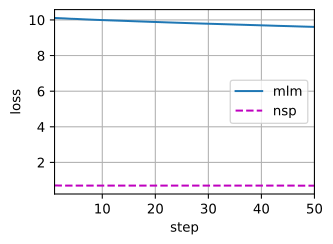
devices = d2l.try_all_gpus()
train_bert(train_iter, net, len(vocab), devices, 50)
MLM loss 9.658, NSP loss 0.721
1011.6 sentence pairs/sec on 1 devices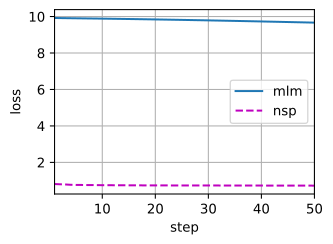
net = train_bert(train_iter, net, len(vocab), 50)MLM loss 9.665, NSP loss 0.712
523.6 sentence pairs/sec on [CudaDevice(id=0)]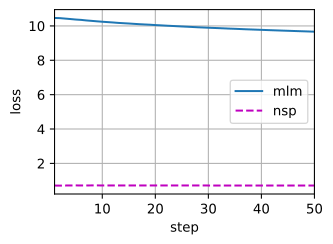
train_bert(train_iter, net, loss, len(vocab), devices, 50)MLM loss 9.604, NSP loss 0.715
1098.3 sentence pairs/sec on [gpu(0)]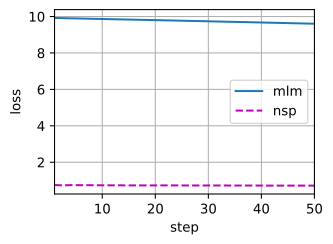
18.11.2 Representing Text with BERT
After pretraining BERT, we can use it to represent single text, text pairs, or any token in them. The following function returns the BERT (net) representations for all tokens in tokens_a and tokens_b.
def get_bert_encoding(net, tokens_a, tokens_b=None):
    tokens, segments = d2l.get_tokens_and_segments(tokens_a, tokens_b)
    token_ids = torch.tensor(vocab[tokens], device=devices[0]).unsqueeze(0)
    segments = torch.tensor(segments, device=devices[0]).unsqueeze(0)
    valid_len = torch.tensor(len(tokens), device=devices[0]).unsqueeze(0)
    encoded_X, _, _ = net(token_ids, segments, valid_len)
    return encoded_X
def get_bert_encoding(net, tokens_a, tokens_b=None):
tokens, segments = d2l.get_tokens_and_segments(tokens_a, tokens_b)
token_ids = tf.expand_dims(
tf.constant(vocab[tokens], dtype=tf.int32), axis=0)
segments = tf.expand_dims(
tf.constant(segments, dtype=tf.int32), axis=0)
valid_len = tf.constant([len(tokens)], dtype=tf.float32)
encoded_X, _, _ = net(token_ids, segments, valid_len, training=False)
return encoded_Xdef get_bert_encoding(net, tokens_a, tokens_b=None):
tokens, segments = d2l.get_tokens_and_segments(tokens_a, tokens_b)
token_ids = jnp.array(vocab[tokens], dtype=jnp.int32)[None, :]
segments = jnp.array(segments, dtype=jnp.int32)[None, :]
valid_len = jnp.array([len(tokens)], dtype=jnp.float32)
encoded_X, _, _ = nnx.view(net, deterministic=True)(
token_ids, segments, valid_len)
return encoded_Xdef get_bert_encoding(net, tokens_a, tokens_b=None):
tokens, segments = d2l.get_tokens_and_segments(tokens_a, tokens_b)
token_ids = np.expand_dims(np.array(vocab[tokens], ctx=devices[0]),
axis=0)
segments = np.expand_dims(np.array(segments, ctx=devices[0]), axis=0)
valid_len = np.expand_dims(np.array(len(tokens), ctx=devices[0]), axis=0)
encoded_X, _, _ = net(token_ids, segments, valid_len)
return encoded_XConsider the sentence “a crane is flying”. Recall the input representation of BERT as discussed in Section 18.9.4. After inserting special tokens “<cls>” (used for classification) and “<sep>” (used for separation), the BERT input sequence has a length of six. Since zero is the index of the “<cls>” token, encoded_text[:, 0, :] is the BERT representation of the entire input sentence. To evaluate the polysemy token “crane”, we also print out the first three elements of the BERT representation of the token.
tokens_a = ['a', 'crane', 'is', 'flying']
encoded_text = get_bert_encoding(net, tokens_a)
# Tokens: '<cls>', 'a', 'crane', 'is', 'flying', '<sep>'
encoded_text_cls = encoded_text[:, 0, :]
encoded_text_crane = encoded_text[:, 2, :]
encoded_text.shape, encoded_text_cls.shape, encoded_text_crane[0][:3]
(torch.Size([1, 6, 128]),
torch.Size([1, 128]),
tensor([ 0.7876, -1.5818, 0.8600], device='cuda:0', grad_fn=<SliceBackward0>))tokens_a = ['a', 'crane', 'is', 'flying']
encoded_text = get_bert_encoding(net, tokens_a)
# Tokens: '<cls>', 'a', 'crane', 'is', 'flying', '<sep>'
encoded_text_cls = encoded_text[:, 0, :]
encoded_text_crane = encoded_text[:, 2, :]
(encoded_text.shape, encoded_text_cls.shape,
encoded_text_crane[0][:3].numpy())(TensorShape([1, 6, 128]),
TensorShape([1, 128]),
array([ 0.74946296, 0.45479003, -0.11314106], dtype=float32))tokens_a = ['a', 'crane', 'is', 'flying']
encoded_text = get_bert_encoding(net, tokens_a)
# Tokens: '<cls>', 'a', 'crane', 'is', 'flying', '<sep>'
encoded_text_cls = encoded_text[:, 0, :]
encoded_text_crane = encoded_text[:, 2, :]
encoded_text.shape, encoded_text_cls.shape, encoded_text_crane[0][:3]((1, 6, 128),
(1, 128),
Array([-0.48675025, -1.4178457 , -0.3135721 ], dtype=float32))tokens_a = ['a', 'crane', 'is', 'flying']
encoded_text = get_bert_encoding(net, tokens_a)
# Tokens: '<cls>', 'a', 'crane', 'is', 'flying', '<sep>'
encoded_text_cls = encoded_text[:, 0, :]
encoded_text_crane = encoded_text[:, 2, :]
encoded_text.shape, encoded_text_cls.shape, encoded_text_crane[0][:3]((1, 6, 128),
(1, 128),
array([-1.8041719, -1.0388503, 1.5500813], device=gpu(0)))Now consider a sentence pair “a crane driver came” and “he just left”. Similarly, encoded_pair[:, 0, :] is the encoded result of the entire sentence pair from the pretrained BERT. Note that the first three elements of the polysemy token “crane” are different from those when the context is different. This supports that BERT representations are context-sensitive.
tokens_a, tokens_b = ['a', 'crane', 'driver', 'came'], ['he', 'just', 'left']
encoded_pair = get_bert_encoding(net, tokens_a, tokens_b)
# Tokens: '<cls>', 'a', 'crane', 'driver', 'came', '<sep>', 'he', 'just',
# 'left', '<sep>'
encoded_pair_cls = encoded_pair[:, 0, :]
encoded_pair_crane = encoded_pair[:, 2, :]
encoded_pair.shape, encoded_pair_cls.shape, encoded_pair_crane[0][:3]
(torch.Size([1, 10, 128]),
torch.Size([1, 128]),
tensor([ 0.6938, -1.6631, 0.9437], device='cuda:0', grad_fn=<SliceBackward0>))tokens_a, tokens_b = ['a', 'crane', 'driver', 'came'], ['he', 'just', 'left']
encoded_pair = get_bert_encoding(net, tokens_a, tokens_b)
# Tokens: '<cls>', 'a', 'crane', 'driver', 'came', '<sep>', 'he', 'just',
# 'left', '<sep>'
encoded_pair_cls = encoded_pair[:, 0, :]
encoded_pair_crane = encoded_pair[:, 2, :]
(encoded_pair.shape, encoded_pair_cls.shape,
encoded_pair_crane[0][:3].numpy())(TensorShape([1, 10, 128]),
TensorShape([1, 128]),
array([1.1518166 , 0.5547633 , 0.08858985], dtype=float32))tokens_a, tokens_b = ['a', 'crane', 'driver', 'came'], ['he', 'just', 'left']
encoded_pair = get_bert_encoding(net, tokens_a, tokens_b)
# Tokens: '<cls>', 'a', 'crane', 'driver', 'came', '<sep>', 'he', 'just',
# 'left', '<sep>'
encoded_pair_cls = encoded_pair[:, 0, :]
encoded_pair_crane = encoded_pair[:, 2, :]
encoded_pair.shape, encoded_pair_cls.shape, encoded_pair_crane[0][:3]((1, 10, 128),
(1, 128),
Array([-0.70371836, -0.90896857, -0.1139093 ], dtype=float32))tokens_a, tokens_b = ['a', 'crane', 'driver', 'came'], ['he', 'just', 'left']
encoded_pair = get_bert_encoding(net, tokens_a, tokens_b)
# Tokens: '<cls>', 'a', 'crane', 'driver', 'came', '<sep>', 'he', 'just',
# 'left', '<sep>'
encoded_pair_cls = encoded_pair[:, 0, :]
encoded_pair_crane = encoded_pair[:, 2, :]
encoded_pair.shape, encoded_pair_cls.shape, encoded_pair_crane[0][:3]((1, 10, 128),
(1, 128),
array([-1.935214 , -0.45819744, 1.3427665 ], device=gpu(0)))In Chapter 19, we will fine-tune a pretrained BERT model for downstream natural language processing applications.
18.11.3 Summary
- The original BERT has two versions, where the base model has 110 million parameters and the large model has 340 million parameters.
- After pretraining BERT, we can use it to represent single text, text pairs, or any token in them.
- In the experiment, the same token has different BERT representation when their contexts are different. This supports that BERT representations are context-sensitive.
18.11.4 Exercises
- In the experiment, we can see that the masked language modeling loss is significantly higher than the next sentence prediction loss. Why?
- Set the maximum length of a BERT input sequence to be 512 (same as the original BERT model). Use the configurations of the original BERT model such as \(\textrm{BERT}_{\textrm{LARGE}}\). Do you encounter any error when running this section? Why?