terms_gib = {"parameters": 14.0, "gradients": 14.0, "optimizer": 56.0,
             "activations": 18.0, "temporary": 5.0}

def per_device_gib(world_size=1, shard_state=False, ckpt_activations=False):
    divisor = world_size if shard_state else 1
    state = sum(terms_gib[k] / divisor
                for k in ("parameters", "gradients", "optimizer"))
    activations = terms_gib["activations"] * (0.35 if ckpt_activations else 1)
    return state + activations + terms_gib["temporary"]

for label, cfg in [("1 GPU, plain", (1, False, False)),
                   ("8 GPU DDP + ckpt", (8, False, True)),
                   ("8 GPU FSDP + ckpt", (8, True, True))]:
print(f"{label:>20s}: {per_device_gib(*cfg):6.1f} GiB/device")30.6 Distributed Model Training
Most examples in this book train on one device. Larger workloads may require several devices because model state does not fit on one accelerator or because a single-device run would take too long. This section introduces the main forms of parallelism, the software layers available in mid-2026, and the scale at which each becomes relevant. Distributed training partitions or replicates state and work, adds communication, and complicates recovery. Begin with a measured single-device baseline, then add the simplest technique that removes an observed memory or throughput constraint.
30.6.1 From One GPU to Many
30.6.1.1 The Scaling Ladder
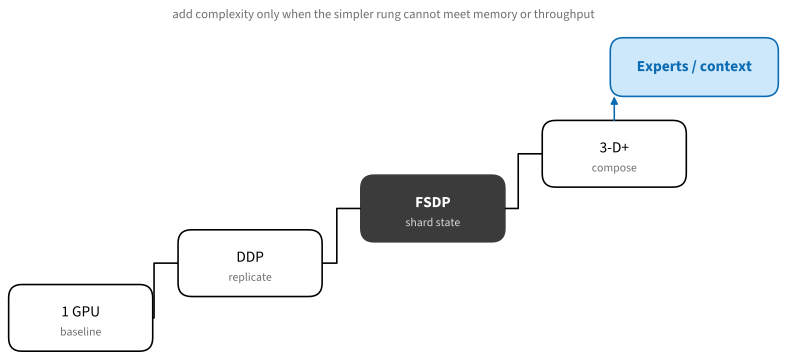
- One accelerator establishes the reference: loss curve, tokens or examples per second, peak memory, and a checkpoint you can trust.
- Data parallelism (DDP) replicates the model on every GPU, feeds each a different slice of the batch, and averages gradients after every backward pass. It is the entry point whenever model, gradients, and optimizer state fit on one device.
- Fully sharded data parallelism (FSDP) shards parameters, gradients, and optimizer state across GPUs and gathers each layer only while it is being used. It is related to DeepSpeed’s ZeRO stage 3 and can reduce per-device state memory approximately in proportion to world size, while adding all-gather traffic.
- Tensor, pipeline, context, and expert parallelism split individual layers, layer groups, the sequence dimension, and mixture-of-experts experts, respectively. Large systems compose several of these because no single axis suffices at scale.
In PyTorch, the first two rungs are a launcher and a wrapper:
torchrun --standalone --nproc-per-node=4 train.pyInside train.py, DDP wraps the model (DistributedDataParallel(model)), while FSDP’s current API applies fully_shard(model) — the rewritten “FSDP2”, which shards each parameter as a DTensor and has displaced the original FSDP wrapper in PyTorch’s documentation and in downstream libraries. JAX expresses the same ideas through sharded arrays and named meshes: jax.jit with sharding specifications compiles the collectives for you, which is why the JAX code in this book has barely mentioned devices at all.
One bookkeeping identity matters on every rung. The batch size that optimization sees is
\[ B_{\textrm{global}} = B_{\textrm{device}} \cdot N_{\textrm{ranks}} \cdot N_{\textrm{accumulation}}, \]
so changing the number of GPUs without adjusting per-device batch size or learning rate silently changes the optimization problem. Distributed samplers must not duplicate examples, and evaluation must aggregate metrics with the right denominators — the two classic sources of “multi-GPU accuracy is different” bugs.
30.6.1.2 Where the Memory Goes
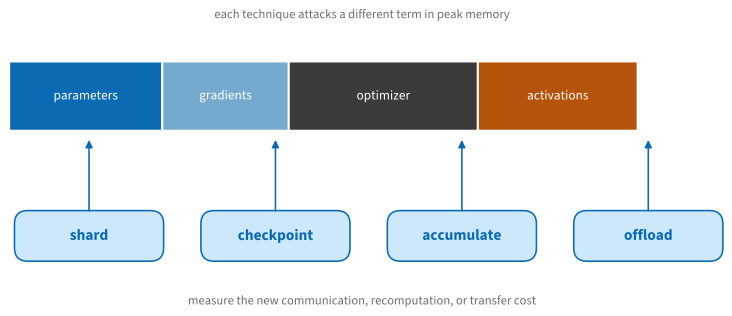
Peak training memory is the sum of parameters, gradients, optimizer state, activations, communication buffers, and allocator overhead — for a 7B- parameter model trained in BF16 with Adam, roughly 14 + 14 + 56 GB of state before a single activation is stored. The toy model below is crude but sorts strategies correctly, and needs no GPU to run:
        1 GPU, plain:  107.0 GiB/device
    8 GPU DDP + ckpt:   95.3 GiB/device
   8 GPU FSDP + ckpt:   21.8 GiB/device
Plain training does not fit any single GPU; DDP does not help, because it replicates state; FSDP brings the same model under 25 GiB per device. Each standard memory technique changes a different term and introduces a different cost. Mixed precision reduces the bytes used by selected tensors and operations. Gradient accumulation permits a smaller per-step microbatch while preserving a larger effective batch, reducing activation memory but not model state. Activation checkpointing recomputes selected activations during backpropagation; its memory savings and compute overhead depend on the partition. CPU/NVMe offload (including DeepSpeed’s ZeRO-Offload) exchanges transfer latency for device capacity. LoRA and QLoRA reduce trainable parameters and optimizer state; with compatible quantization and sequence settings, a 7B fine-tune can fit on a 16 GB card. Combine techniques deliberately: four individually sensible optimizations can interfere with compilation, overlap, or numerics.
Two topology guidelines from the Hugging Face Ultra-Scale Playbook, based on more than 4,000 runs on up to 512 GPUs, summarize its measurements: keep tensor parallelism inside a node, where NVLink can carry its dense traffic — letting TP cross nodes loses several times as much throughput as letting pipeline parallelism cross — and map the highest-volume collectives to the fastest links available.
30.6.2 The Library Landscape
As of mid-2026, the software ecosystem can be organized into several layers. These assignments are dated because APIs and project activity change quickly.
PyTorch built-ins. torchrun + DDP for replication; fully_shard (FSDP2) for sharding; DTensor underneath as the common abstraction for sharded tensors; tensor-, context-, and pipeline-parallel APIs exist but are still marked experimental. These primitives are what most higher-level tools now generate.
Hugging Face stack. accelerate launches the same script on DDP, FSDP2, or DeepSpeed with a config file rather than code changes; transformers.Trainer sits on top of it; peft implements LoRA/QLoRA; and trl provides supervised fine-tuning, DPO, and GRPO-family reinforcement-learning trainers. DeepSeek-R1-Zero demonstrated that reinforcement learning alone could elicit some reasoning behaviors, while the released DeepSeek-R1 training pipeline also included supervised stages. This stack supports many fine-tuning jobs on one node or a small cluster.
DeepSpeed. ZeRO stages 1–3 (optimizer, gradient, parameter sharding) plus CPU/NVMe offload. It introduced sharding techniques related to those in FSDP and remains maintained. FSDP2 provides a native PyTorch alternative. DeepSpeed remains relevant when CPU or NVMe offload is required, or when another framework depends on it.
Megatron-Core and TorchTitan. Frameworks for large-scale pretraining. NVIDIA’s Megatron-Core implements tensor/pipeline/sequence/expert parallelism with FP8 support and powers many industrial labs (and NVIDIA’s own NeMo framework and Nemotron models). TorchTitan is the PyTorch-native equivalent: a clean reference stack composing FSDP, tensor, pipeline, and context parallelism plus expert parallelism for MoE, demonstrated at 1,000-GPU scale on models from Llama 3 405B to DeepSeek-V3. These systems expose many configuration choices and are most appropriate when model scale requires several forms of parallelism.
Fine-tuning frontends. Unsloth targets single-GPU LoRA and QLoRA with fused kernels and quantized training; its speed and memory gains depend on model, sequence length, and hardware. Axolotl drives full and parameter-efficient fine-tunes across a node or several from one YAML file, with FSDP2 and DeepSpeed backends. LLaMA-Factory covers a similar space with a GUI and very broad model support. (Its former peer torchtune wound down in 2025 — check a library’s pulse before adopting it; this landscape churns.)
JAX. MaxText is the reference for TPU (and GPU) pretraining and now post-training; Levanter/Marin demonstrated fully reproducible open pretraining. On TPUs, XLA compiles array-sharding specifications into communication operations. This moves some parallelism decisions from framework wrappers into array layouts and compiler configuration.
RL post-training at scale. veRL combines FSDP or Megatron training with vLLM or SGLang rollouts; OpenRLHF provides a Ray and DeepSpeed alternative. Project adoption and APIs in this area change rapidly, so verify current documentation before selecting a stack.
30.6.2.1 What to Use at Which Scale
| Scale | Typical job | Reach for |
|---|---|---|
| 1 GPU, ≥ 8 GB | LoRA/QLoRA fine-tune ≤ 8B | Unsloth, or PEFT + Trainer |
| 1 node, 2–8 GPUs | full fine-tune ≤ 70B, DDP/FSDP2 | Accelerate or Axolotl |
| few nodes | large fine-tune, small pretrain | FSDP2 + torchrun, DeepSpeed |
| many nodes | serious pretraining, MoE | Megatron-Core, TorchTitan, MaxText |
| RL post-training | GRPO/DPO pipelines | TRL (small), veRL/OpenRLHF (large) |
The table is a starting point rather than a prescription. Tools lower in the table support more forms of parallelism but require more configuration. Use the least complex row that satisfies the measured constraints.
30.6.3 Keeping a Long Run Alive
Throughput alone does not complete a long run. As worker count and duration increase, hardware, network, and software failures become more likely, so recovery must be designed and tested.
- Checkpoint completely and atomically. A resumable checkpoint holds model and optimizer state, the learning-rate schedule and step count, data-loader position, and RNG state. Write to a temporary path and rename on completion, so a crash mid-write cannot destroy the previous checkpoint; keep more than one until restore has been tested. Sharded (per-rank) checkpoints avoid gathering a model larger than any single host’s memory.
- Drill the recovery. Kill the job deliberately, restore on fresh workers, and check that loss, step count, and data position continue as if nothing happened. Test recovery before relying on spot-priced training (Section 30.3), whose savings depend on successful resumption after interruption.
- Feed the accelerators. Profile data loading separately from compute: storage reads, decoding and augmentation, tokenization, and host-to- device transfer. A starved GPU spends time waiting for input and delivers low throughput; adding more GPUs can increase contention without improving a data-bound job.
- Watch convergence, not just speed. Tokens per second without a loss curve rewards fast wrong runs. Log both, plus time spent in collectives and checkpoint duration; debug distributed failures by reproducing on one process, then one node, then many, with rank and host on every log line.
30.6.4 Summary
- Scale in order — DDP while state fits, FSDP2/ZeRO when it does not, tensor, pipeline, or expert parallelism only when model scale requires it — from a measured single-GPU baseline.
- Peak memory is a sum of terms; each technique (sharding, checkpointing, accumulation, offload, LoRA) removes one term at a known price.
- The mid-2026 examples are Unsloth or PEFT on one GPU, Accelerate or Axolotl with FSDP2 on a node, Megatron-Core, TorchTitan, or MaxText for pretraining, and TRL or veRL for RL post-training; verify current project status.
- Keep tensor parallelism inside a node; map heavy collectives to fast links.
- Long runs survive on atomic checkpoints, tested recovery, a fed input pipeline, and convergence metrics — and explicit convergence monitoring.
30.6.5 Exercises
- Extend the memory model with a communication-buffer term and a LoRA configuration (frozen base weights, small trainable adapter). At what world size does FSDP stop paying for a 7B model?
- For a fixed global batch of 4M tokens, enumerate three combinations of device batch, world size, and accumulation steps, and reason about their relative throughput and optimizer behavior.
- Take a training notebook of roughly the scale of Section 18.11 and run it once with
torchrun --nproc-per-node=2. Measure the actual speedup over one GPU and explain the gap from 2×. - Design (on paper) the checkpoint contents and restore protocol for a sharded training job that must resume with a different number of workers. Which parts of the state are per-rank, and which are global?