import collections
import math
from d2l import torch as d2l
import torch
from torch import nn18.1 Encoder-Decoder Models for Sequence Transduction
The language models of Chapter 8 read a sequence and continue it. Many of the most useful problems in machine learning have a different shape: read one sequence and emit a different one. Translate an English sentence into French, transcribe an audio clip into words, summarize a document, answer a question. The input and the output are both sequences, they usually have different lengths, and their tokens need not line up position by position. Problems of this kind are called sequence transduction, or sequence-to-sequence (seq2seq) learning, and they were the arena in which recurrent networks first beat classical pipelines at scale (Sutskever et al. 2014; Cho et al. 2014).
This section is deliberately historical: it builds the 2014 system that taught the field what sequence transduction demands, using the recurrent tools of Chapter 12. You have already met both of its successors — the attention of Chapter 10 grew directly out of this model’s central weakness, and the transformer encoder-decoders of Section 11.4 displaced it outright — so read it as the baseline that the rest of this part, and much of the modern field, is measured against. We introduce the encoder-decoder abstraction that organizes almost every transduction model built since, assemble a small English-to-French translator from two GRUs, train it with the teacher forcing of Section 8.4 and a masked loss, translate with the decoding strategies of Section 8.7, and score the results with a character-level metric. We end by measuring the weakness itself: the encoder squeezes the entire source through a single fixed-size vector, and that bottleneck is where attention began.
import collections
import math
from d2l import tensorflow as d2l
import tensorflow as tf
import collections
import math
from d2l import jax as d2l
from flax import nnx
import jax
from jax import numpy as jnp
import optaximport collections
import math
from d2l import mxnet as d2l
from mxnet import np, npx, init, gluon
from mxnet.gluon import nn
npx.set_np()18.1.1 Sequence Transduction and the Abstraction
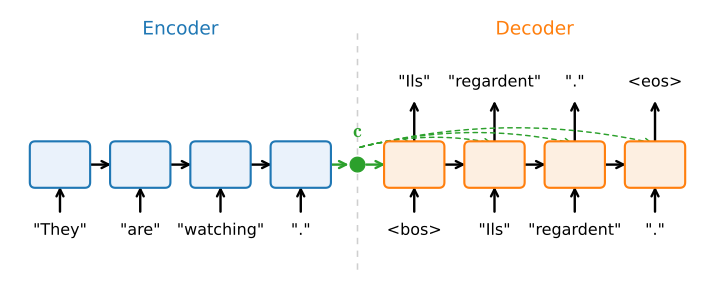
The trick that makes transduction tractable is to split the model in two (Figure 18.1.1). An encoder consumes the variable-length source sequence and compresses it into an intermediate state of fixed shape. A decoder consumes that state and produces the variable-length target, one token at a time. The state is the sole channel between them: everything the decoder ever learns about the source, it learns through that one object.
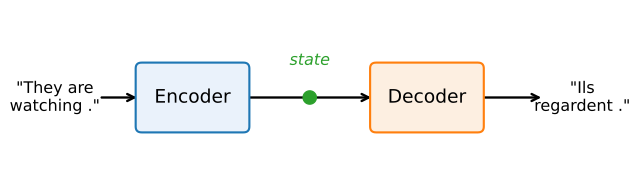
The decoder half should look familiar: it is a language model in the sense of Section 8.3, factorizing the target probability autoregressively, only now every factor is additionally conditioned on the encoder state \(\mathbf{c}\),
\[P(y_1, \ldots, y_{T'} \mid x_1, \ldots, x_T) = \prod_{t'=1}^{T'} P(y_{t'} \mid y_1, \ldots, y_{t'-1}, \mathbf{c}). \tag{18.1.1}\]
A decoder is a conditional language model, and conditioning is the whole game: the same next-token machinery, pointed at a source. This is why the abstraction long outlived the RNN that first filled it. Swap the encoder for a convolutional audio front-end and you have Whisper transcribing speech; swap it for a vision backbone and you have an image-captioning model; feed it text and images together and you have the multimodal front-ends of current assistants. The shape in Figure 18.1.1 survives; only the encoder changes.
Because the abstraction is reused so widely, it pays to fix it in code as a pair of interfaces before committing to any particular network. The encoder exposes a single method that maps an input to outputs. Later stages may need side information, such as the length of the source excluding padding, so we allow extra positional arguments.
class Encoder(nn.Module):
    """The base encoder interface for the encoder-decoder architecture."""
    def __init__(self):
        super().__init__()

    # Later there can be additional arguments (e.g., length excluding padding)
    def forward(self, X, *args):
        raise NotImplementedError
class Encoder(tf.keras.layers.Layer):
"""The base encoder interface for the encoder-decoder architecture."""
def __init__(self):
super().__init__()
# Later there can be additional arguments (e.g., length excluding padding)
def call(self, X, *args):
raise NotImplementedErrorclass Encoder(nnx.Module):
"""The base encoder interface for the encoder-decoder architecture."""
# Later there can be additional arguments (e.g., length excluding padding)
def __call__(self, X, *args):
raise NotImplementedErrorclass Encoder(nn.Block):
"""The base encoder interface for the encoder-decoder architecture."""
def __init__(self):
super().__init__()
# Later there can be additional arguments (e.g., length excluding padding)
def forward(self, X, *args):
raise NotImplementedErrorThe decoder adds one method, init_state, that turns the encoder output into whatever the decoder wants to carry as its running state, plus a forward that maps the next input token and the current state to an output and an updated state.
class Decoder(nn.Module):
    """The base decoder interface for the encoder-decoder architecture."""
    def __init__(self):
        super().__init__()

    def init_state(self, enc_all_outputs, *args):
        raise NotImplementedError

    def forward(self, X, state):
        raise NotImplementedError
class Decoder(tf.keras.layers.Layer):
"""The base decoder interface for the encoder-decoder architecture."""
def __init__(self):
super().__init__()
def init_state(self, enc_all_outputs, *args):
raise NotImplementedError
def call(self, X, state):
raise NotImplementedErrorclass Decoder(nnx.Module):
"""The base decoder interface for the encoder-decoder architecture."""
def init_state(self, enc_all_outputs, *args):
raise NotImplementedError
def __call__(self, X, state):
raise NotImplementedErrorclass Decoder(nn.Block):
"""The base decoder interface for the encoder-decoder architecture."""
def __init__(self):
super().__init__()
def init_state(self, enc_all_outputs, *args):
raise NotImplementedError
def forward(self, X, state):
raise NotImplementedErrorWiring them together is a three-line class: run the encoder, hand its output to init_state, then run the decoder. Subclassing d2l.Classifier gives us the training loop and the softmax cross-entropy loss for free, so a concrete model needs to specify only the encoder, the decoder, and how the two connect.
class EncoderDecoder(d2l.Classifier):
    """The base class for the encoder-decoder architecture."""
    def __init__(self, encoder, decoder):
        super().__init__()
        self.encoder = encoder
        self.decoder = decoder

    def forward(self, enc_X, dec_X, *args):
        enc_all_outputs = self.encoder(enc_X, *args)
        dec_state = self.decoder.init_state(enc_all_outputs, *args)
        # Return decoder output only
        return self.decoder(dec_X, dec_state)[0]
class EncoderDecoder(d2l.Classifier):
"""The base class for the encoder-decoder architecture."""
def __init__(self, encoder, decoder):
super().__init__()
self.encoder = encoder
self.decoder = decoder
def call(self, enc_X, dec_X, *args, training=None):
enc_all_outputs = self.encoder(enc_X, *args, training=training)
dec_state = self.decoder.init_state(enc_all_outputs, *args)
# Return decoder output only
return self.decoder(dec_X, dec_state, training=training)[0]class EncoderDecoder(d2l.Classifier):
"""The base class for the encoder-decoder architecture."""
def __init__(self, encoder, decoder):
super().__init__()
self.encoder = encoder
self.decoder = decoder
def forward(self, enc_X, dec_X, *args):
enc_all_outputs = self.encoder(enc_X, *args)
dec_state = self.decoder.init_state(enc_all_outputs, *args)
# Return decoder output only
return self.decoder(dec_X, dec_state)[0]class EncoderDecoder(d2l.Classifier):
"""The base class for the encoder-decoder architecture."""
def __init__(self, encoder, decoder):
super().__init__()
self.encoder = encoder
self.decoder = decoder
def forward(self, enc_X, dec_X, *args):
enc_all_outputs = self.encoder(enc_X, *args)
dec_state = self.decoder.init_state(enc_all_outputs, *args)
# Return decoder output only
return self.decoder(dec_X, dec_state)[0]18.1.2 The Machine Translation Dataset
To make the abstraction concrete we need data. We use a small English-French corpus of sentence pairs from the Tatoeba Project: each line is a tab-separated pair, an English source and its French target. Statistical machine translation on corpora like this (Brown et al. 1990) was, for decades, the flagship application that drove sequence modeling forward, and it remains the cleanest task on which to see an encoder-decoder learn.
Tokenization follows Section 8.2 exactly: a byte-level BPE tokenizer, trained here on both languages at once to yield a single shared vocabulary. Sharing one vocabulary across source and target is standard practice in translation (Sennrich et al. 2016). English and French overlap heavily in the Latin alphabet, in punctuation, and in outright shared words (“nation”, “possible”), so a joint vocabulary spends its budget where it is actually needed and lets a token learned on one side transfer to the other; and because BPE starts from raw bytes, no word in either language is ever out of vocabulary. Our tokenizer reserves the three special ids the batching below needs: <pad>, <bos>, and <eos>.
Batching pads or truncates every sentence to a fixed length num_steps. We append <eos> to mark where a sequence ends (so the decoder can learn to stop), pad short sentences with <pad> to a common length, and truncate long ones. Targets additionally get a <bos> prefix: the decoder is fed the target shifted right (by one, starting from <bos>), and is trained to predict the target shifted left (ending in <eos>), which is exactly the teacher forcing of Section 8.4. We also record each source’s length excluding padding, the bookkeeping an attention-based decoder uses to mask padded positions (Section 10.2); our recurrent model here never reads it.
class MTFraEng(d2l.DataModule):
    """The English-French dataset, tokenized with a shared byte-level BPE."""
    def __init__(self, batch_size, num_steps=20, num_train=1024, num_val=128,
                 vocab_size=4000):
        super().__init__()
        self.save_hyperparameters()
        pairs = self._pairs(self._preprocess(self._download()))
        # Train ONE shared byte-level BPE over both languages.
        m = min(5000, len(pairs))
        self.tokenizer = d2l.BPETokenizer(
            vocab_size, pattern=d2l.BPETokenizer.GPT2_PATTERN)
        self.tokenizer.train('\n'.join([p[0] for p in pairs[:m]] +
                                       [p[1] for p in pairs[:m]]))
        # src_vocab / tgt_vocab both refer to the shared tokenizer.
        self.src_vocab = self.tgt_vocab = self.tokenizer
        pairs = pairs[:num_train + num_val]
        self.src_sents = [p[0] for p in pairs]
        self.tgt_sents = [p[1] for p in pairs]
        self.arrays = self._encode(pairs)

    def _download(self):
        d2l.extract(d2l.download(
            d2l.DATA_URL + 'fra-eng.zip', self.root,
            '94646ad1522d915e7b0f9296181140edcf86a4f5'))
        with open(self.root + '/fra-eng/fra.txt', encoding='utf-8') as f:
            return f.read()

    def _preprocess(self, text):
        # Normalize spaces, lowercase, and put a space before punctuation.
        text = text.replace(' ', ' ').replace('\xa0', ' ').lower()
        no_space = lambda c, prev: c in ',.!?' and prev != ' '
        return ''.join([' ' + c if i > 0 and no_space(c, text[i - 1]) else c
                        for i, c in enumerate(text)])

    def _pairs(self, text):
        return [ln.split('\t') for ln in text.split('\n') if ln.count('\t') == 1]
The _encode method turns a list of sentence pairs into the four arrays every batch carries: the padded source, the decoder input (target with <bos>), the source length excluding padding, and the label (target with <eos>). Because it takes an explicit list of pairs, we reuse it both to build the dataset and, later, to encode arbitrary sentences we want to translate.
@d2l.add_to_class(MTFraEng)
def _encode(self, pairs):
    tok, t = self.tokenizer, self.num_steps
    def row(sent, is_tgt):
        ids = tok.encode(sent)
        ids = (ids[:t - 1] + [tok.eos] if len(ids) >= t else
               ids + [tok.eos] + [tok.pad] * (t - 1 - len(ids)))
        return [tok.bos] + ids if is_tgt else ids
    src = d2l.tensor([row(s, False) for s, _ in pairs])
    tgt = d2l.tensor([row(t, True) for _, t in pairs])
    valid_len = d2l.reduce_sum(d2l.astype(src != tok.pad, d2l.int32), 1)
    return src, tgt[:, :-1], valid_len, tgt[:, 1:]

@d2l.add_to_class(MTFraEng)
def build(self, src_sentences, tgt_sentences):
    return self._encode([(self._preprocess(s), self._preprocess(t))
                         for s, t in zip(src_sentences, tgt_sentences)])

@d2l.add_to_class(MTFraEng)
def get_dataloader(self, train):
    idx = slice(0, self.num_train) if train else slice(self.num_train, None)
    return self.get_tensorloader(self.arrays, train, idx)
Two small shims let the shared tokenizer stand in for the src_vocab / tgt_vocab interface that later chapters expect, mapping a special token to its id and a list of ids back to token strings.
@d2l.add_to_class(d2l.BPETokenizer)
def __getitem__(self, token):
    return self.specials[token]

@d2l.add_to_class(d2l.BPETokenizer)
def to_tokens(self, ids):
    return [self.decode([int(i)]) for i in ids]
Let us instantiate the dataset and read one small batch. The four tensors are the source, the decoder input (note the leading <bos> id), the source valid length, and the label (the target shifted one step left).
data = MTFraEng(batch_size=3)
src, dec_in, src_valid_len, label = next(iter(data.train_dataloader()))
print('source:', d2l.astype(src, d2l.int32))
print('decoder input:', d2l.astype(dec_in, d2l.int32))
print('source valid length:', d2l.astype(src_valid_len, d2l.int32))
print('shared vocabulary size:', len(data.tokenizer))source: tensor([[ 105, 1892, 304, 256, 4002, 4000, 4000, 4000, 4000, 4000, 4000, 4000,
4000, 4000, 4000, 4000, 4000, 4000, 4000, 4000],
[ 105, 297, 3084, 256, 4002, 4000, 4000, 4000, 4000, 4000, 4000, 4000,
4000, 4000, 4000, 4000, 4000, 4000, 4000, 4000],
[ 105, 297, 1572, 256, 4002, 4000, 4000, 4000, 4000, 4000, 4000, 4000,
4000, 4000, 4000, 4000, 4000, 4000, 4000, 4000]], dtype=torch.int32)
decoder input: tensor([[4001, 106, 39, 268, 768, 558, 694, 256, 4002, 4000, 4000, 4000,
4000, 4000, 4000, 4000, 4000, 4000, 4000, 4000],
[4001, 270, 296, 3569, 2023, 256, 4002, 4000, 4000, 4000, 4000, 4000,
4000, 4000, 4000, 4000, 4000, 4000, 4000, 4000],
[4001, 270, 296, 2381, 256, 4002, 4000, 4000, 4000, 4000, 4000, 4000,
4000, 4000, 4000, 4000, 4000, 4000, 4000, 4000]], dtype=torch.int32)
source valid length: tensor([5, 5, 5], dtype=torch.int32)
shared vocabulary size: 4003source: tf.Tensor(
[[ 421 701 256 4002 4000 4000 4000 4000 4000 4000 4000 4000 4000 4000
4000 4000 4000 4000 4000 4000]
[1910 822 262 4002 4000 4000 4000 4000 4000 4000 4000 4000 4000 4000
4000 4000 4000 4000 4000 4000]
[ 271 2164 256 4002 4000 4000 4000 4000 4000 4000 4000 4000 4000 4000
4000 4000 4000 4000 4000 4000]], shape=(3, 20), dtype=int32)
decoder input: tf.Tensor(
[[4001 497 3577 256 4002 4000 4000 4000 4000 4000 4000 4000 4000 4000
4000 4000 4000 4000 4000 4000]
[4001 1383 275 810 262 4002 4000 4000 4000 4000 4000 4000 4000 4000
4000 4000 4000 4000 4000 4000]
[4001 536 1776 256 4002 4000 4000 4000 4000 4000 4000 4000 4000 4000
4000 4000 4000 4000 4000 4000]], shape=(3, 20), dtype=int32)
source valid length: tf.Tensor([4 4 4], shape=(3,), dtype=int32)
shared vocabulary size: 4003source: [[1683 752 256 4002 4000 4000 4000 4000 4000 4000 4000 4000 4000 4000
4000 4000 4000 4000 4000 4000]
[ 771 642 256 4002 4000 4000 4000 4000 4000 4000 4000 4000 4000 4000
4000 4000 4000 4000 4000 4000]
[2151 471 256 4002 4000 4000 4000 4000 4000 4000 4000 4000 4000 4000
4000 4000 4000 4000 4000 4000]]
decoder input: [[4001 3547 45 507 1231 262 4002 4000 4000 4000 4000 4000 4000 4000
4000 4000 4000 4000 4000 4000]
[4001 3554 45 507 486 262 4002 4000 4000 4000 4000 4000 4000 4000
4000 4000 4000 4000 4000 4000]
[4001 3592 436 262 4002 4000 4000 4000 4000 4000 4000 4000 4000 4000
4000 4000 4000 4000 4000 4000]]
source valid length: [4 4 4]
shared vocabulary size: 4003source: [[1905 399 256 4002 4000 4000 4000 4000 4000 4000 4000 4000 4000 4000
4000 4000 4000 4000 4000 4000]
[ 271 309 735 256 4002 4000 4000 4000 4000 4000 4000 4000 4000 4000
4000 4000 4000 4000 4000 4000]
[ 105 297 1443 256 4002 4000 4000 4000 4000 4000 4000 4000 4000 4000
4000 4000 4000 4000 4000 4000]]
decoder input: [[4001 2340 45 507 262 4002 4000 4000 4000 4000 4000 4000 4000 4000
4000 4000 4000 4000 4000 4000]
[4001 286 259 39 1129 485 900 256 4002 4000 4000 4000 4000 4000
4000 4000 4000 4000 4000 4000]
[4001 270 296 352 788 319 2838 256 4002 4000 4000 4000 4000 4000
4000 4000 4000 4000 4000 4000]]
source valid length: [4 5 5]
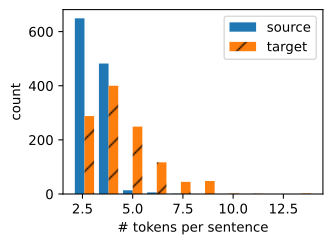
shared vocabulary size: 4003Padding is a real cost, so it is worth seeing how much of it we do. The histogram below plots the distribution of tokenized sentence lengths for the two languages. Most sentences are short, which is why a modest num_steps suffices, and it is this same skew that makes a masked loss (below) worthwhile: without masking, the padding on short sentences would dominate the gradient.
def show_list_len_pair_hist(legend, xlabel, ylabel, xlist, ylist):
    """Plot the histogram for list length pairs."""
    d2l.set_figsize()
    _, _, patches = d2l.plt.hist(
        [[len(l) for l in xlist], [len(l) for l in ylist]])
    d2l.plt.xlabel(xlabel)
    d2l.plt.ylabel(ylabel)
    for patch in patches[1].patches:
        patch.set_hatch('/')
    d2l.plt.legend(legend)
src_ids = [data.tokenizer.encode(s) for s in data.src_sents]
tgt_ids = [data.tokenizer.encode(s) for s in data.tgt_sents]
show_list_len_pair_hist(['source', 'target'], '# tokens per sentence',
'count', src_ids, tgt_ids);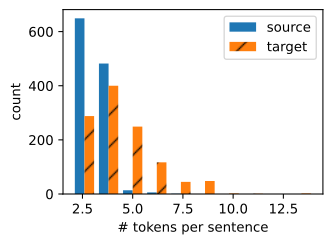
18.1.3 The Seq2Seq Model
We now fill the two interfaces with GRUs (Section 12.1.3). The GRU is a natural choice: its gated additive state carries information across the sentence without the vanishing gradients that would cripple a vanilla RNN encoder.
18.1.3.1 The Encoder
The encoder embeds each source token and runs a multilayer GRU over the sequence. It returns the per-step hidden states of the top layer together with the final hidden state of every layer; the latter is the context \(\mathbf{c}\) of Figure 18.1.1, a fixed-shape summary of the whole source.
One detail of initialization matters enough to name. The seq2seq paper (Sutskever et al. 2014) initializes weights with Xavier-uniform, which frameworks do not all do by default. In PyTorch we apply a small helper via module.apply; MXNet passes init.Xavier() directly; TensorFlow’s Keras layers already default to Xavier (glorot-uniform); and the Flax NNX layers default to LeCun-normal input weights with orthogonal recurrent weights, a combination already well suited to RNNs, so we leave it in place.
def init_seq2seq(module):
    """Initialize weights for sequence-to-sequence learning."""
    if type(module) == nn.Linear:
        nn.init.xavier_uniform_(module.weight)
    if type(module) == nn.GRU:
        for param in module._flat_weights_names:
            if "weight" in param:
                nn.init.xavier_uniform_(module._parameters[param])
class Seq2SeqEncoder(d2l.Encoder):
"""The RNN encoder for sequence-to-sequence learning."""
def __init__(self, vocab_size, embed_size, num_hiddens, num_layers,
dropout=0):
super().__init__()
self.embedding = nn.Embedding(vocab_size, embed_size)
self.rnn = d2l.GRU(embed_size, num_hiddens, num_layers, dropout)
self.embedding.initialize(init.Xavier())
self.rnn.initialize()
def forward(self, X, *args):
embs = self.embedding(d2l.transpose(X))
outputs, state = self.rnn(embs)
# outputs: (num_steps, batch_size, num_hiddens)
# state: (num_layers, batch_size, num_hiddens)
return outputs, stateclass Seq2SeqEncoder(d2l.Encoder):
"""The RNN encoder for sequence-to-sequence learning."""
def __init__(self, vocab_size, embed_size, num_hiddens, num_layers,
dropout=0):
super().__init__()
self.embedding = nn.Embedding(vocab_size, embed_size)
self.rnn = d2l.GRU(embed_size, num_hiddens, num_layers, dropout)
self.apply(init_seq2seq)
def forward(self, X, *args):
embs = self.embedding(d2l.astype(d2l.transpose(X), d2l.int64))
outputs, state = self.rnn(embs)
# outputs: (num_steps, batch_size, num_hiddens)
# state: (num_layers, batch_size, num_hiddens)
return outputs, stateclass Seq2SeqEncoder(d2l.Encoder):
"""The RNN encoder for sequence-to-sequence learning."""
def __init__(self, vocab_size, embed_size, num_hiddens, num_layers,
dropout=0):
super().__init__()
self.embedding = tf.keras.layers.Embedding(vocab_size, embed_size)
self.rnn = d2l.GRU(embed_size, num_hiddens, num_layers, dropout)
def call(self, X, *args):
embs = self.embedding(d2l.transpose(X))
outputs, state = self.rnn(embs)
# outputs: (num_steps, batch_size, num_hiddens)
# state: (num_layers, batch_size, num_hiddens)
return outputs, stateclass Seq2SeqEncoder(d2l.Encoder):
"""The RNN encoder for sequence-to-sequence learning."""
def __init__(self, vocab_size, embed_size, num_hiddens, num_layers,
dropout=0, rngs=None):
rngs = nnx.Rngs(params=0, dropout=1, carry=2) if rngs is None else rngs
self.embedding = nnx.Embed(vocab_size, embed_size, rngs=rngs)
self.rnn = d2l.GRU(embed_size, num_hiddens, num_layers, dropout,
rngs=rngs)
def __call__(self, X, *args):
embs = self.embedding(d2l.astype(d2l.transpose(X), d2l.int64))
outputs, state = self.rnn(embs)
# outputs: (num_steps, batch_size, num_hiddens)
# state: (num_layers, batch_size, num_hiddens)
return outputs, stateA quick shape check confirms the interface. On a batch of 4 sequences of length 9 with a two-layer GRU of width 16, the per-step outputs have shape (num_steps, batch_size, num_hiddens) and the final state has one hidden vector per layer.
vocab_size, embed_size, num_hiddens, num_layers = 10, 8, 16, 2
batch_size, num_steps = 4, 9
encoder = Seq2SeqEncoder(vocab_size, embed_size, num_hiddens, num_layers)
X = d2l.zeros((batch_size, num_steps))
enc_outputs, enc_state = encoder(X)
d2l.check_shape(enc_outputs, (num_steps, batch_size, num_hiddens))
UserWarning: Explicitly requested dtype int64 requested in astype is not
available, and will be truncated to dtype int32. To enable more dtypes, set the
jax_enable_x64 configuration option or the JAX_ENABLE_X64 shell environment
variable. See https://github.com/jax-ml/jax#current-gotchas for more.18.1.3.2 The Decoder
The decoder generates the target autoregressively. At target step \(t'\) it takes the previous target token \(y_{t'-1}\), its own previous hidden state \(\mathbf{s}_{t'-1}\), and the context \(\mathbf{c}\), and produces a distribution over the next token:
\[\mathbf{s}_{t'} = g(y_{t'-1}, \mathbf{c}, \mathbf{s}_{t'-1}). \tag{18.1.2}\]
We realize \(g\) with two design choices. First, the decoder’s initial hidden state is the encoder’s final hidden state, which requires the two GRUs to share width and depth. Second, to keep the source in view at every step and not only the first, we concatenate the context \(\mathbf{c}\) (the encoder’s top-layer final state, broadcast across time) onto the decoder’s input embedding at every step. A dense layer over the top-layer hidden states produces the vocabulary logits.
class Seq2SeqDecoder(d2l.Decoder):
    """The RNN decoder for sequence-to-sequence learning."""
    def __init__(self, vocab_size, embed_size, num_hiddens, num_layers,
                 dropout=0):
        super().__init__()
        self.embedding = nn.Embedding(vocab_size, embed_size)
        self.rnn = d2l.GRU(embed_size + num_hiddens, num_hiddens,
                           num_layers, dropout)
        self.dense = nn.LazyLinear(vocab_size)
        self.apply(init_seq2seq)

    def init_state(self, enc_all_outputs, *args):
        return enc_all_outputs

    def forward(self, X, state):
        embs = self.embedding(d2l.astype(d2l.transpose(X), d2l.int64))
        enc_output, hidden_state = state
        context = enc_output[-1]
        context = context.repeat(embs.shape[0], 1, 1)
        embs_and_context = d2l.concat((embs, context), -1)
        outputs, hidden_state = self.rnn(embs_and_context, hidden_state)
        outputs = d2l.swapaxes(self.dense(outputs), 0, 1)
        return outputs, [enc_output, hidden_state]
class Seq2SeqDecoder(d2l.Decoder):
"""The RNN decoder for sequence-to-sequence learning."""
def __init__(self, vocab_size, embed_size, num_hiddens, num_layers,
dropout=0):
super().__init__()
self.embedding = tf.keras.layers.Embedding(vocab_size, embed_size)
self.rnn = d2l.GRU(embed_size + num_hiddens, num_hiddens, num_layers,
dropout)
self.dense = tf.keras.layers.Dense(vocab_size)
def init_state(self, enc_all_outputs, *args):
return enc_all_outputs
def call(self, X, state):
embs = self.embedding(d2l.transpose(X))
enc_output, hidden_state = state
context = enc_output[-1]
context = tf.tile(tf.expand_dims(context, 0), (embs.shape[0], 1, 1))
embs_and_context = d2l.concat((embs, context), -1)
outputs, hidden_state = self.rnn(embs_and_context, hidden_state)
outputs = d2l.transpose(self.dense(outputs), (1, 0, 2))
return outputs, [enc_output, hidden_state]class Seq2SeqDecoder(d2l.Decoder):
"""The RNN decoder for sequence-to-sequence learning."""
def __init__(self, vocab_size, embed_size, num_hiddens, num_layers,
dropout=0, rngs=None):
rngs = nnx.Rngs(params=2, dropout=3, carry=4) if rngs is None else rngs
self.embedding = nnx.Embed(vocab_size, embed_size, rngs=rngs)
self.rnn = d2l.GRU(embed_size + num_hiddens, num_hiddens,
num_layers, dropout, rngs=rngs)
self.dense = nnx.Linear(num_hiddens, vocab_size, rngs=rngs)
def init_state(self, enc_all_outputs, *args):
return enc_all_outputs
def __call__(self, X, state):
embs = self.embedding(d2l.astype(d2l.transpose(X), d2l.int64))
enc_output, hidden_state = state
context = enc_output[-1]
context = jnp.tile(context, (embs.shape[0], 1, 1))
embs_and_context = d2l.concat((embs, context), -1)
outputs, hidden_state = self.rnn(embs_and_context, hidden_state)
outputs = d2l.swapaxes(self.dense(outputs), 0, 1)
return outputs, [enc_output, hidden_state]class Seq2SeqDecoder(d2l.Decoder):
"""The RNN decoder for sequence-to-sequence learning."""
def __init__(self, vocab_size, embed_size, num_hiddens, num_layers,
dropout=0):
super().__init__()
self.embedding = nn.Embedding(vocab_size, embed_size)
self.rnn = d2l.GRU(embed_size + num_hiddens, num_hiddens, num_layers,
dropout)
self.dense = nn.Dense(vocab_size, flatten=False)
self.embedding.initialize(init.Xavier())
self.rnn.initialize()
self.dense.initialize(init.Xavier())
def init_state(self, enc_all_outputs, *args):
return enc_all_outputs
def forward(self, X, state):
embs = self.embedding(d2l.transpose(X))
enc_output, hidden_state = state
context = enc_output[-1]
context = np.tile(context, (embs.shape[0], 1, 1))
embs_and_context = d2l.concat((embs, context), -1)
outputs, hidden_state = self.rnn(embs_and_context, hidden_state)
outputs = d2l.swapaxes(self.dense(outputs), 0, 1)
return outputs, [enc_output, hidden_state]Running the decoder on the same toy batch, the output has shape (batch_size, num_steps, vocab_size): a distribution over the vocabulary at every step.
decoder = Seq2SeqDecoder(vocab_size, embed_size, num_hiddens, num_layers)
state = decoder.init_state(encoder(X))
dec_outputs, state = decoder(X, state)
d2l.check_shape(dec_outputs, (batch_size, num_steps, vocab_size))
Figure 18.1.2 unrolls the assembled model. The encoder consumes the source tokens; its final state becomes the context \(\mathbf{c}\) that seeds and feeds the decoder; the decoder is driven by the teacher-forced target and predicts the target shifted by one, terminating at <eos>.
<bos> and its label is the target ending in <eos>.
18.1.3.3 The Loss with Masking
Every batch is padded, but the padding is not real data, and letting the model be graded on predicting <pad> tokens would reward it for the wrong thing. We therefore compute the usual softmax cross-entropy at every position, then multiply by a mask that is zero at padded target positions and average over the real tokens only. This is worth doing carefully because it appears nowhere else in the book, and, as the exercises show, dropping it visibly degrades translation.
The Seq2Seq class ties everything together and swaps SGD for Adam, which converges faster on this task.
class Seq2Seq(d2l.EncoderDecoder):
    """The RNN encoder-decoder for sequence-to-sequence learning."""
    def __init__(self, encoder, decoder, tgt_pad, lr):
        super().__init__(encoder, decoder)
        self.save_hyperparameters()

    def validation_step(self, batch):
        Y_hat = self(*batch[:-1])
        self.plot('loss', self.loss(Y_hat, batch[-1]), train=False)

    def configure_optimizers(self):
        return torch.optim.Adam(self.parameters(), lr=self.lr)
class Seq2Seq(d2l.EncoderDecoder):
"""The RNN encoder-decoder for sequence-to-sequence learning."""
def __init__(self, encoder, decoder, tgt_pad, lr):
super().__init__(encoder, decoder)
self.save_hyperparameters()
def validation_step(self, batch):
Y_hat = self(*batch[:-1])
self.plot('loss', self.loss(Y_hat, batch[-1]), train=False)
def configure_optimizers(self):
return tf.keras.optimizers.Adam(learning_rate=self.lr)class Seq2Seq(d2l.EncoderDecoder):
"""The RNN encoder-decoder for sequence-to-sequence learning."""
def __init__(self, encoder, decoder, tgt_pad, lr):
super().__init__(encoder, decoder)
self.tgt_pad, self.lr = tgt_pad, lr
def validation_step(self, batch):
return self.loss(self(*batch[:-1]), batch[-1])
def configure_optimizers(self):
return optax.adam(learning_rate=self.lr)class Seq2Seq(d2l.EncoderDecoder):
"""The RNN encoder-decoder for sequence-to-sequence learning."""
def __init__(self, encoder, decoder, tgt_pad, lr):
super().__init__(encoder, decoder)
self.save_hyperparameters()
def validation_step(self, batch):
Y_hat = self(*batch[:-1])
self.plot('loss', self.loss(Y_hat, batch[-1]), train=False)
def configure_optimizers(self):
return gluon.Trainer(self.parameters(), 'adam',
{'learning_rate': self.lr})@d2l.add_to_class(Seq2Seq)
def loss(self, Y_hat, Y):
l = super(Seq2Seq, self).loss(Y_hat, Y, averaged=False)
mask = d2l.astype(d2l.reshape(Y, (-1,)) != self.tgt_pad, d2l.float32)
return d2l.reduce_sum(l * mask) / d2l.reduce_sum(mask)@d2l.add_to_class(Seq2Seq)
def loss(self, Y_hat, Y):
l = super(Seq2Seq, self).loss(Y_hat, Y, averaged=False)
mask = d2l.astype(d2l.reshape(Y, (-1,)) != self.tgt_pad, d2l.float32)
return d2l.reduce_sum(l * mask) / d2l.reduce_sum(mask)@d2l.add_to_class(Seq2Seq)
def loss(self, Y_hat, Y, averaged=False):
Y_hat = d2l.reshape(Y_hat, (-1, Y_hat.shape[-1]))
Y = d2l.reshape(Y, (-1,))
fn = optax.softmax_cross_entropy_with_integer_labels
l = fn(Y_hat, Y)
mask = d2l.astype(Y != self.tgt_pad, d2l.float32)
return d2l.reduce_sum(l * mask) / d2l.reduce_sum(mask)@d2l.add_to_class(Seq2Seq)
def loss(self, Y_hat, Y):
l = super(Seq2Seq, self).loss(Y_hat, Y, averaged=False)
mask = d2l.astype(d2l.reshape(Y, (-1,)) != self.tgt_pad, d2l.float32)
return d2l.reduce_sum(l * mask) / d2l.reduce_sum(mask)18.1.4 Training, Decoding, and Evaluation
We now train the translator on our 1,024-pair training split. Two layers, width 256, dropout 0.2, Adam at learning rate 0.005, gradients clipped to norm 1, for 30 epochs.
data = d2l.MTFraEng(batch_size=128)
embed_size, num_hiddens, num_layers, dropout = 256, 256, 2, 0.2
encoder = Seq2SeqEncoder(
    len(data.tokenizer), embed_size, num_hiddens, num_layers, dropout)
decoder = Seq2SeqDecoder(
    len(data.tokenizer), embed_size, num_hiddens, num_layers, dropout)
model = Seq2Seq(encoder, decoder, tgt_pad=data.tokenizer.pad, lr=0.005)
trainer = d2l.Trainer(max_epochs=30, gradient_clip_val=1, num_gpus=1)
trainer.fit(model, data)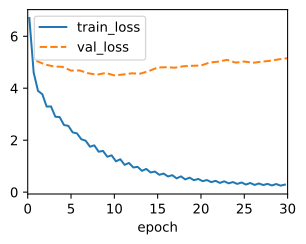
data = d2l.MTFraEng(batch_size=128)
embed_size, num_hiddens, num_layers, dropout = 256, 256, 2, 0.2
with d2l.try_gpu():
    encoder = Seq2SeqEncoder(
        len(data.tokenizer), embed_size, num_hiddens, num_layers, dropout)
    decoder = Seq2SeqDecoder(
        len(data.tokenizer), embed_size, num_hiddens, num_layers, dropout)
    model = Seq2Seq(encoder, decoder, tgt_pad=data.tokenizer.pad, lr=0.005)
trainer = d2l.Trainer(max_epochs=30, gradient_clip_val=1)
trainer.fit(model, data)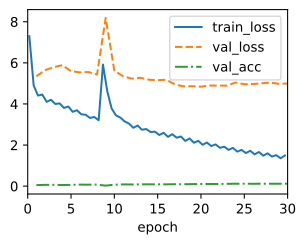
data = d2l.MTFraEng(batch_size=128)
embed_size, num_hiddens, num_layers, dropout = 256, 256, 2, 0.2
encoder = Seq2SeqEncoder(
    len(data.tokenizer), embed_size, num_hiddens, num_layers, dropout)
decoder = Seq2SeqDecoder(
    len(data.tokenizer), embed_size, num_hiddens, num_layers, dropout)
model = Seq2Seq(encoder, decoder, tgt_pad=data.tokenizer.pad, lr=0.005)
trainer = d2l.Trainer(max_epochs=30, gradient_clip_val=1, num_gpus=1)
trainer.fit(model, data)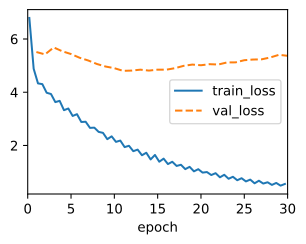
data = d2l.MTFraEng(batch_size=128)
embed_size, num_hiddens, num_layers, dropout = 256, 256, 2, 0.2
encoder = Seq2SeqEncoder(
    len(data.tokenizer), embed_size, num_hiddens, num_layers, dropout)
decoder = Seq2SeqDecoder(
    len(data.tokenizer), embed_size, num_hiddens, num_layers, dropout)
model = Seq2Seq(encoder, decoder, tgt_pad=data.tokenizer.pad, lr=0.005)
trainer = d2l.Trainer(max_epochs=30, gradient_clip_val=1, num_gpus=1)
trainer.fit(model, data)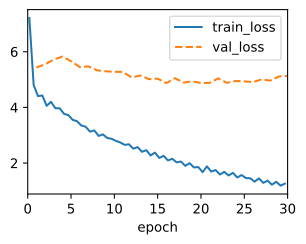
18.1.4.1 Greedy Translation
To translate we run the decoder autoregressively: feed <bos>, take an output token, feed it back, and stop at <eos>. Two forms are useful. The batched predict_step, attached to EncoderDecoder, decodes a whole minibatch in one call, and we use it for the length sweep below.
@d2l.add_to_class(d2l.EncoderDecoder)
def predict_step(self, batch, device, num_steps,
                 save_attention_weights=False):
    self.eval()
    batch = [d2l.to(a, device) for a in batch]
    src, tgt, src_valid_len, _ = batch
    enc_all_outputs = self.encoder(src, src_valid_len)
    dec_state = self.decoder.init_state(enc_all_outputs, src_valid_len)
    outputs, attention_weights = [d2l.expand_dims(tgt[:, 0], 1), ], []
    for _ in range(num_steps):
        Y, dec_state = self.decoder(outputs[-1], dec_state)
        outputs.append(d2l.argmax(Y, 2))
        if save_attention_weights:
            attention_weights.append(self.decoder.attention_weights)
return d2l.concat(outputs[1:], 1), attention_weights@d2l.add_to_class(d2l.EncoderDecoder)
def predict_step(self, batch, device, num_steps,
save_attention_weights=False):
src, tgt, src_valid_len, _ = batch
enc_all_outputs = self.encoder(src, src_valid_len, training=False)
dec_state = self.decoder.init_state(enc_all_outputs, src_valid_len)
outputs, attention_weights = [d2l.expand_dims(tgt[:, 0], 1), ], []
for _ in range(num_steps):
Y, dec_state = self.decoder(outputs[-1], dec_state, training=False)
outputs.append(d2l.argmax(Y, 2))
if save_attention_weights:
attention_weights.append(self.decoder.attention_weights)
return d2l.concat(outputs[1:], 1), attention_weights@d2l.add_to_class(d2l.EncoderDecoder)
def predict_step(self, batch, num_steps, save_attention_weights=False):
model = nnx.view(self, deterministic=True, use_running_average=True,
raise_if_not_found=False)
src, tgt, src_valid_len, _ = batch
enc_all_outputs = model.encoder(src, src_valid_len)
enc_attention_weights = (getattr(model.encoder, 'attention_weights', [])
if save_attention_weights else [])
dec_state = model.decoder.init_state(enc_all_outputs, src_valid_len)
outputs, attention_weights = [d2l.expand_dims(tgt[:, 0], 1), ], []
for _ in range(num_steps):
Y, dec_state = model.decoder(outputs[-1], dec_state)
outputs.append(d2l.argmax(Y, 2))
if save_attention_weights:
attention_weights.append(model.decoder.attention_weights)
return d2l.concat(outputs[1:], 1), (attention_weights,
enc_attention_weights)@d2l.add_to_class(d2l.EncoderDecoder)
def predict_step(self, batch, device, num_steps,
save_attention_weights=False):
batch = [d2l.to(a, device) for a in batch]
src, tgt, src_valid_len, _ = batch
enc_all_outputs = self.encoder(src, src_valid_len)
dec_state = self.decoder.init_state(enc_all_outputs, src_valid_len)
outputs, attention_weights = [d2l.expand_dims(tgt[:, 0], 1), ], []
for _ in range(num_steps):
Y, dec_state = self.decoder(outputs[-1], dec_state)
outputs.append(d2l.argmax(Y, 2))
if save_attention_weights:
attention_weights.append(self.decoder.attention_weights)
return d2l.concat(outputs[1:], 1), attention_weightsA small helper turns one row of predicted ids into a string, cutting it at the first <eos>. We translate a few short English sentences whose French we know, decoding the whole batch at once with predict_step.
def to_text(pred, tokenizer):  # Decode one row of ids, stop at <eos>
    ids = [int(i) for i in d2l.numpy(pred)]
    if tokenizer.eos in ids:
        ids = ids[:ids.index(tokenizer.eos)]
return tokenizer.decode(ids)engs = ['i lost .', "i'm calm .", "i'm home ."]
fras = ["j'ai perdu .", 'je suis calme .', 'je suis chez moi .']
preds, _ = model.predict_step(data.build(engs, fras), d2l.try_gpu(),
data.num_steps)
translations = [to_text(p, data.tokenizer) for p in preds]
for eng, out in zip(engs, translations):
print(f'{eng} => {out!r}')i lost . => "j'ai perdu ."
i'm calm . => 'je suis calme .'
i'm home . => 'je suis chez moi .'engs = ['i lost .', "i'm calm .", "i'm home ."]
fras = ["j'ai perdu .", 'je suis calme .', 'je suis chez moi .']
preds, _ = model.predict_step(data.build(engs, fras), d2l.try_gpu(),
data.num_steps)
translations = [to_text(p, data.tokenizer) for p in preds]
for eng, out in zip(engs, translations):
print(f'{eng} => {out!r}')i lost . => "j'ai perdu ."
i'm calm . => 'je suis en colère .'
i'm home . => 'je suis en tom .'engs = ['i lost .', "i'm calm .", "i'm home ."]
fras = ["j'ai perdu .", 'je suis calme .', 'je suis chez moi .']
preds, _ = model.predict_step(data.build(engs, fras), data.num_steps)
translations = [to_text(p, data.tokenizer) for p in preds]
for eng, out in zip(engs, translations):
print(f'{eng} => {out!r}')i lost . => "j'ai perdu ."
i'm calm . => 'je suis calme .'
i'm home . => 'je suis chez moi .'engs = ['i lost .', "i'm calm .", "i'm home ."]
fras = ["j'ai perdu .", 'je suis calme .', 'je suis chez moi .']
preds, _ = model.predict_step(data.build(engs, fras), d2l.try_gpu(),
data.num_steps)
translations = [to_text(p, data.tokenizer) for p in preds]
for eng, out in zip(engs, translations):
print(f'{eng} => {out!r}')i lost . => "j'ai dit ."
i'm calm . => 'je suis en moi .'
i'm home . => 'je suis en moi .'18.1.4.2 Evaluation with chrF
By what number do we call one translation better than another? For decades the default answer was BLEU (below), which counts matching word \(n\)-grams. The modern default for lexical scoring is chrF (Popović 2015), the metric the WMT evaluation campaigns recommend. chrF compares character \(n\)-grams rather than word \(n\)-grams, which sidesteps tokenization entirely and rewards getting a word almost right (a shared stem, a near-miss inflection) instead of scoring it a flat zero. For orders \(n = 1, \ldots, N\) it computes the precision and recall of character \(n\)-grams, and combines them with an F-score weighted toward recall (\(\beta = 2\)). It is about ten lines.
def chrf(pred, label, n=6, beta=2):
    """chrF (Popovic, 2015): character n-gram F-score."""
    def ngrams(s, k):
        s = s.replace(' ', '')
        return collections.Counter(s[i:i + k] for i in range(len(s) - k + 1))
    prec = rec = 0.0
    for k in range(1, n + 1):
        p, r = ngrams(pred, k), ngrams(label, k)
        overlap = sum((p & r).values())
        if sum(p.values()) and sum(r.values()):
            prec += overlap / sum(p.values())
            rec += overlap / sum(r.values())
    prec, rec = prec / n, rec / n
    if prec + rec == 0:
        return 0.0
    return (1 + beta**2) * prec * rec / (beta**2 * prec + rec)
Scoring our greedy translations, a correct translation earns a chrF near 1 while a wrong word costs partial credit rather than everything. At this toy scale translation quality varies from framework to framework: on some tabs the model returns a fluent but wrong French sentence, and chrF’s partial credit, not an all-or-nothing zero, is exactly what you then see in its score.
for eng, fra, out in zip(engs, fras, translations):
print(f'{eng} => {out!r}, chrF {chrf(out, data._preprocess(fra)):.3f}')i lost . => "j'ai perdu .", chrF 1.000
i'm calm . => 'je suis calme .', chrF 1.000
i'm home . => 'je suis chez moi .', chrF 1.000i lost . => "j'ai perdu .", chrF 1.000
i'm calm . => 'je suis en colère .', chrF 0.394
i'm home . => 'je suis en tom .', chrF 0.347i lost . => "j'ai perdu .", chrF 1.000
i'm calm . => 'je suis calme .', chrF 1.000
i'm home . => 'je suis chez moi .', chrF 1.000i lost . => "j'ai dit .", chrF 0.231
i'm calm . => 'je suis en moi .', chrF 0.388
i'm home . => 'je suis en moi .', chrF 0.444A note on BLEU. You will still meet BLEU (Papineni et al. 2002) constantly, so it is worth naming. It is a geometric mean of word \(n\)-gram precisions \(p_n\), damped by a brevity penalty that stops a model from gaming precision by emitting only a couple of sure words:
\[\text{BLEU} = \exp\!\left(\min\!\left(0, 1 - \frac{\text{len}_{\text{label}}}{\text{len}_{\text{pred}}}\right)\right) \prod_{n=1}^{k} p_n^{1/2^n}. \tag{18.1.3}\]
We keep its implementation, d2l.bleu, in the library for the exercises, but chrF is the metric we teach.
def bleu(pred_seq, label_seq, k):
    """Compute the BLEU."""
    pred_tokens, label_tokens = pred_seq.split(' '), label_seq.split(' ')
    len_pred, len_label = len(pred_tokens), len(label_tokens)
    score = math.exp(min(0, 1 - len_label / len_pred))
    for n in range(1, min(k, len_pred) + 1):
        num_matches, label_subs = 0, collections.defaultdict(int)
        for i in range(len_label - n + 1):
            label_subs[' '.join(label_tokens[i: i + n])] += 1
        for i in range(len_pred - n + 1):
            if label_subs[' '.join(pred_tokens[i: i + n])] > 0:
                num_matches += 1
                label_subs[' '.join(pred_tokens[i: i + n])] -= 1
        score *= math.pow(num_matches / (len_pred - n + 1), math.pow(0.5, n))
    return score
Both chrF and BLEU are surface-overlap metrics; neither knows whether a translation means the same thing. That gap is filled by learned neural metrics such as COMET and, increasingly, by prompting a large language model to judge — a model of exactly the kind Chapter 11 builds.
18.1.4.3 Beam Search
Greedy decoding commits to the single best token at each step, which need not produce the best sequence overall. Beam search keeps the \(k\) best prefixes alive. The decoding toolkit of Section 8.7 plugs straight in: everything downstream of the model speaks one narrow interface, a step_fn mapping the token ids so far to NumPy logits for the next token. Here the source is fixed and the “ids so far” are the target prefix, so we encode the source (padded exactly as in training) and wrap the decoder. We show this on the PyTorch and JAX tabs.
def make_step_fn(model, src):  # src: padded source token ids
    model.eval()
    enc = model.encoder(d2l.tensor([src], device=d2l.try_gpu()))
    def step_fn(tgt_ids):
        state = model.decoder.init_state(enc)
        Y, _ = model.decoder(d2l.tensor([tgt_ids], device=d2l.try_gpu()), state)
        return d2l.numpy(Y)[0, -1]
    return step_fn
def make_step_fn(model, src): # src: padded source token ids
m = nnx.view(model, deterministic=True, use_running_average=True,
raise_if_not_found=False)
enc = m.encoder(d2l.tensor([src]))
def step_fn(tgt_ids):
state = m.decoder.init_state(enc)
Y, _ = m.decoder(d2l.tensor([tgt_ids]), state)
return d2l.numpy(Y)[0, -1]
return step_fnGreedy is the special case \(k = 1\); we score it against beams of size 2 and 5 with chrF, reusing the padded encoding of the training batch.
tok = data.tokenizer
for eng, fra in zip(engs, fras):
    src = [int(i) for i in d2l.numpy(data.build([eng], [eng])[0][0])]
    step_fn = make_step_fn(model, src)
    row = []
    for k in (1, 2, 5):
        ids = d2l.beam_search(step_fn, [tok.bos], data.num_steps,
                              beam_size=k, eos_id=tok.eos)[0][1]
        out = tok.decode([i for i in ids[1:] if i != tok.eos])
        row.append(f'k={k}: {chrf(out, data._preprocess(fra)):.2f}')
    print(f'{eng:<12} ' + '  '.join(row))
i lost . k=1: 1.00 k=2: 1.00 k=5: 1.00
i'm calm . k=1: 1.00 k=2: 1.00 k=5: 1.00
i'm home . k=1: 1.00 k=2: 1.00 k=5: 1.00tok = data.tokenizer
for eng, fra in zip(engs, fras):
src = [int(i) for i in d2l.numpy(data.build([eng], [eng])[0][0])]
step_fn = make_step_fn(model, src)
row = []
for k in (1, 2, 5):
ids = d2l.beam_search(step_fn, [tok.bos], data.num_steps,
beam_size=k, eos_id=tok.eos)[0][1]
out = tok.decode([i for i in ids[1:] if i != tok.eos])
row.append(f'k={k}: {chrf(out, data._preprocess(fra)):.2f}')
print(f'{eng:<12} ' + ' '.join(row))i lost . k=1: 1.00 k=2: 1.00 k=5: 1.00
i'm calm . k=1: 1.00 k=2: 1.00 k=5: 1.00
i'm home . k=1: 1.00 k=2: 1.00 k=5: 1.00On sentences this short the beams mostly agree with greedy, as expected: beam search buys the most where a locally suboptimal first token unlocks a better whole, which is rare here and common on the long sentences we turn to next.
18.1.5 The Fixed-Vector Bottleneck
Everything the decoder knows about the source arrives through a single fixed-size vector \(\mathbf{c}\). For “i’m home .” that is plenty. For a long, clause-laden sentence it is a tight squeeze: the same 256 numbers must encode a three-word sentence and a thirty-word one, and the longer the source, the more must be forgotten to fit. We can watch this happen. Below we translate a held-out set of sentence pairs and plot mean chrF against source length.
holdout = data._pairs(data._preprocess(data._download()))
holdout = holdout[data.num_train + data.num_val::250][:600]
h_src, h_tgt = [p[0] for p in holdout], [p[1] for p in holdout]
h_preds, _ = model.predict_step(data.build(h_src, h_tgt), d2l.try_gpu(),
                                data.num_steps)
holdout = data._pairs(data._preprocess(data._download()))
holdout = holdout[data.num_train + data.num_val::250][:600]
h_src, h_tgt = [p[0] for p in holdout], [p[1] for p in holdout]
h_preds, _ = model.predict_step(data.build(h_src, h_tgt), d2l.try_gpu(),
data.num_steps)holdout = data._pairs(data._preprocess(data._download()))
holdout = holdout[data.num_train + data.num_val::250][:600]
h_src, h_tgt = [p[0] for p in holdout], [p[1] for p in holdout]
h_preds, _ = model.predict_step(data.build(h_src, h_tgt), data.num_steps)holdout = data._pairs(data._preprocess(data._download()))
holdout = holdout[data.num_train + data.num_val::250][:600]
h_src, h_tgt = [p[0] for p in holdout], [p[1] for p in holdout]
h_preds, _ = model.predict_step(data.build(h_src, h_tgt), d2l.try_gpu(),
data.num_steps)import numpy as np
buckets = collections.defaultdict(list)
for s, t, p in zip(h_src, h_tgt, h_preds):
L = len(data.tokenizer.encode(s))
buckets[L].append(chrf(to_text(p, data.tokenizer), t))
xs = sorted(L for L in buckets if len(buckets[L]) >= 8 and L <= data.num_steps)
ys = [np.mean(buckets[L]) for L in xs]
d2l.set_figsize()
d2l.plt.plot(xs, ys, 'o-')
d2l.plt.xlabel('source length (tokens)')
d2l.plt.ylabel('mean chrF')
d2l.plt.grid(True);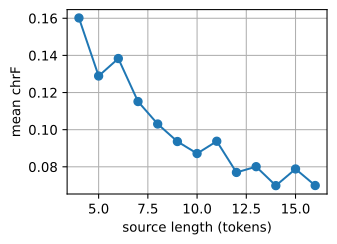
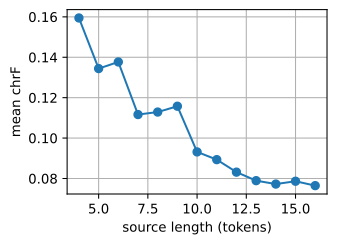
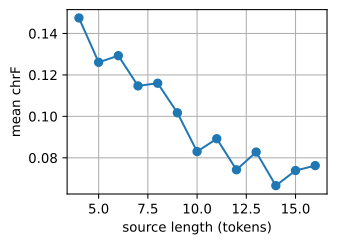
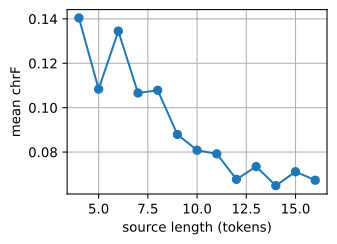
The curve slopes down: as the source grows, translation quality falls off, and it falls off precisely because the model must funnel more and more information through an unchanged \(\mathbf{c}\). This single bottleneck is where two large stories in this book began, and you have now read both. One escape lets the decoder look back at all the encoder’s per-step states instead of only the final one, choosing what to attend to at each step — that is attention (Chapter 10), born in 2014 as exactly this repair (Bahdanau et al. 2015), and its transformer descendants (Chapter 11) retired this model from production. The other keeps a single running state but makes it a far better memory, one that decides what to store and what to discard as it goes — the linear and selective state space models of Chapter 12. The same bottleneck, measured here on a fifty-line translator, motivated both.
18.1.6 Summary
Sequence transduction maps one variable-length sequence to another. The encoder-decoder abstraction handles it by compressing the source into a fixed-shape state with an encoder and expanding that state into the target with a decoder, which is a conditional language model. We built a concrete instance from two GRUs, trained on English-French pairs tokenized by a shared byte-level BPE, using teacher forcing and a masked loss that ignores padding. At inference the decoding strategies of Section 8.7 apply directly, from greedy to beam search, and we scored translations with chrF, the character-level metric that has displaced BLEU as the lexical default. The whole source passing through one fixed vector is a hard limit that degrades with sentence length, and escaping it, through attention or through better recurrent state, organizes everything that follows.
18.1.7 Exercises
- The dataset uses one shared vocabulary for both languages. Rebuild
MTFraEngwith two separate tokenizers, one per language, and compare training loss and translation quality. When would separate vocabularies help, and when hurt? - Sweep the beam width \(k \in \{1, 2, 4, 8, 16\}\) on the three example sentences and on a handful of longer held-out sentences. Where does quality stop improving, and why (recall the large-beam discussion of Section 8.7.3)?
d2l.beam_searchnormalizes scores by length raised to \(\alpha\). Decode with \(\alpha \in \{0, 0.75, 1.5\}\) and relate the lengths of the winning translations to Equation 8.7.3.- Rerun training with the masked loss replaced by a plain cross-entropy over all positions, padding included. What happens to the translations, and why?
- Replace the GRU with an LSTM (Section 12.1) in both encoder and decoder. Does translation quality change at this scale?
- Feed the context \(\mathbf{c}\) only at the first decoder step (as in Sutskever et al. (2014)) instead of at every step. How does that change the results, and why might repeating the context help a small model?
- Score the example translations with both
chrfandd2l.bleu. Construct a translation on which the two metrics most disagree, and explain the mechanism.