from collections import deque
requests = deque([5, 2, 7, 3]) # output tokens requested
capacity = 2
active, timeline = [], []
while requests or active:
while requests and len(active) < capacity:
active.append(requests.popleft())
timeline.append(tuple(active))
active = [remaining - 1 for remaining in active if remaining > 1]
timeline30.7 Model Serving
Training produces model parameters; serving exposes model inference to people or programs. Serving emphasizes latency distributions, concurrent request state, capacity planning, and operational controls. This section compares representative local and server engines as of mid-2026 and explains four recurring techniques: KV-cache management, continuous batching, prefix reuse, and quantization.
30.7.1 Know Your Workload
Two numbers govern interactive serving of autoregressive models: time to first token (TTFT), dominated by prefill — processing the prompt, a parallel, compute-bound pass — and time per output token (TPOT), dominated by decode — one token at a time, bandwidth-bound, as Section 30.4 quantified. Throughput (tokens per second across all users) trades against both.
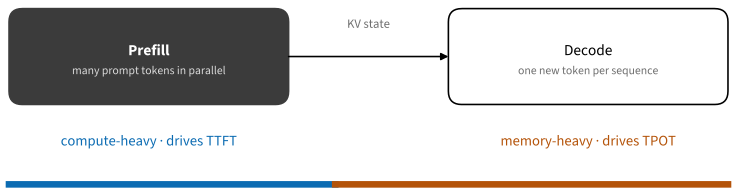
Which numbers matter depends on the workload, and the workload picks the tool:
| Workload | Optimize for | Start with |
|---|---|---|
| Personal assistant on your machine | simplicity, privacy | Ollama / LM Studio (llama.cpp), MLX on Macs |
| Offline batch scoring | throughput per dollar | vLLM offline mode |
| One application’s API | operability | vLLM behind a small authenticated proxy |
| Multi-user / agentic service | goodput under an SLO | vLLM or SGLang, then NVIDIA Dynamo at scale |
| Max throughput on fixed NVIDIA fleet | compiled kernels | TensorRT-LLM |
“Goodput” — completed requests that also met their latency target — is the production metric; overload can raise raw throughput while goodput collapses.
30.7.2 Serving on Your Own Machine
Many local inference tools use llama.cpp and its GGUF file format. Community repositories commonly publish GGUF conversions of open-weight models. Users often access llama.cpp through a wrapper:
- Ollama wraps it (plus an Apple-MLX backend) in a one-command experience —
ollama run qwen3:8bdownloads, caches, and serves a model with an OpenAI-compatible local API. It provides a low-configuration starting point for local use. - LM Studio offers the same engines behind a GUI, with per-layer GPU offload control — a graphical interface for users who prefer not to work in a terminal.
- MLX is Apple’s array framework; on M-series Macs,
mlx-lmis optimized for Apple silicon and has many pre-converted models on the Hub. Performance depends on the model and conversion.
Common GGUF quantizations include Q4_K_M (~4.5 bits/weight), Q5_K_M, and Q8_0. Higher-bit formats require more memory and usually retain model quality better, but the effect is model- and task-dependent and should be measured on the target workload. The rule of thumb follows the decode bound of Section 30.4: pick the largest model whose chosen quant fits your memory with room for the KV cache, then take the highest quant that still fits.
30.7.3 Serving as a Service
30.7.3.1 vLLM and SGLang
For an open-source GPU server, vLLM provides continuous batching, paged KV-cache management, prefix caching, tensor parallelism, quantized-model support, and an OpenAI-compatible server in one command:
vllm serve Qwen/Qwen3-8B --max-model-len 32768SGLang is its closest peer, distinguished by RadixAttention — a radix-tree KV cache shared across requests, which can improve reuse when many requests share long prefixes (chat with a system prompt, RAG over the same documents, agent trees). The DeepSeek ecosystem has used it for such workloads. Both projects evolve quickly and support multiple accelerator backends. Benchmark both with the target prompt-length and concurrency distributions before selecting one.
NVIDIA-specific tools trade portability for compiled optimizations. TensorRT-LLM compiles a model into optimized engines, which can improve steady-state serving at the cost of additional setup, while Dynamo orchestrates disaggregated prefill/decode and KV-aware routing across a fleet, wrapping vLLM, SGLang, or TensorRT-LLM as backends. These matter at datacenter scale; below it, they are complexity you do not need.
30.7.3.2 One Client Contract
Many of these tools implement the OpenAI chat-completions API, which serves as a common client contract — the same application code targets a local Ollama, your vLLM server, or a commercial provider by changing one URL:
from openai import OpenAI

client = OpenAI(base_url="http://127.0.0.1:8000/v1", api_key="local")
response = client.chat.completions.create(
    model="Qwen/Qwen3-8B",
    messages=[{"role": "user", "content": "Explain KV caching briefly."}],
    temperature=0,
)
print(response.choices[0].message.content)
“Compatible” is not “identical”: tokenization, sampling defaults, structured-output support, streaming behavior, and token accounting all vary. Keep a small conformance test and rerun it before swapping engines.
30.7.4 Why These Engines Are Fast
Four composable techniques explain much of serving-engine performance:
Continuous batching. A static batch waits for its slowest member. Continuous batching admits new requests and retires finished ones between decode steps, keeping the GPU full:
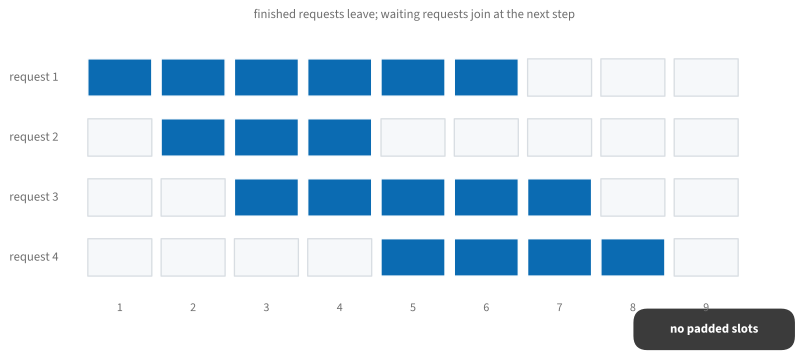
The toy scheduler below captures the idea in ten lines. The exercises extend it with arrival times and a memory budget:
[(5, 2), (4, 1), (3, 7), (2, 6), (1, 5), (4, 3), (3, 2), (2, 1), (1,)]Paged KV cache. Each active sequence’s key–value cache grows with its length; vLLM’s PagedAttention allocates it in fixed-size blocks, like virtual memory, eliminating the fragmentation that once capped batch sizes. Capacity planning follows: GPU memory must hold weights plus KV for every concurrent sequence. A model that fits for one request may therefore exceed memory under high concurrency.
Prefix caching. When two requests share a tokenized prefix (the same system prompt, the same document), its KV state can be computed once and reused:
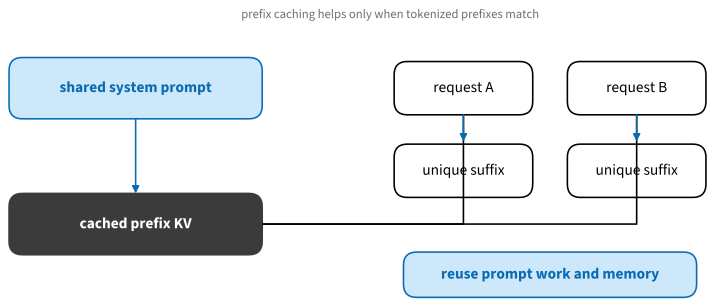
Some commercial APIs charge less for cached input tokens. Place shared, stable content before variable suffixes when the provider’s documented cache semantics support prefix reuse; prices and eligibility vary by provider.
Speculative decoding and quantization. A small draft model proposes several tokens; the target model verifies them in one parallel pass — potential decode speedups when acceptance is high, while preserving the target distribution under the algorithm’s sampling assumptions. Quantization reduces the bytes transferred during decode: fewer bytes per weight, more tokens per second. On recent datacenter GPUs, supported formats include FP8 on Hopper and NVFP4 on Blackwell, while vLLM and SGLang support AWQ for 4-bit weights; GGUF quants play the same role locally.
30.7.5 Operating Notes
A model behind a port is not yet a service. The short version of the production checklist: put authentication, TLS, and rate limits at a proxy in front of the engine (never expose the raw port); make admission control reject or queue before memory exhausts rather than OOM after; propagate client cancellations so abandoned generations stop burning compute; measure TTFT, TPOT, and end-to-end latency as p50/p95 distributions under realistic arrival patterns, not averages under a closed loop; avoid logging raw prompts by default; and pin model, tokenizer, quantization, and engine versions together — a faster server that answers differently is a different system, so gate rollouts on task quality as well as latency.
30.7.6 Summary
- Separate prefill (compute-bound, sets TTFT) from decode (bandwidth-bound, sets TPOT), and pick tools by workload: Ollama/LM Studio/MLX locally, vLLM or SGLang for services, TensorRT-LLM and Dynamo at NVIDIA-fleet scale.
- GGUF quantizations are common in local serving, while server engines support formats such as AWQ, FP8, and NVFP4; in both cases quantization converts bytes saved into tokens per second.
- Continuous batching, paged KV, prefix caching, and speculative decoding are four recurring serving optimizations — and prefix structure is something you control from the prompt side.
- The OpenAI-compatible API is the portable client contract; verify compatibility with your own conformance tests.
- Capacity is weights plus per-user KV; production means admission control, cancellation, percentile latencies, and pinned revisions.
30.7.7 Exercises
- Extend the toy scheduler with Poisson arrivals, a KV-memory budget, and rejection. Compare first-come-first-served against shortest-remaining-work on p95 TTFT.
- Serve the same 8B model through Ollama (Q4_K_M) and vLLM (AWQ) on whatever hardware you have, and measure TTFT and TPOT at concurrency 1, 4, and 16. Which engine performs better for each workload, and why?
- Estimate KV-cache bytes per token for a model whose config you know (layers × 2 × kv-heads × head-dim × bytes), then compute how many 8K-context users fit beside the weights on a 24 GB card.
- Design the cache-key policy for a service that reuses a long system prompt across users. What must be in the key, and what is the privacy obligation of caching at all?