import collections
import re
import tiktoken
from d2l import torch as d2l
import torch8.2 From Text to Tokens
The sequence models of this chapter will spend most of their time reading and writing text. Text poses a problem that the synthetic series of Section 8.1 did not: neural networks consume vectors of numbers, while text arrives as a string of characters. Before we can model language, we must decide how to carve a string into tokens, the atomic units that our models will treat as observations \(x_t\), and how to map each token to a numerical index. This choice determines the size of the model’s output layer, the effective length of every document it reads, and even which arithmetic problems it can solve. Every modern language model ships with a tokenizer, and the tokenizer is best thought of as part of the model.
We first compare character and word tokens, which occupy opposite ends of a vocabulary-size and sequence-length trade-off. We then represent text as raw bytes and learn a vocabulary from data with byte pair encoding (BPE), one of several widely deployed subword schemes (Sennrich et al. 2016; Radford et al. 2019). WordPiece and Unigram tokenization make different modeling choices. Our implementation also accepts the published GPT-2 merge table and reproduces the GPT-2 output of OpenAI’s tiktoken library token for token.
8.2.1 Reading the Dataset
Throughout the chapter we work with H. G. Wells’ The Time Machine, a novella of just over 30,000 words. Real corpora are measured in trillions of tokens, but this one is large enough to exhibit the statistics that matter and small enough to tokenize in seconds. The _download method reads the raw text into a single string.
import collections
import re
import tiktoken
from d2l import tensorflow as d2l
import tensorflow as tf
import collections
import re
import tiktoken
from d2l import jax as d2l
import jaximport collections
import re
import tiktoken
from d2l import mxnet as d2l
from mxnet import np, npx
npx.set_np()class TimeMachine(d2l.DataModule):
"""The Time Machine dataset."""
def _download(self):
fname = d2l.download(d2l.DATA_URL + 'timemachine.txt', self.root,
'090b5e7e70c295757f55df93cb0a180b9691891a')
with open(fname) as f:
return f.read()
data = TimeMachine()
raw_text = data._download()
raw_text[:60]'The Time Machine, by H. G. Wells [1898]\n\n\n\n\nI\n\n\nThe Time Tra'Classical preprocessing pipelines aggressively normalized text of this kind: they stripped punctuation, folded everything to lowercase, and only then split it into units. We keep such a step around, both because it simplifies the character- and word-level experiments below and because several later sections reuse it, but note its cost. Normalization throws away information (capitalization distinguishes “Bill” from “bill”) and it already commits us to decisions about what a token may look like. The byte-level tokenizer we build later in this section needs no normalization at all.
@d2l.add_to_class(TimeMachine)
def _preprocess(self, text):
    return re.sub('[^A-Za-z]+', ' ', text).lower()

text = data._preprocess(raw_text)
text[:60]
'the time machine by h g wells i the time traveller for so it'8.2.2 Characters, Words, and Bytes
8.2.2.1 Two Ends of a Spectrum
Tokens are the indivisible units that a sequence model reads, one per time step. The two schemes that suggest themselves immediately are characters and words, and it is instructive to try both.
@d2l.add_to_class(TimeMachine)
def _tokenize(self, text):
    return list(text)

tokens = data._tokenize(text)
','.join(tokens[:30])
't,h,e, ,t,i,m,e, ,m,a,c,h,i,n,e, ,b,y, ,h, ,g, ,w,e,l,l,s, 'Splitting on whitespace instead yields word tokens. Comparing the two schemes on our corpus makes the trade-off concrete: we count the number of distinct token values (the vocabulary a model must handle) and the total number of tokens (the length of the sequence a model must process).
words = text.split()
print(f'characters: {len(set(tokens)):>6} distinct, '
      f'{len(tokens):>7} tokens in the corpus')
print(f'words:      {len(set(words)):>6} distinct, '
      f'{len(words):>7} tokens in the corpus')
characters: 27 distinct, 173428 tokens in the corpus
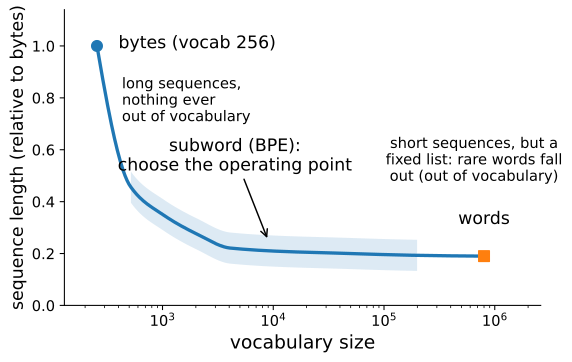
words: 4579 distinct, 32775 tokens in the corpusCharacter tokenization needs a vocabulary of a few dozen symbols and can represent any input, but it stretches the corpus to some 170,000 time steps, and every long-range relationship (say, between a subject and its verb) must be carried across dozens of steps. Word tokenization compresses the same text into a fifth as many tokens, each far more meaningful, but already on this small corpus it produces thousands of distinct types, and the vocabulary keeps growing with the corpus: every name, typo, and inflection (“traveller”, “travellers”, “travelled”) claims its own slot. Worse, any word not seen during training is simply out of vocabulary (OOV) at test time. Figure 8.2.1 places the two schemes on a common axis: vocabulary size buys shorter sequences, and the interesting question is where between the extremes to sit. Subword tokenizers, to which we now turn, let us choose that operating point freely.
8.2.2.2 Text as Bytes
Before we can interpolate between characters and words we need a base alphabet that is truly universal. “Characters” are shakier ground than they appear: Unicode defines around 150,000 of them, covering scripts, accents, and emoji, so a character-level vocabulary is not small at all once we leave English. The fix used by modern tokenizers is to go one level lower. Every string your computer stores is ultimately a sequence of bytes under some encoding, almost always UTF-8. A byte holds one of \(2^8 = 256\) values, so a byte-level model needs a base vocabulary of exactly 256 symbols, and no input can ever be out of vocabulary: any string, in any language, with any typo, is some sequence of bytes.
UTF-8 is a variable-length code: it spends one byte on ASCII characters and up to four on rarer ones.
s = 'Hello, naïve café: 你好 🚀'
print(len(s), 'characters,', len(s.encode('utf-8')), 'bytes')
for ch in 'a é 你 🚀'.split():
    print(repr(ch), '->', list(ch.encode('utf-8')))
23 characters, 32 bytes
'a' -> [97]
'é' -> [195, 169]
'你' -> [228, 189, 160]
'🚀' -> [240, 159, 154, 128]The price of universality is length. English text costs about one byte per character, but the accented “é” costs two, the Chinese character three, and the emoji four: raw bytes stretch non-English text even further than they stretch English. How many tokens a tokenizer spends per word of a language is called its fertility, and we will measure it at the end of this section. Keep this cost in mind: everything that follows is an attempt to keep the universality of bytes while clawing back the length.
8.2.3 Byte Pair Encoding
8.2.3.1 The Merge Rule
Byte pair encoding starts from the 256 byte symbols and grows the vocabulary greedily: count how often each pair of adjacent tokens occurs in the training corpus, merge the most frequent pair into a single new token, and repeat until the vocabulary reaches a target size (Sennrich et al. 2016). Each merge shortens the corpus by the number of occurrences it collapses, so BPE is a greedy compression algorithm, and its vocabulary is a learned dictionary of the corpus’s most common fragments.
The algorithm is best seen once in slow motion. Take the toy corpus below, five distinct words in eight occurrences:
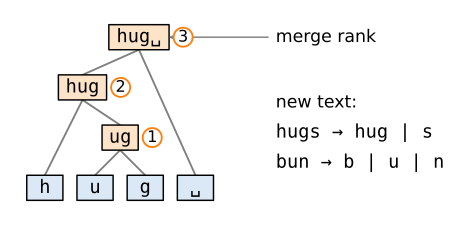
hug pug pun bun hugs hug hug pugThe corpus is 32 bytes long. The most frequent adjacent pair is (u, g), which occurs six times (in “hug”, “pug”, and “hugs”), so the first merge creates the token ug. After replacing every occurrence, the most frequent pair is (h, ug), and so on:
| step | most frequent pair | count | new token | corpus length |
|---|---|---|---|---|
| 0 | (start from bytes) | 32 | ||
| 1 | u, g |
6 | ug |
26 |
| 2 | h, ug |
4 | hug |
22 |
| 3 | hug, ' ' |
3 | 'hug ' |
19 |
Two things are worth noticing. First, merges compose: the token hug is built on top of ug, so the learned vocabulary forms a merge tree over the byte alphabet (Figure 8.2.2), and any new text can be retokenized by replaying the same merges. The word “hugs”, for instance, becomes the two tokens hug and s; the rare word “bun” stays as three raw bytes. Nothing is ever out of vocabulary, because unmergeable input simply falls back to bytes. Second, the third merge already glued a word to the space that follows it: nothing stops BPE from merging across word boundaries. Hold that thought; it becomes a real problem on a real corpus.
8.2.3.2 Implementation
The trainer below implements exactly the loop we just traced. Token ids 0 through 255 denote raw bytes; each learned merge gets the next free id, so ids double as merge ranks: a smaller id means the merge was learned earlier. The optional pattern and specials arguments will be explained shortly; both defaults are harmless for now. Note that we import regex, a drop-in extension of Python’s re whose Unicode character classes (such as \p{L} for “any letter”) we will need for pre-tokenization.
import regex

class BPETokenizer:
    """Byte-level BPE tokenizer trained by iterated most-frequent-pair
    merges.

    Token ids 0..255 are raw bytes; learned merges get ids
    256..vocab_size-1; special tokens sit above those and are never
    produced by BPE itself. `pattern` is an optional pre-tokenization
    regex: text is split into chunks and merges never cross chunk
    boundaries.
    """

    GPT2_PATTERN = (r"'s|'t|'re|'ve|'m|'ll|'d| ?\p{L}+| ?\p{N}+"
                    r"| ?[^\s\p{L}\p{N}]+|\s+(?!\S)|\s+")

    def __init__(self, vocab_size=1024, pattern=None,
                 specials=('<pad>', '<bos>', '<eos>')):
        self.vocab_size, self.pattern = vocab_size, pattern
        self.merges = {}                                  # (id, id) -> new id
        self.vocab = {i: bytes([i]) for i in range(256)}  # id -> bytes
        self.byte_ids = list(range(256))                  # byte value -> id
        self.specials = {s: vocab_size + i for i, s in enumerate(specials)}

    def __len__(self):
        return self.vocab_size + len(self.specials)

    @property
    def pad(self):
        return self.specials['<pad>']

    @property
    def bos(self):
        return self.specials['<bos>']

    @property
    def eos(self):
        return self.specials['<eos>']

    def _chunks(self, text):
        return [text] if self.pattern is None else regex.findall(
            self.pattern, text)

    def _merge(self, ids, pair, new_id):
        """Replace every occurrence of pair in ids by new_id."""
        out, i = [], 0
        while i < len(ids):
            try:  # list.index scans for the next candidate at C speed
                j = ids.index(pair[0], i)
            except ValueError:
                j = len(ids)
            out.extend(ids[i:j])
            if j < len(ids) - 1 and ids[j + 1] == pair[1]:
                out.append(new_id)
                i = j + 2
            elif j < len(ids):
                out.append(ids[j])
                i = j + 1
            else:
                i = j
        return out

    def train(self, text):
        """Learn vocab_size - 256 merges, most frequent pair first."""
        chunk_freq = collections.Counter(self._chunks(text))
        seqs = [list(chunk.encode('utf-8')) for chunk in chunk_freq]
        for new_id in range(256, self.vocab_size):
            pairs = collections.Counter()
            for seq, w in zip(seqs, chunk_freq.values()):
                if w == 1:  # Counter.update counts at C speed
                    pairs.update(zip(seq, seq[1:]))
                else:  # weight pair counts by chunk frequency
                    for pair in zip(seq, seq[1:]):
                        pairs[pair] += w
            if not pairs:
                break  # nothing left to merge
            pair = max(pairs, key=pairs.get)
            self.merges[pair] = new_id
            self.vocab[new_id] = self.vocab[pair[0]] + self.vocab[pair[1]]
            seqs = [self._merge(seq, pair, new_id) for seq in seqs]
A few implementation notes. Training deduplicates identical chunks and weights their pair counts by frequency; without a pre-tokenization pattern there is a single chunk (the whole corpus), so this costs nothing, and with one it makes training roughly tenfold faster. Production trainers further update pair counts incrementally around each merge site rather than recounting; we recount for clarity. Training on our toy corpus reproduces the hand trace:
toy_tok = BPETokenizer(vocab_size=256 + 3)
toy_tok.train('hug pug pun bun hugs hug hug pug')
for (a, b), new_id in toy_tok.merges.items():
    print(f'{toy_tok.vocab[a]} + {toy_tok.vocab[b]} -> '
          f'{toy_tok.vocab[new_id]}')
b'u' + b'g' -> b'ug'
b'h' + b'ug' -> b'hug'
b'hug' + b' ' -> b'hug '8.2.3.3 Encoding and Decoding
Training produced a merge table. To encode new text we replay merges on its bytes: repeatedly find the adjacent pair with the lowest merge rank and merge it, until no adjacent pair is in the table. Because ranks are consulted rather than corpus statistics, encoding is a pure function of the merge table: the tokenizer is defined by its merge ranks, and training time and inference time agree by construction. Decoding is trivial, since every token id maps to a byte string; we concatenate and decode as UTF-8. (A generation model can emit ids whose bytes do not align with character boundaries, so we ask Python to replace, rather than reject, malformed fragments.)
@d2l.add_to_class(BPETokenizer)
def _encode_chunk(self, text_bytes):
    ids = [self.byte_ids[b] for b in text_bytes]
    while len(ids) > 1:
        # The lowest-rank merge applicable anywhere in this chunk
        pair = min(zip(ids, ids[1:]),
                   key=lambda p: self.merges.get(p, float('inf')))
        if pair not in self.merges:
            break
        ids = self._merge(ids, pair, self.merges[pair])
    return ids

@d2l.add_to_class(BPETokenizer)
def encode(self, text, allow_special=False):
    if allow_special and self.specials:
        pat = '(' + '|'.join(regex.escape(s) for s in self.specials) + ')'
        ids = []
        for part in regex.split(pat, text):
            if part in self.specials:
                ids.append(self.specials[part])
            elif part:
                ids.extend(self.encode(part))
        return ids
    return [i for chunk in self._chunks(text)
            for i in self._encode_chunk(chunk.encode('utf-8'))]

@d2l.add_to_class(BPETokenizer)
def decode(self, ids):
    specials = {i: s.encode('utf-8') for s, i in self.specials.items()}
    data = b''.join(self.vocab[i] if i in self.vocab else specials[i]
                    for i in ids)
    return data.decode('utf-8', errors='replace')
On the toy tokenizer, encoding behaves as promised: frequent fragments become single tokens, rare ones fall back toward bytes, and decoding inverts encoding exactly.
print([toy_tok.vocab[i] for i in toy_tok.encode('hugs')])
print([toy_tok.vocab[i] for i in toy_tok.encode('bun')])
toy_tok.decode(toy_tok.encode('hug pug hugs'))
[b'hug', b's']
[b'b', b'u', b'n']'hug pug hugs'8.2.3.4 Training on The Time Machine
Token lists and, later in the chapter, generated text run wider than a printed page. One utility folds them, and we reach for it throughout the rest of the book whenever output would otherwise run off the margin.
import textwrap

def print_wrapped(*args, width=76):
    """Print like `print`, folding each line to the width of a page."""
    for line in ' '.join(str(a) for a in args).split('\n'):
        print(textwrap.fill(line, width, subsequent_indent='    '))
Now the real thing: we train a 1,024-token vocabulary on the raw, unnormalized novella. The first merges are humble letter pairs; by the end of training the tokenizer has discovered whole words of Wells’ prose. Look closely at the encoded sample, though: one of its “tokens” is the two-word composite “Time Traveller”, spaces included. We will return to that.
tok = BPETokenizer(vocab_size=1024)
tok.train(raw_text)
merged_ids = list(tok.merges.values())
print('first:', [tok.vocab[i] for i in merged_ids[:8]])
print('last: ', [tok.vocab[i] for i in merged_ids[-8:]])
ids = tok.encode('The Time Traveller smiled. Are you sure?')
print_wrapped(len(ids), 'tokens:', [tok.vocab[i] for i in ids])
first: [b'e ', b'th', b'd ', b'in', b't ', b's ', b'an', b'er']
last: [b'appe', b'vo', b'ering ', b'too ', b'door', b'acro', b'clo', b'after ']
13 tokens: [b'The ', b'Time Traveller ', b's', b'mi', b'le', b'd', b'. A',
b'r', b'e ', b'you ', b'su', b're', b'?']How much does a bigger vocabulary buy? Because ids are assigned in rank order, a BPE tokenizer with a smaller vocabulary is literally a prefix of a larger one trained on the same corpus: keeping only the merges with id below \(v\) recovers exactly the tokenizer we would have gotten by stopping training at vocabulary size \(v\). We exploit this to sweep the vocabulary size from 256 to 4,096 with a single training run, measuring compression in bytes per token on an excerpt.
big = BPETokenizer(vocab_size=4096)
big.train(raw_text)
excerpt = raw_text[:10000]
sizes = [256, 384, 512, 768, 1024, 1536, 2048, 3072, 4096]
ratios = []
for v in sizes:
    sub = BPETokenizer(vocab_size=v)  # the first v - 256 merges of big
    sub.merges = {p: i for p, i in big.merges.items() if i < v}
    sub.vocab = {i: b for i, b in big.vocab.items() if i < v}
    ratios.append(len(excerpt.encode('utf-8')) / len(sub.encode(excerpt)))
d2l.plot(sizes, [ratios], 'vocabulary size', 'bytes per token',
         xscale='log')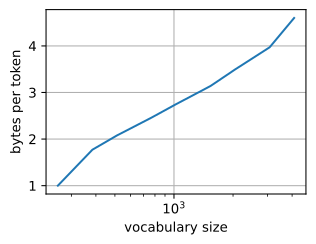
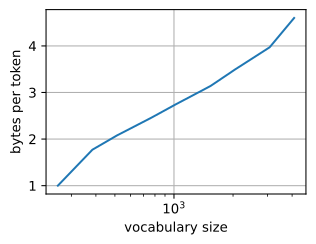
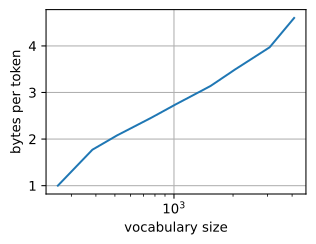
Each doubling of the vocabulary buys a roughly constant increment of compression: bytes per token grows only logarithmically in vocabulary size. That is the greedy dynamic at work. Early merges (“e”, “th”, “d”) each save thousands of occurrences, while the 4,000th merge saves a handful, so returns per merge fall off relentlessly. This also explains why production vocabularies of 50,000 to 200,000 tokens are not dramatically deeper into the curve: on English prose they land around four to five bytes per token, roughly one token per word, as we will measure below. Their extra slots mostly buy compression of other languages, to which we also return.
8.2.3.5 Pre-Tokenization: Telling BPE Where Words End
Look at what our unconstrained tokenizer actually learned, though. Alongside sensible word fragments, its vocabulary is peppered with tokens that straddle word boundaries:
crossers = [v.decode('utf-8', 'replace') for i, v in tok.vocab.items()
            if i >= 256 and b' ' in v.strip(b' ')]
print_wrapped(len(crossers), 'tokens cross a word boundary, e.g.',
              crossers[:8])
78 tokens cross a word boundary, e.g. [', and ', 'of the ', '. I ', '. Th',
'. A', '. I', 'in the ', 'ed to ']Merges like “of the” compress the training corpus, but they are brittle composites: they burn vocabulary slots on specific phrase spellings, fragment the counts of the words they contain (“of” now appears in many disguises), and generalize poorly to new text. Every production tokenizer therefore adds one ingredient we have so far omitted: pre-tokenization. The text is first split into chunks with a regular expression, and BPE is trained, and applied, strictly within chunks, so no merge can cross a chunk boundary. The pattern used by GPT-2 (Radford et al. 2019), kept as BPETokenizer.GPT2_PATTERN, is worth reading once:
's|'t|'re|'ve|'m|'ll|'d        common English contractions, split off
| ?\p{L}+                      a run of letters, with its leading space
| ?\p{N}+                      a run of digits, with its leading space
| ?[^\s\p{L}\p{N}]+            a run of punctuation or other symbols
|\s+(?!\S)|\s+                 remaining whitespace
Note the design decisions embedded here. A word’s leading space is kept attached to it (” the” rather than “the”), so a word carries its own separation from the previous one; letters, digits, and punctuation are segregated, so numbers and symbols never fuse with words; contractions split into meaningful units. Later OpenAI tokenizers refine the digit rule further, capping digit runs at three, a detail whose surprising consequences we examine shortly.
regex.findall(BPETokenizer.GPT2_PATTERN,
              "The traveller's clock struck 12,345 times.")
['The',
' traveller',
"'s",
' clock',
' struck',
' 12',
',',
'345',
' times',
'.']Training with the pattern is a one-argument change (Figure 8.2.3 shows the resulting pipeline end to end), and comparing the learned vocabulary against the unconstrained run shows exactly the repair we hoped for: boundary-crossing composites disappear and their slots are spent on genuine words instead.
bpe = BPETokenizer(vocab_size=1024, pattern=BPETokenizer.GPT2_PATTERN)
bpe.train(raw_text)
crossers = [v for i, v in bpe.vocab.items()
            if i >= 256 and b' ' in v.strip(b' ')]
print('boundary-crossing tokens now:', len(crossers))
gained = sorted(set(bpe.vocab.values()) - set(tok.vocab.values()),
                key=lambda v: (-len(v), v))
print_wrapped('longest tokens gained instead:',
              [v.decode('utf-8', 'replace') for v in gained[:6]])
boundary-crossing tokens now: 0
longest tokens gained instead: [' Psychologist', 'sychologist', '
Traveller', ' Morlocks', ' darkness', ' Machine']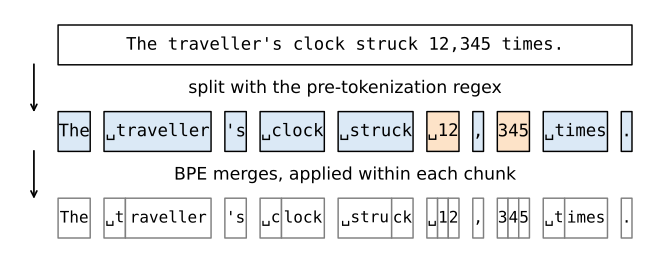
8.2.4 Vocabularies and Special Tokens
8.2.4.1 From Tokens to Indices
For the character- and word-level pipelines that some later sections still use, we need a component already supplied by BPE: a vocabulary object that assigns each distinct token string an index and maps unknown tokens to a reserved <unk> slot. Rare tokens (below min_freq occurrences) can be dropped to keep the table small; needing to do so at all is precisely the OOV problem that byte-level BPE eliminates.
class Vocab:
    """Vocabulary for text."""
    def __init__(self, tokens=[], min_freq=0, reserved_tokens=[]):
        # Flatten a 2D list if needed
        if tokens and isinstance(tokens[0], list):
            tokens = [token for line in tokens for token in line]
        # Count token frequencies
        counter = collections.Counter(tokens)
        self.token_freqs = sorted(counter.items(), key=lambda x: x[1],
                                  reverse=True)
        # The list of unique tokens, ordered by descending frequency.
        # Reserve <unk> at index 0 so vocab[0] is the unknown token.
        self.idx_to_token = ['<unk>'] + reserved_tokens + [
            token for token, freq in self.token_freqs
            if freq >= min_freq and token not in reserved_tokens]
        self.token_to_idx = {token: idx
                             for idx, token in enumerate(self.idx_to_token)}

    def __len__(self):
        return len(self.idx_to_token)

    def __getitem__(self, tokens):
        if not isinstance(tokens, (list, tuple)):
            return self.token_to_idx.get(tokens, self.unk)
        return [self.__getitem__(token) for token in tokens]

    def to_tokens(self, indices):
        if hasattr(indices, '__len__') and len(indices) > 1:
            return [self.idx_to_token[int(index)] for index in indices]
        return self.idx_to_token[indices]

    @property
    def unk(self):  # Index for the unknown token
        return self.token_to_idx['<unk>']
vocab = Vocab(tokens)
indices = vocab[tokens[:10]]
print('indices:', indices)
print('tokens:', vocab.to_tokens(indices))indices: [3, 9, 2, 1, 3, 5, 13, 2, 1, 13]
tokens: ['t', 'h', 'e', ' ', 't', 'i', 'm', 'e', ' ', 'm']The build convenience method packages the whole classical pipeline, preprocess, tokenize, and index, returning a corpus of ids and its vocabulary; several later sections call it.
@d2l.add_to_class(TimeMachine)
def build(self, raw_text, vocab=None):
    tokens = self._tokenize(self._preprocess(raw_text))
    if vocab is None: vocab = Vocab(tokens)
    corpus = [vocab[token] for token in tokens]
    return corpus, vocab

corpus, vocab = data.build(raw_text)
len(corpus), len(vocab)
(173428, 28)8.2.4.2 Special Tokens
Training pipelines need a handful of tokens that mean something to the infrastructure rather than to the text: <pad> fills the unused tail of short sequences in a batch, <bos> marks the beginning of a sequence, and <eos> lets a model declare that generation is finished. (The encoder-decoder models of Section 18.1.2 will use all three.) Our BPETokenizer assigns these ids above the BPE range, and this is a deliberate safety property, not a convenience: a special token must never be producible by encoding ordinary text. If it were, any document that happened to contain the string “<eos>” could inject a control signal into the model’s input, a cousin of the prompt-injection attacks that plague deployed LLM systems. Our encode therefore treats special strings in ordinary text as plain bytes unless the caller explicitly opts in with allow_special=True; tiktoken implements the same guard with its allowed_special argument and raises an error by default.
print('as plain text:  ', bpe.encode('<bos>the time machine'))
print('as control code:', bpe.encode('<bos>the time machine',
                                     allow_special=True))
print('pad/bos/eos ids:', bpe.pad, bpe.bos, bpe.eos, '| len:', len(bpe))
as plain text: [60, 98, 111, 115, 62, 341, 513, 680]
as control code: [1025, 341, 513, 680]
pad/bos/eos ids: 1024 1025 1026 | len: 10278.2.5 Tokenizers in the Wild
8.2.5.1 What a Production Tokenizer Stores
GPT-2’s tokenizer is specified by a mergeable-rank table, a byte-to-symbol mapping, a pre-tokenization pattern, and special-token rules. It has no neural network at inference time. Other tokenizer families may additionally store normalization rules or a probabilistic segmentation model. We inspect the GPT-2 rank table around the byte boundary below; the leading underscore on _mergeable_ranks marks this as a version-sensitive private API.
enc = tiktoken.get_encoding('gpt2')
print(list(enc._mergeable_ranks.items())[254:260])
print(enc._special_tokens)
[(b'\xa0', 254), (b'\xad', 255), (b' t', 256), (b' a', 257), (b'he', 258), (b'in', 259)]
{'<|endoftext|>': 50256}The first 256 ranks are the single bytes (in a permuted order: GPT-2 lists printable characters first), and rank 256 onward are learned merges in rank order, exactly the structure our BPETokenizer uses. Amusingly, GPT-2’s first two merges, learned from 40 gigabytes of web text, are ” t” and ” a”, among the very first our tokenizer learned from one Victorian novella: the head of the English fragment distribution is that stable.
8.2.5.2 Verifying Our Implementation
Since the artifact is just a rank table, we can load GPT-2’s published table into our encoder: ranks become our token ids, the 256 single-byte entries give the byte permutation, and each multi-byte token’s parents are recovered by re-running BPE on its own bytes with all strictly lower-ranked merges (a token’s two parents are whatever its bytes merge into just before its own rank applies).
@d2l.add_to_class(BPETokenizer)
@classmethod
def from_tiktoken(cls, name):
    """Load a published bytes->rank table (e.g. 'gpt2') into our encoder."""
    import tiktoken  # lazy: d2l itself does not require tiktoken
    enc = tiktoken.get_encoding(name)
    ranks = enc._mergeable_ranks
    tok = cls(vocab_size=len(ranks), pattern=enc._pat_str, specials=())
    tok.specials = dict(enc._special_tokens)
    tok.vocab = {rank: b for b, rank in ranks.items()}
    tok.byte_ids = [ranks[bytes([b])] for b in range(256)]
    for token, rank in ranks.items():
        if len(token) > 1:  # recover which pair merged into this token
            parts = [bytes([b]) for b in token]
            while len(parts) > 2:
                a, b = min(zip(parts, parts[1:]),
                           key=lambda p: ranks.get(p[0] + p[1],
                                                   float('inf')))
                i = list(zip(parts, parts[1:])).index((a, b))
                parts[i:i + 2] = [a + b]
            tok.merges[ranks[parts[0]], ranks[parts[1]]] = rank
    return tok
The moment of truth: on a paragraph mixing prose, numbers, accents, and an emoji, our from-scratch encoder must reproduce tiktoken’s output token for token. It does; the assert below runs, and passes, every time this book is built.
ours = BPETokenizer.from_tiktoken('gpt2')
para = ('The Time Traveller (for so it will be convenient to speak of '
        'him) was expounding a recondite matter to us; his pale grey '
        'eyes shone and twinkled. Prices rose 3.5% in 1895, and naïve '
        'café patrons paid £12,345 more! 🚀')
assert ours.encode(para) == enc.encode(para)
print(len(ours.encode(para)), 'tokens, identical to tiktoken')
print([ours.vocab[i].decode('utf-8', 'replace')
       for i in ours.encode(para)[:8]])
60 tokens, identical to tiktoken
['The', ' Time', ' Trave', 'ller', ' (', 'for', ' so', ' it']How do vocabularies across the generations compare on our corpus? We pit our 1,024-token Time Machine tokenizer against GPT-2’s 50,257 and o200k_base (the roughly 200,000-token vocabulary used by GPT-4o-era models).
n_bytes = len(raw_text.encode('utf-8'))
rows = [('ours (1k, in-domain)', len(bpe.encode(raw_text)))]
for name in ('gpt2', 'o200k_base'):
    e = tiktoken.get_encoding(name)
    rows.append((f'{name} ({len(e._mergeable_ranks) // 1000}k)',
                 len(e.encode(raw_text))))
for name, n in rows:
    print(f'{name:>22}: {n:>6} tokens, {n_bytes / n:.2f} bytes/token')
ours (1k, in-domain): 65741 tokens, 2.72 bytes/token
gpt2 (50k): 44073 tokens, 4.06 bytes/token
o200k_base (199k): 42624 tokens, 4.20 bytes/tokenToken counts fall as vocabularies grow, but note how well our tiny tokenizer holds up: trained on exactly this distribution, it achieves two thirds the compression of tokenizers fifty and two hundred times its size. A tokenizer is a compression model of its training corpus, and like any model it performs best in domain. The flip side is that mismatch costs context budget: text that is cheap for one tokenizer can be expensive for another, which brings us to the pathologies.
8.2.5.3 Fertility, Digits, and Glitch Tokens
Fertility, the average number of tokens per word, measures that mismatch across languages. GPT-2’s tokenizer was trained on overwhelmingly English text; the same short sentence, translated, costs dramatically different amounts of context:
sentences = {
    'English': 'The time traveller returned after many years.',
    'German': 'Der Zeitreisende kehrte nach vielen Jahren zurück.',
    'Greek': 'Ο ταξιδιώτης του χρόνου επέστρεψε μετά από πολλά χρόνια.'}
fert = {lang: [len(tiktoken.get_encoding(e).encode(s)) / len(s.split())
               for e in ('gpt2', 'o200k_base')]
        for lang, s in sentences.items()}
d2l.set_figsize((5, 3))
xs = range(len(fert))
d2l.plt.bar([x - 0.2 for x in xs], [v[0] for v in fert.values()],
            0.4, label='gpt2 (50k)')
d2l.plt.bar([x + 0.2 for x in xs], [v[1] for v in fert.values()],
            0.4, label='o200k_base (200k)')
d2l.plt.xticks(list(xs), list(fert))
d2l.plt.ylabel('tokens per word')
d2l.plt.legend();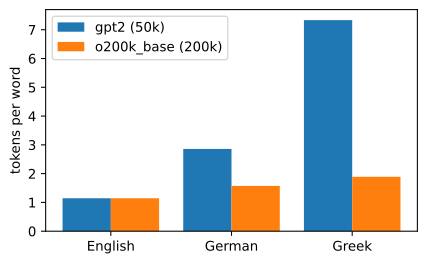
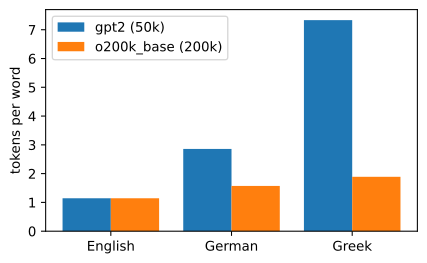
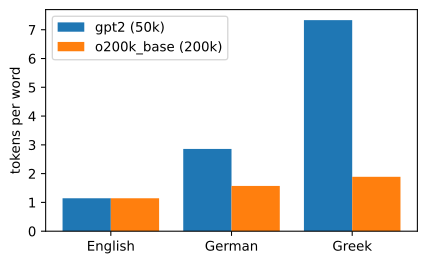
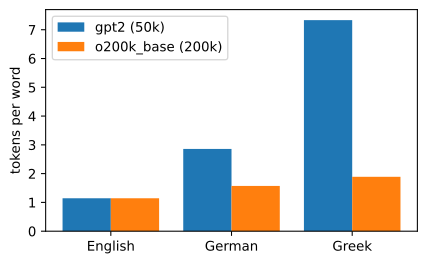
Under GPT-2’s tokenizer a Greek word costs about seven tokens (Greek letters are two UTF-8 bytes each, and almost no Greek merges were learned), while an English word costs about one: the same context window holds seven times less Greek than English, and every Greek word must be “spelled out” byte by byte. The multilingually trained o200k_base narrows the gap to about two.
Digits show how sensitive model behavior is to tokenization minutiae. GPT-2 lets BPE carve numbers by corpus frequency, so digit strings split into irregular, frequency-dependent pieces; modern tokenizers cap digit runs at three in pre-tokenization, making token boundaries at least predictable:
for name in ('gpt2', 'o200k_base'):
    e = tiktoken.get_encoding(name)
    print(f'{name}: 12345678 ->',
          [e.decode([t]) for t in e.encode('12345678')])
gpt2: 12345678 -> ['123', '45', '678']
o200k_base: 12345678 -> ['123', '456', '78']Neither scheme aligns token boundaries with the columns of arithmetic: grade-school addition works right to left in ones, tens, and hundreds, while “12345678” tokenizes left to right into “123 456 78”. A model must learn arithmetic over these misaligned chunks, one reason why LLM arithmetic is brittle and why asking a model to insert separators (“12,345,678”) often helps. The exercises pursue this.
Finally, a cautionary tale about trusting the tokenizer’s training data. Early GPT-2/GPT-3 vocabularies contained tokens such as ” SolidGoldMagikarp”, single tokens for strings (here, a Reddit username) that were frequent in the tokenizer’s training corpus but were later filtered out of the language model’s training corpus. The result is a so-called glitch token: it occupies a vocabulary slot, so a prompt can contain it, yet the model has essentially never seen it during training and its embedding is close to its random initialization. Models asked to repeat such tokens have produced evasions, insults, and unrelated words instead. The lesson generalizes: the tokenizer is part of the model, and a vocabulary entry is only as meaningful as the model’s training exposure to it.
enc.encode(' SolidGoldMagikarp') # one token for an 18-character string[43453]8.2.6 Summary
Tokenization converts raw text into the integer sequences that sequence models consume, and it embodies a trade-off: larger vocabularies encode the same text in fewer tokens but cost more parameters, more data to estimate them, and, for word-level schemes, an out-of-vocabulary failure mode. Byte-level BPE resolves the tension by starting from the 256 bytes (so no input is ever out of vocabulary) and greedily merging the most frequent adjacent pair to build a learned vocabulary of frequent fragments; encoding replays merges by rank, so the merge table is the tokenizer. Pre-tokenization regexes confine merges to within words, and special tokens live outside the BPE range so that untrusted text can never forge them. Production tokenizers such as tiktoken’s are exactly this construction at scale, as we verified by reproducing GPT-2’s tokenization token for token, and their fingerprints (fertility differences across languages, digit chunking, glitch tokens) are visible in the behavior of every deployed language model. Section 8.3 takes up the statistics of the token sequences we have just produced, and what it takes to model them.
8.2.7 Exercises
- Encoding by rank. Suppose a
BPETokenizerwithvocab_size=258has learned exactly two merges: (b,c) with id 256, and then (a,b) with id 257. The rank rule of_encode_chunkalways applies the lowest-ranked applicable merge. The leftmost rule always merges the leftmost adjacent pair that appears in the merge table.- Segment the string “abc” under each of the two rules.
- Give the segmentation that every occurrence of “abc” in the training corpus had at the end of training, and say which rule agrees with it.
- Rank replay. ● Argue that, for any merge table learned by
BPETokenizer.train, the rank rule of_encode_chunkreproduces the end-of-training segmentation of every chunk of the training corpus. - [code] Cross-corpus compression. Train a
BPETokenizerwith a 1,024-token vocabulary andBPETokenizer.GPT2_PATTERNon a different text of your choice, such as another public-domain book, your own notes, or source code.- Compute the fraction of its first 100 merged tokens, and of its last 100, that are also tokens of
bpe. Explain the difference between the two fractions. - Measure bytes per token of your tokenizer on The Time Machine and of
bpeon your corpus, and compare both with the in-domain figures.
- Compute the fraction of its first 100 merged tokens, and of its last 100, that are also tokens of
- [code] Pre-tokenization ablation. ● Split
raw_textinto its first 90% and its last 10%. On the first part, train two 4,096-token tokenizers that differ only in the pattern: one without a pattern, asbigwas trained, and one withBPETokenizer.GPT2_PATTERN.- List the 20 longest tokens learned by each tokenizer, and mark those that span more than one word.
- Measure which of the two compresses the first part better, and explain the outcome in terms of the merge rule.
- Measure bytes per token of both tokenizers on the last 10%. Which tokenizer loses the larger fraction of its compression on this held-out text, and which compresses it better? Relate both answers to the tokens you listed.
- [code] Special-token round trip. Section 8.2.4.2 places special tokens above the BPE id range so that ordinary text can never produce them. Construct a
BPETokenizerwhosespecialsadd a document separator<sep>to the three defaults, and train it onraw_text. Letxbe two short documents joined by<sep>.- Encode
xonce with and once withoutallow_special=True, and check that both id sequences decode tox. - Re-encode the decoded text once with
allow_special=Trueand once without it. Which of the two id sequences from the previous sub-problem does each re-encoding reproduce? State what this implies for a pipeline that decodes a model’s output and later feeds the text back in as input. tiktokenraises an error when a special string appears in text that is not allowed to contain it, whereasencodetreats the string as plain bytes. Give one situation in which each policy is preferable.
- Encode
- [code] Digit chunking. Tokenize the addition prompts “1234+5678=”, “1234+567=” and “567+678=” and their sums “6912”, “1801” and “1245” with the
gpt2ando200k_baseencodings oftiktoken, writing out the token boundaries of each number.- Under the three-digit cap of
o200k_base, label each digit token with the place values (ones, tens, hundreds, thousands) it covers. For each prompt, state whether the tokens at matching positions of the two summands and of the sum cover the same place values. Explain what goes wrong for a model that adds token by token when they do not. - Propose a pre-tokenization rule that aligns tokens with place value, and state one drawback of your rule.
- Under the three-digit cap of
- Glitch tokens. Section 8.2.5.3 attributes a glitch token to a string that was frequent in the tokenizer’s training corpus but absent from the language model’s.
- Why does the merge rule of
BPETokenizer.trainturn such a string into a single token rather than several fragments, and what role does pre-tokenization play in fixing the token’s extent? - Propose a test that flags glitch tokens given the trained embedding table and the model’s training corpus, and state what each of the two inputs contributes.
- Why does the merge rule of