import time
import numpy as np
from d2l import torch as d2l
import torch
from torch import nn2.2 Object-Oriented Design for Implementation
Almost every model in this book follows the same loop: load data, run a forward pass, compute the loss, update the parameters, and repeat. If we wrote that loop from scratch for each new model, a small change to the training procedure (say, adding gradient clipping or a learning-rate schedule) would force us to touch every chapter. The fix, borrowed from libraries such as Lightning, is to write the loop once inside a reusable Trainer class and let the model and the data vary as subclasses of Module and DataModule:
Moduleholds the model parameters, theforwardpass, the loss, and the optimizer. Every model in the book is a subclass.DataModuleholds a dataset and serves its training and validation data loaders. Every dataset is a subclass.Trainerowns the epoch loop: it feeds batches from theDataModuleinto theModuleand applies the optimizer.
Most chapters subclass only Module and DataModule; we return to the Trainer itself when we reach GPUs, parallel training, and optimization. Figure 2.2.1 shows how the three fit together.
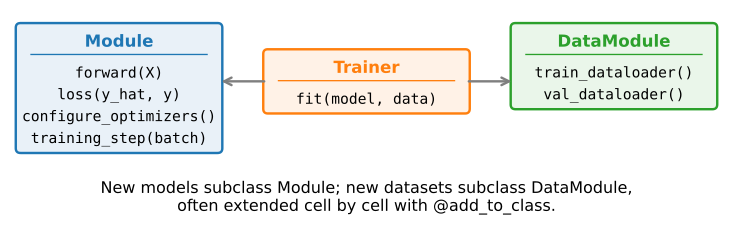
Trainer.fit drives a Module (which holds the model, loss, and optimizer) over data served by a DataModule; new models and datasets are written as subclasses.
import time
import numpy as np
from d2l import tensorflow as d2l
import tensorflow as tf
from d2l import jax as d2l
from flax import nnx
from jax import numpy as jnp
import numpy as np
import jax
import timeimport time
import numpy as np
from d2l import mxnet as d2l
from mxnet.gluon import nn2.2.1 Utilities
The book presents class definitions in short notebook cells next to the prose that explains them. The following decorator registers a function as a method after a class has been created, allowing one class definition to be split across those cells. This is notebook scaffolding rather than part of the learning algorithm; ordinary Python modules would usually define the complete class in one place.
def add_to_class(Class):
    """Register functions as methods in created class."""
    def wrapper(obj):
        setattr(Class, obj.__name__, obj)
        return obj
    return wrapper
To illustrate its use, we declare a class A and create an instance a before defining its method do in a later cell.
class A:
    def __init__(self):
        self.b = 1

a = A()
We define do outside the original class block and decorate it with add_to_class(A). The registered method can access the instance attributes of A in the same way as a method written in the class definition. We then invoke it on a.
@add_to_class(A)
def do(self):
    print('Instance attribute "b" is', self.b)

a.do()
Instance attribute "b" is 1The second one is a utility class that saves all arguments in a class’s __init__ method as instance attributes. This allows us to extend constructor call signatures implicitly without additional code.
class HyperParameters:
    """The base class of hyperparameters."""
    def save_hyperparameters(self, ignore=None):
        raise NotImplementedError
The stub above fixes the interface; Section 30.9 fills in the implementation on this same class, which is why saving even a NotImplementedError body with #@save is worthwhile. To use it, we define our class that inherits from HyperParameters and calls save_hyperparameters in the __init__ method.
# Call the fully implemented HyperParameters class saved in d2l
class B(d2l.HyperParameters):
    def __init__(self, a, b, c):
        self.save_hyperparameters(ignore=['c'])
        print('self.a =', self.a, 'self.b =', self.b)
        print('There is no self.c =', not hasattr(self, 'c'))

b = B(a=1, b=2, c=3)
self.a = 1 self.b = 2
There is no self.c = TrueThe final utility plots experiment progress interactively. We call it ProgressBoard; its implementation is deferred to Section 30.9.
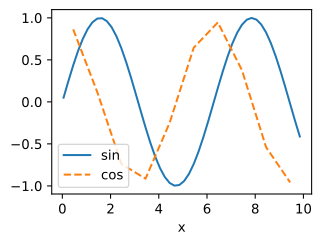
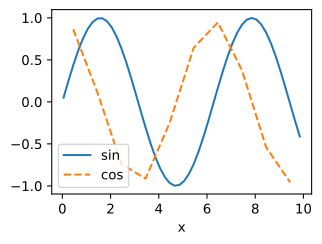
The draw method records a point (x, y) to be shown in the figure, with label specified in the legend. The optional every_n smooths the line by plotting the average of the last \(n\) recorded values. The method schedules the point and returns immediately, reducing synchronization and rendering overhead on the training path.
class ProgressBoard(d2l.HyperParameters):
    """The board that plots data points in animation."""
    def __init__(self, xlabel=None, ylabel=None, xlim=None,
                 ylim=None, xscale='linear', yscale='linear',
                 ls=['-', '--', '-.', ':'], colors=['C0', 'C1', 'C2', 'C3'],
                 fig=None, axes=None, figsize=(3.5, 2.5), display=True):
        self.save_hyperparameters()

    def draw(self, x, y, label, every_n=1):
        raise NotImplementedError
Why does draw go to the trouble of scheduling work instead of plotting right away? The answer previews a theme that runs through the entire book. Modern frameworks can compile or trace the training computation so that an accelerator executes it with little Python in the loop. The exact restrictions differ by framework: Python side effects may cause graph breaks, execute only during tracing, or be rejected. A second issue is common to accelerator execution: the device often runs asynchronously, ahead of Python; the instant we ask for a concrete number (to print or plot it), Python must block until the device catches up, stalling the very pipeline we worked to speed up.
ProgressBoard decouples monitoring from rendering: draw hands the value to a queue and returns, while a background thread performs device-to-host transfer and rendering at its own pace, dropping points if it falls behind. This design usually keeps rendering off the critical path, although queueing, host transfer, and the worker still have a measurable cost. The general pattern is to keep the hot path compatible with compilation and move logging, plotting, and checkpointing outside it.
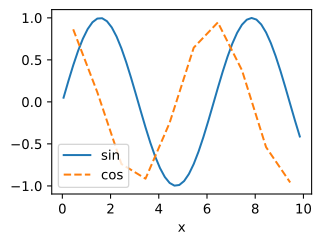
In the following example, we draw sin and cos with different smoothness. If you run this code block interactively, you will see the lines grow in animation. Because drawing is asynchronous, we finish with board.flush(), which waits for the queue to drain and renders the final figure; Trainer.fit (developed below) does this for you.
board = d2l.ProgressBoard('x')
for x in np.arange(0, 10, 0.1):
    board.draw(x, np.sin(x), 'sin', every_n=2)
    board.draw(x, np.cos(x), 'cos', every_n=10)
board.flush()  # wait for the queued points, then render the final figure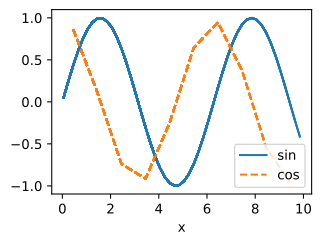
2.2.2 Models
The Module class is the base class of all models we will implement. At the very least we need three methods. The first, __init__, stores the learnable parameters, the training_step method accepts a data batch to return the loss value, and finally, configure_optimizers returns the optimization method, or a list of them, that is used to update the learnable parameters. Optionally we can define validation_step to report the evaluation measures. Sometimes we put the code for computing the output into a separate forward method to make it more reusable. The plot method converts the trainer’s batch counter into a fractional epoch for the x-coordinate, so that the training loss (recorded several times per epoch) and the validation loss (recorded once per epoch) can share a single x-axis, with every_n chosen so each curve shows a fixed number of points per epoch.
Flax NNX modules are ordinary Python objects. Their constructors create parameters eagerly and store them on the module, while NNX transformations make those stateful objects compatible with JAX compilation and differentiation.
class Module(d2l.nn_Module, d2l.HyperParameters):
    """The base class of models."""
    def __init__(self, plot_train_per_epoch=2, plot_valid_per_epoch=1):
        super().__init__()
        self.save_hyperparameters()
        self.board = ProgressBoard()

    def loss(self, y_hat, y):
        raise NotImplementedError

    def forward(self, X):
        assert hasattr(self, 'net'), 'Neural network is not defined'
        return self.net(X)

    def plot(self, key, value, train):
        """Plot a point in animation."""
        assert hasattr(self, 'trainer'), 'Trainer is not inited'
        self.board.xlabel = 'epoch'
        if train:
            x = self.trainer.train_batch_idx / \
                self.trainer.num_train_batches
            n = self.trainer.num_train_batches / \
                self.plot_train_per_epoch
        else:
            x = self.trainer.epoch + 1
            n = self.trainer.num_val_batches / \
                self.plot_valid_per_epoch
        # Pass a thunk, not the value: the device-to-host transfer is deferred
        # to the board's drawing thread so this loop never blocks on it.
        self.board.draw(x, lambda v=value: d2l.numpy(d2l.to(v, d2l.cpu())),
                        ('train_' if train else 'val_') + key,
                        every_n=int(n))

    def training_step(self, batch):
        l = self.loss(self(*batch[:-1]), batch[-1])
        self.plot('loss', l, train=True)
        return l

    def validation_step(self, batch):
        l = self.loss(self(*batch[:-1]), batch[-1])
        self.plot('loss', l, train=False)

    def configure_optimizers(self):
        raise NotImplementedError
class Module(d2l.nn_Module, d2l.HyperParameters):
"""The base class of models."""
def __init__(self, plot_train_per_epoch=2, plot_valid_per_epoch=1):
super().__init__()
self.save_hyperparameters()
self.board = ProgressBoard()
self.training = None
self.__dict__.pop('loss', None)
def loss(self, y_hat, y):
raise NotImplementedError
def forward(self, X):
assert hasattr(self, 'net'), 'Neural network is not defined'
return self.net(X)
def call(self, X, *args, training=None, **kwargs):
if training is not None:
self.training = training
return self.forward(X, *args)
def plot(self, key, value, train):
"""Plot a point in animation."""
assert hasattr(self, 'trainer'), 'Trainer is not inited'
self.board.xlabel = 'epoch'
if train:
x = self.trainer.train_batch_idx / \
self.trainer.num_train_batches
n = self.trainer.num_train_batches / \
self.plot_train_per_epoch
else:
x = self.trainer.epoch + 1
n = self.trainer.num_val_batches / \
self.plot_valid_per_epoch
# Defer the device-to-host transfer to the board's drawing thread.
self.board.draw(x, lambda v=value: d2l.numpy(v), (
'train_' if train else 'val_') + key, every_n=int(n))
def training_step(self, batch):
l = self.loss(self(*batch[:-1]), batch[-1])
self.plot('loss', l, train=True)
return l
def _report_train(self, loss):
self.plot('loss', loss, train=True)
def validation_step(self, batch):
l = self.loss(self(*batch[:-1]), batch[-1])
self.plot('loss', l, train=False)
def _report_val(self, y_hat, batch):
self.plot('loss', self.loss(y_hat, batch[-1]), train=False)
def configure_optimizers(self):
raise NotImplementedErrorclass Module(d2l.nn_Module, d2l.HyperParameters):
"""The base class of models."""
def __init__(self, plot_train_per_epoch=2, plot_valid_per_epoch=1):
super().__init__()
self.save_hyperparameters()
self.board = ProgressBoard()
self.trainer = None
def loss(self, y_hat, y):
raise NotImplementedError
def forward(self, X, *args, **kwargs):
assert hasattr(self, 'net'), 'Neural network is not defined'
return self.net(X, *args, **kwargs)
def __call__(self, X, *args, **kwargs):
return self.forward(X, *args, **kwargs)
def plot(self, key, value, train):
"""Plot a point in animation."""
assert hasattr(self, 'trainer'), 'Trainer is not inited'
self.board.xlabel = 'epoch'
if train:
x = self.trainer.train_batch_idx / \
self.trainer.num_train_batches
n = self.trainer.num_train_batches / \
self.plot_train_per_epoch
else:
x = self.trainer.epoch + 1
n = self.trainer.num_val_batches / \
self.plot_valid_per_epoch
# Defer the device-to-host transfer to the board's drawing thread, so
# this loop never blocks on it (the board itself filters via every_n).
self.board.draw(x, lambda v=value: d2l.numpy(d2l.to(v, d2l.cpu())),
('train_' if train else 'val_') + key,
every_n=int(n))
def training_step(self, batch):
return self.loss(self(*batch[:-1]), batch[-1])
def validation_step(self, batch):
return self.loss(self(*batch[:-1]), batch[-1])
def configure_optimizers(self):
raise NotImplementedErrorclass Module(d2l.nn_Module, d2l.HyperParameters):
"""The base class of models."""
def __init__(self, plot_train_per_epoch=2, plot_valid_per_epoch=1):
super().__init__()
self.save_hyperparameters()
self.board = ProgressBoard()
def loss(self, y_hat, y):
raise NotImplementedError
def forward(self, X):
assert hasattr(self, 'net'), 'Neural network is not defined'
return self.net(X)
def plot(self, key, value, train):
"""Plot a point in animation."""
assert hasattr(self, 'trainer'), 'Trainer is not inited'
self.board.xlabel = 'epoch'
if train:
x = self.trainer.train_batch_idx / \
self.trainer.num_train_batches
n = self.trainer.num_train_batches / \
self.plot_train_per_epoch
else:
x = self.trainer.epoch + 1
n = self.trainer.num_val_batches / \
self.plot_valid_per_epoch
# MXNet's engine is NOT safe for GPU->host transfers issued from a
# foreign thread (under load it corrupts the CUDA context -> error 999).
# So resolve the value on THIS (main) thread and enqueue the host
# scalar; the board's drawing thread then does only matplotlib,
# never an MXNet GPU op.
self.board.draw(x, d2l.numpy(value), (
'train_' if train else 'val_') + key, every_n=int(n))
def training_step(self, batch):
l = self.loss(self(*batch[:-1]), batch[-1])
self.plot('loss', l, train=True)
return l
def validation_step(self, batch):
l = self.loss(self(*batch[:-1]), batch[-1])
self.plot('loss', l, train=False)
def configure_optimizers(self):
raise NotImplementedErrorModule is a subclass of nn.Module, the base class of neural networks in PyTorch. It provides convenient features for handling neural networks. For example, if we define a forward method, such as forward(self, X), then for an instance a we can invoke this method by a(X). This works since it calls the forward method in the built-in __call__ method. You can find more details and examples about nn.Module in Section 5.1.
Module is a subclass of tf.keras.Model, the base class of neural networks in TensorFlow. It provides convenient features for handling neural networks. For example, it invokes the call method in the built-in __call__ method. Here we redirect call to the forward method, saving its arguments as a class attribute, consistent with the forward convention used elsewhere in the book. Note that in __init__ we remove the loss instance attribute that Keras 3 sets to None, since it would shadow the loss method defined by our subclasses.
Module is a subclass of nnx.Module, the NNX base class. An NNX module owns its parameters and child modules as ordinary attributes. Here we redirect __call__ to forward, consistent with the convention used elsewhere in the book. Later, nnx.jit and nnx.value_and_grad will traverse that object graph without requiring a separate parameter dictionary.
Module is a subclass of nn.Block, the base class of neural networks in Gluon. It provides convenient features for handling neural networks. For example, if we define a forward method, such as forward(self, X), then for an instance a we can invoke this method by a(X). This works since it calls the forward method in the built-in __call__ method. You can find more details and examples about nn.Block in Section 5.1.
2.2.3 Data
The DataModule class is the base class for data. Quite frequently the __init__ method is used to prepare the data. This includes downloading and preprocessing if needed. The train_dataloader returns the data loader for the training dataset. A data loader is a (Python) generator that yields a data batch each time it is used. This batch is then fed into the training_step method of Module to compute the loss. There is an optional val_dataloader to return the validation dataset loader. It behaves in the same manner, except that it yields data batches for the validation_step method in Module.
class DataModule(d2l.HyperParameters):
    """The base class of data."""
    def __init__(self, root='../data', num_workers=4):
        self.save_hyperparameters()

    def get_dataloader(self, train):
        raise NotImplementedError

    def train_dataloader(self):
        return self.get_dataloader(train=True)

    def val_dataloader(self):
        return self.get_dataloader(train=False)
class DataModule(d2l.HyperParameters):
"""The base class of data."""
def __init__(self, root='../data', num_workers=4):
self.save_hyperparameters()
def get_dataloader(self, train):
raise NotImplementedError
def train_dataloader(self):
return self.get_dataloader(train=True)
def val_dataloader(self):
return self.get_dataloader(train=False)class DataModule(d2l.HyperParameters):
"""The base class of data."""
def __init__(self, root='../data', num_workers=4):
self.save_hyperparameters()
def get_dataloader(self, train):
raise NotImplementedError
def train_dataloader(self):
return self.get_dataloader(train=True)
def val_dataloader(self):
return self.get_dataloader(train=False)class DataModule(d2l.HyperParameters):
"""The base class of data."""
def __init__(self, root='../data', num_workers=4):
self.save_hyperparameters()
def get_dataloader(self, train):
raise NotImplementedError
def train_dataloader(self):
return self.get_dataloader(train=True)
def val_dataloader(self):
return self.get_dataloader(train=False)2.2.4 Training
The Trainer class trains the learnable parameters in the Module class with data specified in DataModule. The key method is fit, which accepts two arguments: model, an instance of Module, and data, an instance of DataModule. It iterates over the entire dataset max_epochs times to train the model. Note that fit_epoch is left abstract here; it is implemented just two sections later, in Section 2.4.
The Trainer class trains the learnable parameters in the Module class with data specified in DataModule. The key method is fit, which accepts two arguments: model, an instance of Module, and data, an instance of DataModule. It iterates over the entire dataset max_epochs times to train the model. Note that fit_epoch is left abstract here; it is implemented just two sections later, in Section 2.4.
The Trainer class trains the learnable parameters params with data specified in DataModule. The key method is fit, which accepts three arguments: model, an instance of Module, data, an instance of DataModule, and key, a typed JAX random key stored in a jax.Array. We make the key argument optional here to simplify the interface, but production JAX code should pass an explicit root key and split or thread it through every stochastic operation. It iterates over the entire dataset max_epochs times to train the model. Note that fit_epoch is left abstract here; it is implemented just two sections later, in Section 2.4.
The Trainer class trains the learnable parameters in the Module class with data specified in DataModule. The key method is fit, which accepts two arguments: model, an instance of Module, and data, an instance of DataModule. It iterates over the entire dataset max_epochs times to train the model. Note that fit_epoch is left abstract here; it is implemented just two sections later, in Section 2.4.
class Trainer(d2l.HyperParameters):
    """The base class for training models with data."""
    def __init__(self, max_epochs, num_gpus=0, gradient_clip_val=0):
        self.save_hyperparameters()
        assert num_gpus == 0, 'No GPU support yet'

    def prepare_data(self, data):
        self.train_dataloader = data.train_dataloader()
        self.val_dataloader = data.val_dataloader()
        self.num_train_batches = len(self.train_dataloader)
        self.num_val_batches = (len(self.val_dataloader)
                                if self.val_dataloader is not None else 0)

    def prepare_model(self, model):
        model.trainer = self
        model.board.xlim = [0, self.max_epochs]
        self.model = model

    def fit(self, model, data):
        self.prepare_data(data)
        self.prepare_model(model)
        self.optim = model.configure_optimizers()
        self.epoch = 0
        self.train_batch_idx = 0
        self.val_batch_idx = 0
        for self.epoch in range(self.max_epochs):
            self.fit_epoch()
        self.model.board.flush()  # drain queued points; render the final figure

    def fit_epoch(self):
        raise NotImplementedError
class Trainer(d2l.HyperParameters):
"""The base class for training models with data."""
def __init__(self, max_epochs, num_gpus=0, gradient_clip_val=0):
self.save_hyperparameters()
self.gpus = [d2l.gpu(i) for i in range(min(num_gpus, d2l.num_gpus()))]
def prepare_data(self, data):
self.train_dataloader = data.train_dataloader()
self.val_dataloader = data.val_dataloader()
self.num_train_batches = len(self.train_dataloader)
self.num_val_batches = (len(self.val_dataloader)
if self.val_dataloader is not None else 0)
def prepare_model(self, model):
model.trainer = self
model.board.xlim = [0, self.max_epochs]
self.model = model
def fit(self, model, data):
self.prepare_data(data)
self.prepare_model(model)
self.optim = model.configure_optimizers()
self.epoch = 0
self.train_batch_idx = 0
self.val_batch_idx = 0
self._compile_steps()
for self.epoch in range(self.max_epochs):
self.fit_epoch()
self.model.board.flush() # drain queued points; render the final figure
def fit_epoch(self):
raise NotImplementedErrorclass Trainer(d2l.HyperParameters):
"""The base class for training models with data."""
def __init__(self, max_epochs, num_gpus=0, gradient_clip_val=0):
self.save_hyperparameters()
assert num_gpus == 0, 'No GPU support yet'
def prepare_data(self, data):
self.train_dataloader = data.train_dataloader()
self.val_dataloader = data.val_dataloader()
self.num_train_batches = len(self.train_dataloader)
self.num_val_batches = (len(self.val_dataloader)
if self.val_dataloader is not None else 0)
def prepare_model(self, model):
model.trainer = self
model.board.xlim = [0, self.max_epochs]
self.model = model
def fit(self, model, data):
self.prepare_data(data)
self.prepare_model(model)
tx = model.configure_optimizers()
if self.gradient_clip_val > 0:
tx = optax.chain(
optax.clip_by_global_norm(self.gradient_clip_val), tx)
self.optim = nnx.Optimizer(model, tx, wrt=nnx.Param)
self.train_model = nnx.view(
model, deterministic=False, use_running_average=False,
raise_if_not_found=False)
self.val_model = nnx.view(
model, deterministic=True, use_running_average=True,
raise_if_not_found=False)
self.epoch = 0
self.train_batch_idx = 0
self.val_batch_idx = 0
for self.epoch in range(self.max_epochs):
self.fit_epoch()
self.model.board.flush() # drain queued points; render the final figure
def fit_epoch(self):
raise NotImplementedErrorclass Trainer(d2l.HyperParameters):
"""The base class for training models with data."""
def __init__(self, max_epochs, num_gpus=0, gradient_clip_val=0):
self.save_hyperparameters()
assert num_gpus == 0, 'No GPU support yet'
def prepare_data(self, data):
self.train_dataloader = data.train_dataloader()
self.val_dataloader = data.val_dataloader()
self.num_train_batches = len(self.train_dataloader)
self.num_val_batches = (len(self.val_dataloader)
if self.val_dataloader is not None else 0)
def prepare_model(self, model):
model.trainer = self
model.board.xlim = [0, self.max_epochs]
self.model = model
def fit(self, model, data):
self.prepare_data(data)
self.prepare_model(model)
self.optim = model.configure_optimizers()
self.epoch = 0
self.train_batch_idx = 0
self.val_batch_idx = 0
for self.epoch in range(self.max_epochs):
self.fit_epoch()
self.model.board.flush() # drain queued points; render the final figure
def fit_epoch(self):
raise NotImplementedError2.2.5 Summary
The Module, DataModule, and Trainer classes separate models, datasets, and optimization loops. Later sections extend these classes with @add_to_class. Their complete implementations are also available in the D2L library. This modular design permits a model, optimizer, or dataset to change without rewriting the other components.
2.2.6 Exercises
- [code] Monkey-patching. The
add_to_classdecorator callssetattr(Class, obj.__name__, obj).- Register a second
domethod on classAwith@add_to_class(A), giving it a different body, and calla.do()on the instance created earlier. Explain which version runs and why an instance created before either definition is affected. - Attach a function
greet(self)to the instance instead, withsetattr(a, 'greet', greet), and calla.greet(). Explain the difference from registering it on the class.
- Register a second
- Optimizer and model. The
Moduleclass keeps the optimizer inconfigure_optimizers, a method of the model, rather than passing it as an argument toTrainer. State the advantages of this design choice, and describe a training setup in which putting the optimizer on the model becomes awkward. - [code] Saving hyperparameters.
save_hyperparametersis implemented in Section 30.9 with Python’sinspectmodule, which gives it access to the stack frame of the method that calls it.- Remove the
save_hyperparameterscall from classB, instantiateBagain, and explain the outcome. Then restore the call, insert the lined = 4before it in__init__, and state whetherself.dexists after construction. - Implement a version of
save_hyperparametersthat receives the values to store as explicit arguments instead of reading the caller’s stack frame. Change the call inBto use it, and verify thatself.aandself.bexist andself.cdoes not. - State one thing the
inspect-based version provides that your version gives up.
- Remove the
- [code] Synchronous logs. ●
ProgressBoard.drawis asynchronous: it queues the point for a background thread, which converts it to a number and redraws the figure at most once every \(0.1\) s. Starting from the implementation in Section 30.9, implement a variant whosedrawconverts the point and redraws on the calling thread, with the same limit of one redraw per \(0.1\) s.- Time both boards on the
sin/cosloop of Section 2.2.1 with the step reduced to \(0.001\). Count the points each board ends up plotting, and explain any difference. - Time both boards again inside a training run once Section 2.4 supplies
fit_epoch. State under which conditions the synchronous version is measurably slower and when the two are indistinguishable.
- Time both boards on the