import json
import os
import struct
from collections import Counter
from dataclasses import asdict, dataclass
import torch
from torch import nn
from torch.nn import functional as F
from torchvision.models import resnet18, ResNet18_Weights
from safetensors.torch import load_file, save_file
from d2l import torch as d2l5.6 Saving, Loading, and Pretrained Weights
A trained network consists of code and state stored separately. The code defines its layers, forward pass, and configuration. The model state contains the tensors produced by training: weights, biases, and running statistics. Optimizer moments, random-number streams, and the step belong to the wider training state. A weight file saves model state; a resumable checkpoint saves full training state. The code stays in your source repository under version control. Restoring a model therefore requires rebuilding its structure in code and loading the saved state into that structure.
This distinction explains why a checkpoint cannot reconstruct an arbitrary model on its own, why the config object from Section 5.1 belongs inside the checkpoint, and why the format that stores the state matters once you start sharing files with people who do not have your code.
import json
import struct
import warnings
from dataclasses import asdict, dataclass
import numpy as np
from d2l import tensorflow as d2l
import tensorflow as tf
from safetensors.tensorflow import load_file, save_file
import json
import os
import struct
from dataclasses import asdict, dataclass
import jax
from jax import numpy as jnp
from flax import nnx
import optax
import orbax.checkpoint as ocp
from safetensors.flax import load_file, save_file
from d2l import jax as d2l
from d2l.nnx_resnet import ResNet50import json
import os
import struct
from collections import Counter
from dataclasses import asdict, dataclass
from mxnet import autograd, gluon, np, npx
from mxnet.gluon import nn
from safetensors.numpy import load_file, save_file
npx.set_np()5.6.1 State, Not Code
The state of a network is a dictionary from parameter names to tensors, the state_dict of Section 5.2. The same save and load calls also operate on individual tensors and the lists or dictionaries that contain them.
The state of a network is a collection of named variables, the weights of Section 5.2. np.save and np.load also operate on individual tensors and, through NumPy’s pickle fallback, dictionaries that contain them.
The state of a network is a tree of typed, named variables introduced in Section 5.2. jnp.save and jnp.load also operate on individual arrays and, through NumPy’s pickle fallback, dictionaries that contain them.
The state of a network is a dictionary from parameter names to arrays, the collect_params dictionary of Section 5.2. npx.save and npx.savez also operate on individual arrays and named collections; npx.load returns a saved collection as a dictionary.
x = torch.arange(4)
torch.save({'x': x, 'y': torch.zeros(4)}, 'tensors.pt')
torch.load('tensors.pt', weights_only=True)
{'x': tensor([0, 1, 2, 3]), 'y': tensor([0., 0., 0., 0.])}x = tf.range(4)
np.save('tensors.npy', {'x': x, 'y': tf.zeros(4)})
np.load('tensors.npy', allow_pickle=True).item(){'x': <tf.Tensor: shape=(4,), dtype=int32, numpy=array([0, 1, 2, 3], dtype=int32)>,
'y': <tf.Tensor: shape=(4,), dtype=float32, numpy=array([0., 0., 0., 0.], dtype=float32)>}x = jnp.arange(4)
jnp.save('tensors.npy', {'x': x, 'y': jnp.zeros(4)})
jnp.load('tensors.npy', allow_pickle=True).item(){'x': Array([0, 1, 2, 3], dtype=int32),
'y': Array([0., 0., 0., 0.], dtype=float32)}x = np.arange(4)
npx.savez('tensors-mx', x=x, y=np.zeros(4))
npx.load('tensors-mx'){'x': array([0., 1., 2., 3.]), 'y': array([0., 0., 0., 0.])}A model’s state_dict is one such dictionary, built for you. The keys are the dotted paths through the module tree (hidden.weight, output.bias); the values are the tensors, buffers included. Here is the tree for a small MLP.
A model’s state is one such collection, built for you: net.weights is the list of its variables, and each variable’s path names its place in the layer tree (mlp/hidden/kernel, mlp/output/bias; Keras calls a weight matrix a kernel). Keras invents layer names like dense_3 when you do not choose them, so we name the layers explicitly to keep the paths stable across instances. Here is the tree for a small MLP.
A model’s parameter state is one such structure. Its paths follow the module graph (hidden.kernel, output.bias; Flax calls a weight matrix a kernel). Here is the tree for a small MLP.
A model’s state is one such dictionary, built for you: collect_params maps the dotted paths through the block tree (hidden.weight, output.bias) to the parameters, the running statistics of any BatchNorm layers included. Here is the tree for a small MLP.
class MLP(nn.Module):
    def __init__(self):
        super().__init__()
        self.hidden = nn.LazyLinear(256)
        self.output = nn.LazyLinear(10)

    def forward(self, x):
        return self.output(F.relu(self.hidden(x)))

net = MLP()
X = torch.randn(2, 20)
Y = net(X)
{name: tuple(t.shape) for name, t in net.state_dict().items()}
{'hidden.weight': (256, 20),
'hidden.bias': (256,),
'output.weight': (10, 256),
'output.bias': (10,)}class MLP(tf.keras.Model):
def __init__(self):
super().__init__(name='mlp')
self.hidden = tf.keras.layers.Dense(256, name='hidden')
self.out = tf.keras.layers.Dense(10, name='output')
def call(self, x):
return self.out(tf.nn.relu(self.hidden(x)))
net = MLP()
X = tf.random.normal((2, 20))
Y = net(X)
{v.path: tuple(v.shape) for v in net.weights}{'mlp/hidden/kernel': (20, 256),
'mlp/hidden/bias': (256,),
'mlp/output/kernel': (256, 10),
'mlp/output/bias': (10,)}class MLP(nnx.Module):
def __init__(self, rngs=None):
rngs = nnx.Rngs(0) if rngs is None else rngs
self.hidden = nnx.Linear(20, 256, rngs=rngs)
self.output = nnx.Linear(256, 10, rngs=rngs)
def __call__(self, x):
return self.output(nnx.relu(self.hidden(x)))
net = MLP()
X = jax.random.normal(d2l.get_key(), (2, 20))
Y = net(X)
params = nnx.state(net, nnx.Param)
[(path, tuple(value.shape)) for path, value in params.flat_state()][(('hidden', 'bias'), (256,)),
(('hidden', 'kernel'), (20, 256)),
(('output', 'bias'), (10,)),
(('output', 'kernel'), (256, 10))]class MLP(nn.Block):
def __init__(self):
super().__init__()
self.hidden = nn.Dense(256, activation='relu')
self.output = nn.Dense(10)
def forward(self, x):
return self.output(self.hidden(x))
net = MLP()
net.initialize()
X = np.random.uniform(size=(2, 20))
Y = net(X)
{name: p.shape for name, p in net.collect_params().items()}{'hidden.weight': (256, 20),
'hidden.bias': (256,),
'output.weight': (10, 256),
'output.bias': (10,)}This dictionary records no MLP class identity. Its names and shapes can populate a network with a compatible architecture and naming structure. Renaming an attribute or changing the nesting can break that match even when the computation is equivalent; the final section shows how to migrate such keys explicitly.
5.6.2 safetensors: the Interchange Format
torch.save writes its files with Python’s pickle, which does not store data so much as a program that reconstructs data. Unpickling runs that program. Loading pickle executes reconstruction code, so use this format only for files from a trusted source. A downloaded pickle can execute code selected by the file’s author during loading.
np.save writes NumPy’s .npy format. For a single tensor that is pure data: a small header with the dtype and shape, then the raw bytes. The dictionary example differs. NumPy can only store a dict by falling back to Python’s pickle, which does not store data so much as a program that reconstructs data, and loading runs that program; that is what allow_pickle=True opted into. Loading pickle executes reconstruction code, so use this format only for files from a trusted source. An object in a downloaded stream can name a callable for the loader to invoke; NumPy therefore rejects pickled contents by default (allow_pickle=False).
jnp.save writes NumPy’s .npy format. For a single array that is pure data: a small header with the dtype and shape, then the raw bytes. The dictionary example differs. NumPy can only store a dict by falling back to Python’s pickle, which does not store data so much as a program that reconstructs data, and loading runs that program; that is what allow_pickle=True opted into. Loading pickle executes reconstruction code, so use this format only for files from a trusted source. An object in a downloaded stream can name a callable for the loader to invoke; NumPy therefore rejects pickled contents by default (allow_pickle=False).
npx.savez writes MXNet’s own array format: the saver accepts nothing but MXNet arrays, and the file holds only their names, dtypes, shapes, and raw bytes. There is no pickle stream or executable reconstruction code in the file. Its limitation is interoperability: few tools outside MXNet read this format, which matters when recipients do not use the archived framework.
class Tripwire:
    def __reduce__(self):
        return (print, ('*** payload executed while loading ***',))

torch.save(Tripwire(), 'tripwire.pt')
_ = torch.load('tripwire.pt', weights_only=False)  # the payload runs here
*** payload executed while loading ***Since version 2.6, PyTorch defaults torch.load to weights_only=True, which refuses any pickle opcode that is not a plain tensor. The same file is now rejected instead of executed.
try:
    torch.load('tripwire.pt', weights_only=True)  # the default in this torch
except Exception as e:
    print(type(e).__name__, str(e).splitlines()[0])
UnpicklingError Weights only load failed. This file can still be loaded, to do so you have two options, do those steps only if you trust the source of the checkpoint. The allowlist behind weights_only=True is defense in depth, not a sandbox: it has itself had bypasses patched.
TensorFlow’s own model files sidestep pickle: neither a TF checkpoint nor the Keras .weights.h5/.keras formats execute it on load. They are not automatically safe to download, though. A .keras archive can carry serialized code (a Lambda layer’s function), which is why Keras refuses to deserialize such code unless you pass safe_mode=False, and why a model file from an untrusted source deserves the same caution as a pickle.
allow_pickle=False is a refusal, not a fix: it keeps the loader safe by declining to load the very files, dicts of named parameters, that model sharing needs.
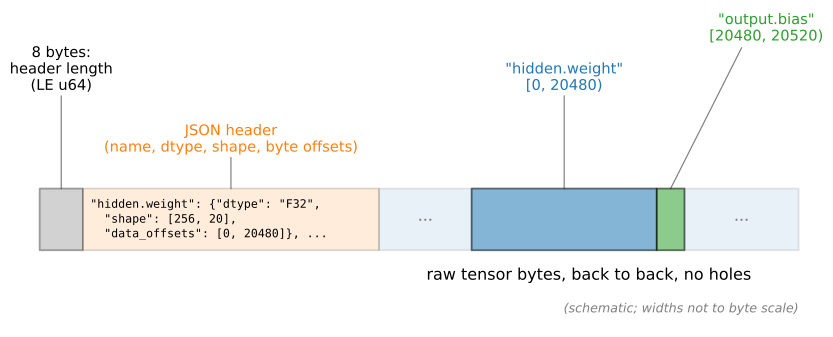
safetensors removes the problem at the root by having no program to run. As Figure 5.6.1 lays out byte by byte, a safetensors file is an 8-byte little-endian integer giving the header length, then that many bytes of JSON naming each tensor’s dtype, shape, and byte range, then the raw tensor bytes back to back. There is no opcode stream to interpret, so the format itself carries no executable program. Loaders must still validate malformed headers, offsets, and allocation sizes. It is also framework-neutral and memory-mappable, which is why model hubs commonly prefer it. Save and reload the MLP’s state through it and confirm the round trip is exact.
Here the variable paths provide the names, and a comprehension over net.weights constructs the flat mapping. Two quirks of the tensorflow binding to know: it converts through NumPy in both directions, so load_file hands back constant tensors that you assign into a model’s variables, and save_file overwrites the values of the dict you pass it during that conversion, so give it a throwaway copy.
One mismatch to bridge first: safetensors stores a flat mapping from names to tensors, while NNX state forms a nested pytree. This MLP has only string-keyed paths, so two small helpers join them with dots and split them on the way back. For an arbitrary pytree, preserve typed list indices and escape dots in keys, or restore values against a template instead of using this shortcut.
There is no safetensors.mxnet module because the archived framework has no native binding. The format contains names, dtypes, and bytes, so the safetensors.numpy binding plus two dictionary comprehensions provides the conversion: .asnumpy() on the way out and np.array on the way back. The conversion requires no framework-specific file-format machinery.
save_file(net.state_dict(), 'mlp.safetensors')
clone = MLP()
clone(X)                                   # materialize the lazy layers first
clone.load_state_dict(load_file('mlp.safetensors'))
clone.eval()
torch.equal(clone(X), Y)Truestate = {v.path: v for v in net.weights}
save_file(dict(state), 'mlp-tf.safetensors') # dict(): save_file clobbers its arg
restored = load_file('mlp-tf.safetensors')
clone = MLP()
clone(X) # build the variables first
for v in clone.weights:
v.assign(restored[v.path])
tf.reduce_all(clone(X) == Y)<tf.Tensor: shape=(), dtype=bool, numpy=True>def flatten(tree):
if hasattr(tree, 'flat_state'):
leaves = tree.flat_state()
else:
leaves = jax.tree_util.tree_flatten_with_path(tree)[0]
leaves = [(tuple(getattr(k, 'key', getattr(k, 'idx', k))
for k in path), value)
for path, value in leaves]
return {'.'.join(map(str, path)): value for path, value in leaves}
def unflatten(flat):
tree = {}
for name, value in flat.items():
*parents, leaf = name.split('.')
node = tree
for p in parents:
node = node.setdefault(p, {})
node[leaf] = value
return tree
save_file(flatten(params), 'mlp-jax.safetensors')
restored = unflatten(load_file('mlp-jax.safetensors'))
clone = MLP(nnx.Rngs(1))
clone_state = nnx.state(clone, nnx.Param)
nnx.replace_by_pure_dict(clone_state, restored)
nnx.update(clone, clone_state)
exact = jax.tree_util.tree_all(jax.tree_util.tree_map(
jnp.array_equal, restored, nnx.to_pure_dict(params)))
exact, jnp.array_equal(clone(X), Y)(True, Array(True, dtype=bool))state = {name: p.data().asnumpy() for name, p in net.collect_params().items()}
save_file(state, 'mlp-mx.safetensors')
restored = load_file('mlp-mx.safetensors')
clone = MLP()
clone.load_dict({name: np.array(v) for name, v in restored.items()})
(clone(X) == Y).all()array(True)Because the header is JSON at a known offset, the next cell reads its metadata without the safetensors library.
with open('mlp.safetensors', 'rb') as f:
    n = struct.unpack('<Q', f.read(8))[0]   # header length, little-endian
    header = json.loads(f.read(n))
header['hidden.weight']
{'dtype': 'F32', 'shape': [256, 20], 'data_offsets': [1024, 21504]}with open('mlp-tf.safetensors', 'rb') as f:
n = struct.unpack('<Q', f.read(8))[0] # header length, little-endian
header = json.loads(f.read(n))
header['mlp/hidden/kernel']{'dtype': 'F32', 'shape': [20, 256], 'data_offsets': [1024, 21504]}with open('mlp-jax.safetensors', 'rb') as f:
n = struct.unpack('<Q', f.read(8))[0] # header length, little-endian
header = json.loads(f.read(n))
header['hidden.kernel']{'dtype': 'F32', 'shape': [20, 256], 'data_offsets': [1024, 21504]}with open('mlp-mx.safetensors', 'rb') as f:
n = struct.unpack('<Q', f.read(8))[0] # header length, little-endian
header = json.loads(f.read(n))
header['hidden.weight']{'dtype': 'F32', 'shape': [256, 20], 'data_offsets': [1024, 21504]}Interchange files should be non-executable, documented, and accompanied by a checksum and a state schema. Safetensors is the data-only example used here; framework-native formats remain appropriate when all consumers share a trusted, compatible runtime. For archived frameworks, a data-only format also supplies an exit path that current tools can read.
5.6.3 Checkpointing a Training Run
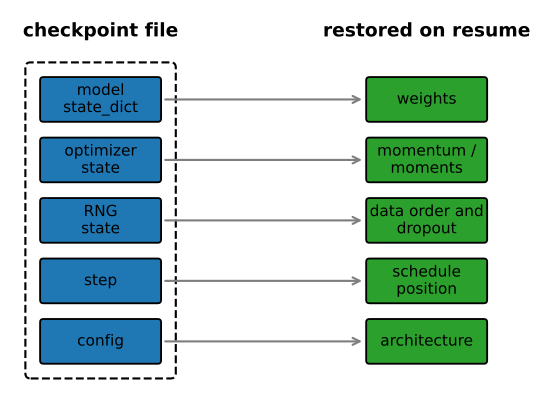
A checkpoint you can resume from holds more than weights. Resuming means picking up the optimizer where it stopped, and Adam’s state is the running first and second moments of the gradients from Section 5.2. Drop them and the optimizer restarts its momentum from zero, so the first steps after a resume no longer behave like a continuation. A full checkpoint therefore bundles the model state, the optimizer state, the RNG state (so data shuffling and dropout continue the same stream), the step counter, and the config that sizes the model when you rebuild it. Figure 5.6.2 pairs each of those five compartments with the exact thing it restores on resume.
Two details separate a checkpoint from a corrupted file. First, keep the contents to tensors and primitives so the file loads under weights_only=True; a dataclass config goes in as a plain dict via asdict. Second, write atomically: save to a temporary path and os.replace it into place, so a crash mid-write leaves the previous good checkpoint untouched rather than a half-written one.
In TensorFlow the bundle already has a name. tf.train.Checkpoint takes the objects to track as keyword arguments, model, optimizer, and a step counter, walks their variables, and saves and restores them as one unit, Adam’s moment estimates included. Because this native already covers the job, the tensorflow tab defines no helper of its own; the calls below are the idiom as you would write it in any project. Saves are numbered (run-tf-1, run-tf-2, …), so a crash cannot corrupt the previous completed number. The config travels in a JSON sidecar named for that number. A tracked tf.random.Generator carries the random stream; the process-global generator is not captured automatically.
NNX exposes the model and optimizer state as pytrees, including the optimizer’s step counter. Orbax, the JAX checkpointing library, saves and restores such trees whole: its StandardCheckpointer commits a temporary directory by rename. The demonstration overwrites a fixed path with force=True so the notebook is rerunnable; production runs should write numbered steps through CheckpointManager and retain the previous completed step. Because these natives already cover the job, the jax tab defines no helper of its own; the calls below are the idiom as you would write it in any project. The config rides along as one more branch of the saved tree, as does the PRNG key, which in JAX is explicit data rather than hidden global state.
In MXNet the bundle is three files rather than one. save_parameters covers the model; the optimizer state lives with the gluon.Trainer, whose save_states writes Adam’s moments with pickle, so a trainer-states file deserves the same your-own-disk-only caution as any pickle. It does not write per-parameter attributes such as lr_mult, which come from your code on rebuild. The step counter and config travel in a JSON sidecar. One compartment of Figure 5.6.2 stays empty: MXNet has no API to snapshot its random-number generators, only npx.random.seed to restart them, so a resumed run reseeds rather than continuing the old stream. The helper atomically replaces each component, but three renames are not one transaction. Production code should write a numbered prefix and update one LATEST manifest only after all three files are complete.
def save_checkpoint(path, model, optimizer, step, cfg=None):
    """Atomically write a resumable training checkpoint."""
    ckpt = {'model': model.state_dict(),
            'optimizer': optimizer.state_dict(),
            'step': step,
            'cpu_rng': torch.get_rng_state()}
    if cfg is not None:
        ckpt['cfg'] = asdict(cfg)
    if torch.cuda.is_available():
        ckpt['cuda_rng'] = torch.cuda.get_rng_state_all()
    tmp = path + '.tmp'
    torch.save(ckpt, tmp)
    os.replace(tmp, path)

def load_checkpoint(path, model, optimizer=None):
    """Restore the state written by save_checkpoint; return the raw dict."""
    ckpt = torch.load(path, weights_only=True)
    model.load_state_dict(ckpt['model'])
    if optimizer is not None:
        optimizer.load_state_dict(ckpt['optimizer'])
    torch.set_rng_state(ckpt['cpu_rng'])
    if torch.cuda.is_available() and 'cuda_rng' in ckpt:
        torch.cuda.set_rng_state_all(ckpt['cuda_rng'])
    return ckpt
def save_checkpoint(prefix, model, trainer, step, cfg=None):
"""Replace each component of a resumable MXNet checkpoint."""
meta = {'step': step}
if cfg is not None:
meta['cfg'] = asdict(cfg)
model.save_parameters(prefix + '.params.tmp')
trainer.save_states(prefix + '.states.tmp')
with open(prefix + '.json.tmp', 'w') as f:
json.dump(meta, f)
for ext in ('.params', '.states', '.json'):
os.replace(prefix + ext + '.tmp', prefix + ext)
def load_checkpoint(prefix, model, trainer=None):
"""Restore the state written by save_checkpoint; return the metadata."""
model.load_parameters(prefix + '.params')
if trainer is not None:
trainer.load_states(prefix + '.states')
with open(prefix + '.json') as f:
return json.load(f)Train a tiny regressor for a hundred steps and checkpoint it. The Config dataclass is what a rebuild reads to size the model, so it travels with the weights.
@dataclass
class Config:
    in_dim: int = 20
    hidden: int = 64
    lr: float = 0.05

def build(cfg):
    return nn.Sequential(nn.Linear(cfg.in_dim, cfg.hidden), nn.ReLU(),
                         nn.Linear(cfg.hidden, 1))

torch.manual_seed(1)
cfg = Config()
data = torch.randn(256, cfg.in_dim)
target = data @ torch.randn(cfg.in_dim, 1) + 0.1 * torch.randn(256, 1)
loss = nn.MSELoss()

def step(model, opt):
    opt.zero_grad()
    l = loss(model(data), target)
    l.backward()
    opt.step()
    return l.item()

net = build(cfg)
opt = torch.optim.Adam(net.parameters(), lr=cfg.lr)
for _ in range(100):
    step(net, opt)
save_checkpoint('run.pt', net, opt, step=100, cfg=cfg)
round(loss(net(data), target).item(), 4)0.0016@dataclass
class Config:
in_dim: int = 20
hidden: int = 64
lr: float = 0.05
def build(cfg):
return tf.keras.Sequential([
tf.keras.layers.Dense(cfg.hidden, activation='relu'),
tf.keras.layers.Dense(1)])
tf.keras.utils.set_random_seed(1)
cfg = Config()
data = tf.random.normal((256, cfg.in_dim))
target = data @ tf.random.normal((cfg.in_dim, 1)) + 0.1 * tf.random.normal((256, 1))
loss = tf.keras.losses.MeanSquaredError()
def step(model, opt):
with tf.GradientTape() as tape:
l = loss(target, model(data))
opt.apply_gradients(zip(tape.gradient(l, model.trainable_variables),
model.trainable_variables))
return float(l)
net = build(cfg)
net(data[:1]) # build the variables
opt = tf.keras.optimizers.Adam(cfg.lr)
for _ in range(100):
step(net, opt)
rng = tf.random.Generator.from_seed(1)
ckpt = tf.train.Checkpoint(model=net, optimizer=opt, step=tf.Variable(100),
rng=rng)
path = ckpt.save('run-tf') # a numbered save: 'run-tf-1'
with open(path + '.cfg.json', 'w') as f:
json.dump(asdict(cfg), f)
path, round(float(loss(target, net(data))), 4)('run-tf-1', 0.0023)@dataclass
class Config:
in_dim: int = 20
hidden: int = 64
lr: float = 0.05
def build(cfg):
return nnx.Sequential(
nnx.Linear(cfg.in_dim, cfg.hidden, rngs=nnx.Rngs(0)), nnx.relu,
nnx.Linear(cfg.hidden, 1, rngs=nnx.Rngs(1)))
def fresh_state(cfg):
model = build(cfg)
optimizer = nnx.Optimizer(model, optax.adam(cfg.lr), wrt=nnx.Param)
return model, optimizer
cfg = Config()
model = build(cfg)
data = jax.random.normal(d2l.get_key(), (256, cfg.in_dim))
target = (data @ jax.random.normal(d2l.get_key(), (cfg.in_dim, 1))
+ 0.1 * jax.random.normal(d2l.get_key(), (256, 1)))
def loss(model):
return jnp.mean((model(data) - target) ** 2)
@nnx.jit
def step(model, optimizer):
l, grads = nnx.value_and_grad(loss)(model)
optimizer.update(model, grads)
return l
model, optimizer = fresh_state(cfg)
train_key = jax.random.key(1)
for _ in range(100):
l = step(model, optimizer)
ckptr = ocp.StandardCheckpointer()
ckptr.save(os.path.abspath('run-jax'), # orbax wants an absolute path
{'model': nnx.to_pure_dict(nnx.state(model)),
'optimizer': nnx.to_pure_dict(nnx.state(optimizer)),
'rng': train_key,
'cfg': asdict(cfg)}, force=True)
int(optimizer.step), round(float(loss(model)), 4)(100, 0.0021)@dataclass
class Config:
in_dim: int = 20
hidden: int = 64
lr: float = 0.05
def build(cfg):
net = nn.Sequential()
net.add(nn.Dense(cfg.hidden, activation='relu'), nn.Dense(1))
net.initialize()
return net
npx.random.seed(1)
cfg = Config()
data = np.random.normal(size=(256, cfg.in_dim))
target = data @ np.random.normal(size=(cfg.in_dim, 1)) \
+ 0.1 * np.random.normal(size=(256, 1))
def loss(model):
return float(((model(data) - target) ** 2).mean())
def step(model, trainer):
with autograd.record():
l = ((model(data) - target) ** 2).mean()
l.backward()
trainer.step(batch_size=1) # the loss is already a mean
return float(l)
net = build(cfg)
trainer = gluon.Trainer(net.collect_params(), 'adam',
{'learning_rate': cfg.lr})
for _ in range(100):
step(net, trainer)
save_checkpoint('run-mx', net, trainer, step=100, cfg=cfg)
round(loss(net), 4)0.0018The restore is exact. Corrupt every parameter, load the checkpoint back, and the loss returns to where it was.
Note the shape of the restore call: restore patches the tracked objects in place, matching each variable by its route through the object graph (model, then the layer, then its kernel) rather than by name, and it returns a status object. assert_consumed() on that status checks that every saved value found a variable and every variable found a value, turning a silent partial restore into a loud error.
Orbax fills a template with the saved arrays. We then update freshly built NNX objects from the restored pure dictionaries. Rebuilding first checks that the architecture still agrees with the checkpoint structure.
Note the shape of the restore: load_parameters and load_states patch the model and trainer in place, matching parameters by the same dotted names the file stores. There is no template to fill and no status object to check; what checking you want, you write yourself, as the final section of this page does with its key-set diff.
with torch.no_grad():
    for p in net.parameters():
        p.add_(1.0)                       # wreck the weights
before = loss(net(data), target).item()
load_checkpoint('run.pt', net, opt)
after = loss(net(data), target).item()
f'perturbed {before:.2f} -> restored {after:.4f}'
'perturbed 47291.83 -> restored 0.0016'for v in net.trainable_variables:
v.assign_add(tf.ones_like(v)) # wreck the weights
before = float(loss(target, net(data)))
ckpt.restore(path).assert_consumed()
after = float(loss(target, net(data)))
f'perturbed {before:.2f} -> restored {after:.4f}''perturbed 53412.14 -> restored 0.0023'model_state = nnx.state(model)
nnx.update(model, jax.tree.map(lambda p: p + 1.0, model_state))
before = float(loss(model))
template_model, template_optimizer = fresh_state(cfg)
template = {
'model': nnx.to_pure_dict(nnx.state(template_model)),
'optimizer': nnx.to_pure_dict(nnx.state(template_optimizer)),
'rng': jax.random.key(0),
'cfg': asdict(Config())}
ckpt = ckptr.restore(os.path.abspath('run-jax'), template)
cfg = Config(**ckpt['cfg'])
train_key = ckpt['rng']
restored_model = nnx.state(model)
nnx.replace_by_pure_dict(restored_model, ckpt['model'])
nnx.update(model, restored_model)
restored_optimizer = nnx.state(optimizer)
nnx.replace_by_pure_dict(restored_optimizer, ckpt['optimizer'])
nnx.update(optimizer, restored_optimizer)
after = float(loss(model))
f'perturbed {before:.2f} -> restored {after:.4f}''perturbed 50460.26 -> restored 0.0021'for p in net.collect_params().values():
p.set_data(p.data() + 1.0) # wreck the weights
before = loss(net)
load_checkpoint('run-mx', net, trainer)
after = loss(net)
f'perturbed {before:.2f} -> restored {after:.4f}''perturbed 49008.15 -> restored 0.0018'Now the reason the optimizer state is in the file. Resume the run two ways from the same checkpoint: once restoring the optimizer, once with a fresh one holding only the weights. In this example, the network is near its minimum, so restoring Adam’s state continues with small updates. A fresh Adam resets its moment estimates and bias correction, producing a larger first update that overshoots the local minimum.
Keras 3 requires an additional step in the resume path. A freshly constructed Adam owns no slot variables; the moment estimates are created only when the optimizer is built. Restore into a fresh optimizer without building it first and the saved moments have no variables to land in, so assert_consumed() fails with an unresolved optimizer object. Build the optimizer variables before restoring them with opt.build(model.trainable_variables).
net_full = build(cfg)
opt_full = torch.optim.Adam(net_full.parameters(), lr=cfg.lr)
load_checkpoint('run.pt', net_full, opt_full)          # weights + optimizer
full = [round(step(net_full, opt_full), 4) for _ in range(5)]

net_fresh = build(cfg)
load_checkpoint('run.pt', net_fresh, optimizer=None)   # weights only
opt_fresh = torch.optim.Adam(net_fresh.parameters(), lr=cfg.lr)
fresh = [round(step(net_fresh, opt_fresh), 4) for _ in range(5)]

print('full  optimizer:', full)
print('fresh optimizer:', fresh)
full optimizer: [0.0016, 0.0016, 0.0015, 0.0015, 0.0015]
fresh optimizer: [0.0016, 3.8324, 0.2922, 1.0421, 1.845]with open(path + '.cfg.json') as f:
cfg = Config(**json.load(f))
net_full = build(cfg)
net_full(data[:1])
opt_full = tf.keras.optimizers.Adam(cfg.lr)
opt_full.build(net_full.trainable_variables) # create Adam's slots first
rng_full = tf.random.Generator.from_seed(0)
tf.train.Checkpoint(model=net_full, optimizer=opt_full,
step=tf.Variable(0), rng=rng_full).restore(path).assert_consumed()
full = [round(step(net_full, opt_full), 4) for _ in range(5)]
net_fresh = build(cfg)
net_fresh(data[:1])
tf.train.Checkpoint(model=net_fresh).restore(path).expect_partial() # weights only
opt_fresh = tf.keras.optimizers.Adam(cfg.lr)
fresh = [round(step(net_fresh, opt_fresh), 4) for _ in range(5)]
print('full optimizer:', full)
print('fresh optimizer:', fresh)full optimizer: [0.0023, 0.0022, 0.0022, 0.0021, 0.002]
fresh optimizer: [0.0023, 1.8525, 0.4389, 0.8488, 0.681]full, full_opt = fresh_state(cfg)
full_state, full_opt_state = nnx.state(full), nnx.state(full_opt)
nnx.replace_by_pure_dict(full_state, ckpt['model'])
nnx.replace_by_pure_dict(full_opt_state, ckpt['optimizer'])
nnx.update(full, full_state)
nnx.update(full_opt, full_opt_state)
full_losses = []
for _ in range(5):
l = step(full, full_opt)
full_losses.append(round(float(l), 4))
fresh, fresh_opt = fresh_state(cfg)
fresh_state_ = nnx.state(fresh)
nnx.replace_by_pure_dict(fresh_state_, ckpt['model'])
nnx.update(fresh, fresh_state_)
fresh_losses = []
for _ in range(5):
l = step(fresh, fresh_opt)
fresh_losses.append(round(float(l), 4))
print('full optimizer:', full_losses)
print('fresh optimizer:', fresh_losses)full optimizer: [0.0021, 0.002, 0.002, 0.002, 0.002]
fresh optimizer: [0.0021, 3.0551, 0.2507, 0.8011, 1.4134]net_full = build(cfg)
trainer_full = gluon.Trainer(net_full.collect_params(), 'adam',
{'learning_rate': cfg.lr})
load_checkpoint('run-mx', net_full, trainer_full) # weights + optimizer
full = [round(step(net_full, trainer_full), 4) for _ in range(5)]
net_fresh = build(cfg)
load_checkpoint('run-mx', net_fresh, trainer=None) # weights only
trainer_fresh = gluon.Trainer(net_fresh.collect_params(), 'adam',
{'learning_rate': cfg.lr})
fresh = [round(step(net_fresh, trainer_fresh), 4) for _ in range(5)]
print('full optimizer:', full)
print('fresh optimizer:', fresh)full optimizer: [0.0018, 0.0018, 0.0017, 0.0017, 0.0017]
fresh optimizer: [0.0018, 3.6124, 0.1789, 1.1589, 1.8473]The full-state loss continues to decrease, whereas the weights-only loss first increases and then recovers. The difference results from resetting the optimizer state; model weights alone do not form a resumable training checkpoint.
For models too large to hold in memory, checkpoints are split across several files with an index, and torch.load(..., mmap=True) pages tensors off disk on demand instead of copying the whole file up front. Combined with meta-device construction and load_state_dict(..., assign=True), this loads such a model without ever allocating its randomly-initialized weights; Chapter 13 returns to the machinery when models get that big.
For models too large to hold in memory, the format already cooperates: a TF checkpoint is an index file plus data shards rather than one monolith, and restores are lazy, so a variable created later is filled from the file at creation time instead of everything materializing up front. Multi-host tf.distribute jobs build on the same machinery; Chapter 13 returns to it when models get that big.
For models too large to hold in memory, orbax already works at scale: a checkpoint is a directory of per-array files rather than one monolith, a restore can target a device sharding so each accelerator materializes only its own pieces, and multi-host jobs save and restore in parallel; Chapter 13 returns to the machinery when models get that big.
MXNet provides no comparable sharded-checkpoint or memory-mapped loading API: a .params file loads as a whole, and the project was archived before those features were added. Models that exceed available memory therefore require external tooling or another framework; Chapter 13 discusses the mechanisms available elsewhere.
5.6.4 Loading Weights You Did Not Train
A common reason to load a state_dict is to reuse weights produced elsewhere. You take a network trained on a large dataset and adapt it: keep the learned feature extractor, replace the final layer for your own labels. The mechanics are state_dict manipulation. torchvision serves the weights through a weights= enum, which also downloads the matching parameters the first time.
A common reason to load weights is to reuse weights produced elsewhere. You take a network trained on a large dataset and adapt it: keep the learned feature extractor, replace the final layer for your own labels. keras.applications is the built-in zoo; weights='imagenet' downloads the matching parameters the first time, and include_top=False drops the 1000-class head so you can attach your own.
A common reason to load parameters is to reuse weights produced elsewhere. You take a network trained on a large dataset and adapt it: keep the learned feature extractor, replace the final layer for your own labels. The book’s NNX ResNet-50 loader downloads pinned Microsoft ImageNet safetensors from the Hugging Face Hub and maps them into an NNX model. We use that real artifact, then reuse the small MLP file to demonstrate key-by-key mapping changes on a compact state tree.
A common reason to load parameters is to reuse weights produced elsewhere. You take a network trained on a large dataset and adapt it: keep the learned feature extractor, replace the final layer for your own labels. gluon.model_zoo.vision is the built-in zoo; pretrained=True downloads the matching parameters the first time. One caveat before you rely on it: the download comes from the archived project’s file hosting, which was available when this notebook last ran but has no continuing availability guarantee. Verify it before depending on the download.
net = resnet18(weights=ResNet18_Weights.DEFAULT)   # ~45 MB on first run
net.fc = nn.Linear(net.fc.in_features, 10)          # new 10-class head
net.fc
Linear(in_features=512, out_features=10, bias=True)backbone = tf.keras.applications.MobileNetV2( # ~9 MB on first run
weights='imagenet', include_top=False, input_shape=(160, 160, 3),
pooling='avg')
net = tf.keras.Sequential([backbone, tf.keras.layers.Dense(10, name='head')])
net(tf.zeros((1, 160, 160, 3))) # build the new 10-class head
net.layers[-1]<Dense name=head, built=True>pretrained_net = ResNet50.from_pretrained()
pretrained_net.fc = nnx.Linear(2048, 10, rngs=nnx.Rngs(2))
print('new pretrained-model head:', pretrained_net.fc.kernel.shape)
class Classifier(nnx.Module):
def __init__(self, rngs=None):
rngs = nnx.Rngs(0) if rngs is None else rngs
self.hidden = nnx.Linear(20, 256, rngs=rngs)
self.head = nnx.Linear(256, 2, rngs=rngs) # new head, new name
def __call__(self, x):
return self.head(nnx.relu(self.hidden(x)))
classifier = Classifier()
new_params = nnx.state(classifier, nnx.Param)
[(path, tuple(value.shape)) for path, value in new_params.flat_state()]Downloading bytes: | 0.00B Reconstructing (incomplete total...): | | 0.00B / 0.00B Fetching 1 files: 0%| | 0/1 [00:00<?, ?it/s]new pretrained-model head: (2048, 10)[(('head', 'bias'), (2,)),
(('head', 'kernel'), (256, 2)),
(('hidden', 'bias'), (256,)),
(('hidden', 'kernel'), (20, 256))]net = gluon.model_zoo.vision.resnet18_v2(pretrained=True) # ~42 MB on first run
net.output = nn.Dense(10, in_units=512) # new 10-class head
net.output.initialize()
net.outputDense(512 -> 10, linear)A state_dict is an ordinary Python dictionary, so adaptation consists of explicit mapping edits. We drop the pretrained 1000-class head (the replaced head) and, to show what a damaged file looks like, also drop one residual block. Loading with strict=False then returns a report of what did not line up instead of raising.
Keras loads weight files as a unit, so a flag controls partial loading rather than explicit mapping edits: load_weights(path, skip_mismatch=True) fills every variable whose saved shape matches and skips the rest, reporting the skips as a warning. To stage a mismatch, save the weights of a donor whose head has 101 classes, our stand-in for a fine-tuned model someone else published, then load that file into the 10-class network. The cell records the warning so we can read it back as a report.
There is no strict=False to lean on: the merge is yours to write, and so is the report. Take from the file every entry whose name and shape match the new model, keep the fresh initialization for the rest, and compute the two key sets that say what happened: missing, parameters the model has but the file did not fill, and unexpected, file entries with no home in the model.
The partial-loading flags do not produce a report: allow_missing=True skips parameters the file did not fill, and ignore_extra=True skips file entries with no home in the model. The example therefore computes the same explicit key-set difference as the JAX tab. It first constructs an incomplete file: take the pretrained parameters, drop the replaced head and the deepest residual stage (features.8), and save what remains as a plain parameter dict.
pretrained = ResNet18_Weights.DEFAULT.get_state_dict(progress=False)
pretrained = {k: v for k, v in pretrained.items()
              if not k.startswith('fc.') and not k.startswith('layer4.')}
damaged_target = resnet18(weights=None)
damaged_target.fc = nn.Linear(damaged_target.fc.in_features, 10)
report = damaged_target.load_state_dict(pretrained, strict=False)
print('missing by block:', dict(Counter(k.split('.')[0]
                                         for k in report.missing_keys)))
print('unexpected:', report.unexpected_keys)
missing by block: {'layer4': 25, 'fc': 2}
unexpected: []donor = tf.keras.Sequential([backbone, tf.keras.layers.Dense(101, name='head')])
donor(tf.zeros((1, 160, 160, 3)))
donor.save_weights('donor-101.weights.h5') # stand-in for a downloaded file
with warnings.catch_warnings(record=True) as caught:
warnings.simplefilter('always')
net.load_weights('donor-101.weights.h5', skip_mismatch=True)
report = str(caught[-1].message).splitlines()
print(report[0])
print(report[2].split(' Target variable:')[0])A total of 1 objects could not be loaded. Example error message for object <Dense name=head, built=True>:
The shape of the target variable and the shape of the target value in `variable.assign(value)` must match. variable.shape=(1280, 10), Received: value.shape=(1280, 101).file_flat = load_file('mlp-jax.safetensors')
new_flat = flatten(new_params)
matched = {k: v for k, v in file_flat.items()
if k in new_flat and v.shape == new_flat[k].shape}
merged = unflatten({**new_flat, **matched})
print('missing:', sorted(set(new_flat) - set(matched)))
print('unexpected:', sorted(set(file_flat) - set(new_flat)))
nnx.replace_by_pure_dict(new_params, merged)
nnx.update(classifier, new_params)
print('loaded trunk:', jnp.array_equal(
classifier.hidden.kernel, restored['hidden']['kernel']))missing: ['head.bias', 'head.kernel']
unexpected: ['output.bias', 'output.kernel']
loaded trunk: Truedonor = gluon.model_zoo.vision.resnet18_v2(pretrained=True)
file_params = {name: p.data() for name, p in donor.collect_params().items()
if not name.startswith(('output', 'features.8'))}
npx.savez('resnet18-partial.params', **file_params)
file_keys = set(npx.load('resnet18-partial.params'))
damaged_target = gluon.model_zoo.vision.resnet18_v2(classes=10)
damaged_target.initialize()
model_keys = set(damaged_target.collect_params())
damaged_target.load_parameters(
'resnet18-partial.params', allow_missing=True,
ignore_extra=True) # both skip silently
print('missing by block:', dict(Counter('.'.join(k.split('.')[:2])
for k in sorted(model_keys - file_keys))))
print('unexpected:', sorted(file_keys - model_keys))missing by block: {'features.8': 21, 'output.bias': 1, 'output.weight': 1}
unexpected: []Read this report; do not discard it. We loaded the damaged file into a fresh target so every unexplained missing key really remains random. missing_keys lists parameters the model has but the file did not fill. The two fc entries are expected: that head is new and meant to start random. The layer4 entries indicate an unexpected problem: the incoming file omitted a whole backbone block, leaving it at random initialization and producing untrained features. unexpected_keys, empty here, would list names in the file with no home in the model, the usual sign of a renamed layer. Specify the keys expected to be missing and treat additional entries as load errors.
Read the warning; do not silence it. It names exactly one object that could not be loaded, the head layer, and gives the two shapes that disagree, (1280, 10) against (1280, 101). That is the expected mismatch: the head is new and meant to start random. Any other layer in that list would indicate incompatible backbones, an incorrect input shape, or a renamed layer, and should be treated as a load error. One piece of API drift to know: older tutorials pass by_name=True for partial loads, but in Keras 3 that flag only applies to legacy .h5 files and raises on the native .weights.h5 format; skip_mismatch is the current control.
Read both sets before trusting the merged tree. The two head entries under missing are expected: that layer is new and meant to start random. The two output entries under unexpected are the file’s old head, stranded by the rename, and a renamed layer is what unexpected usually means in practice. Because the API does not print these sets, the merge code must report them. Specify the keys expected in each set and treat additional entries as load errors.
Read the explicit key-set difference because the loading API does not report it. We used a fresh target so unexplained missing keys retain random initialization. The two output entries under missing are expected: that head is new and meant to start random. The 21 features.8 entries indicate an omitted residual stage. If this file were the only source, those layers would retain their initial values and produce untrained features. Unexpected, empty here, would list file entries with no home in the model, the usual sign of a renamed layer. Because the flags do not report skipped entries, specify the keys expected in each set and treat additional entries as load errors.
for p in net.parameters():
    p.requires_grad = False
for p in net.fc.parameters():
    p.requires_grad = True

trainable = sum(p.numel() for p in net.parameters() if p.requires_grad)
total = sum(p.numel() for p in net.parameters())
f'{trainable} trainable of {total}'
'5130 trainable of 11181642'backbone.trainable = False
trainable = sum(int(tf.size(v)) for v in net.trainable_variables)
total = sum(int(tf.size(v)) for v in net.weights)
f'{trainable} trainable of {total}''12810 trainable of 2270794'def labels(params):
return jax.tree_util.tree_map_with_path(
lambda path, _: ('train' if any(
getattr(p, 'key', None) == 'head' for p in path) else 'freeze'),
params)
tx = optax.multi_transform(
{'train': optax.adam(0.05), 'freeze': optax.set_to_zero()}, labels)
optimizer = nnx.Optimizer(classifier, tx, wrt=nnx.Param)
hidden_before = classifier.hidden.kernel[...].copy()
head_before = classifier.head.kernel[...].copy()
@nnx.jit
def frozen_step(model, optimizer, X):
loss, grads = nnx.value_and_grad(
lambda m: jnp.square(m(X)).mean())(model)
optimizer.update(model, grads)
return loss
_ = frozen_step(classifier, optimizer, X)
print('trunk unchanged:', jnp.array_equal(
hidden_before, classifier.hidden.kernel))
print('head changed:', not jnp.array_equal(head_before, classifier.head.kernel))
sizes = flatten(jax.tree_util.tree_map(jnp.size, merged))
flat_labels = flatten(labels(merged))
trainable = sum(int(s) for k, s in sizes.items() if flat_labels[k] == 'train')
total = sum(int(s) for s in sizes.values())
f'{trainable} trainable of {total}'trunk unchanged: True
head changed: True'514 trainable of 5890'for p in net.collect_params().values():
p.grad_req = 'null'
for p in net.output.collect_params().values():
p.grad_req = 'write'
trainable = sum(p.data().size for p in net.collect_params().values()
if p.grad_req == 'write')
total = sum(p.data().size for p in net.collect_params().values())
f'{trainable} trainable of {total}''5130 trainable of 11187926'torchvision and the Hugging Face Hub are two sources of pretrained weights. Many Hub repositories distribute safetensors files in the format described in the previous section. This section covers how to load and adapt pretrained weights; Section 20.2 covers when it helps and how far to unfreeze.
keras.applications and the Hugging Face Hub are two sources of pretrained weights. Many Hub repositories distribute safetensors files in the format described in the previous section. This section covers how to load and adapt pretrained weights; Section 20.2 covers when it helps and how far to unfreeze.
The Hugging Face Hub distributes JAX weights as safetensors, whose flat mapping has the same structure as the mapping merged above. This section covers how to load and adapt pretrained weights; Section 20.2 covers when it helps and how far to unfreeze.
gluon.model_zoo is one source, frozen where the project stopped. The Hugging Face Hub also distributes weights as safetensors. MXNet reads them through the NumPy bridge from the previous section. This section covers how to load and adapt pretrained weights; Section 20.2 covers when it helps and how far to unfreeze.
5.6.5 Summary
A saved model is state, not code: a state_dict becomes meaningful after the network code reconstructs a compatible structure. torch.save supports trusted local files; safetensors stores shared tensors without executable pickle and is supported by many model hubs. A resumable checkpoint adds optimizer state, RNG state, step, and configuration, and publishes them atomically. Without optimizer state, training resumes with newly initialized moments. When adapting external weights, explicit mapping edits and strict=False produce a missing/unexpected-key report that must be reviewed.
A saved model is state, not code: path-named variables become meaningful after the network code reconstructs a compatible structure. np.save and .weights.h5 support trusted local files; safetensors stores shared tensors behind a JSON header without executable pickle and is supported by many model hubs. A resumable tf.train.Checkpoint saves the model, optimizer, and step as one unit. Build a fresh optimizer before restoration so its Adam moment variables can receive saved values. For partial external loads, skip_mismatch=True reports skipped variables, and that report must be reviewed.
A saved model is state, not code: a pytree of named arrays becomes meaningful after the network code reconstructs a compatible structure. jnp.save supports trusted local files; safetensors stores shared tensors behind a JSON header without executable pickle and is supported by many model hubs. Orbax atomically saves model state, optimizer state, and step for resumable training. Without optimizer state, training resumes with newly initialized moments. When adapting external weights, an explicit pytree merge should report and validate its missing and unexpected keys.
A saved model is state, not code: a dictionary of dotted-path arrays becomes meaningful after the network code reconstructs a compatible structure. save_parameters stores array data without executable pickle; safetensors is more broadly readable through its NumPy bridge. A resumable checkpoint uses versioned parameter and trainer-state files plus a JSON sidecar for step and configuration. Trainer-state files contain pickle and should remain trusted; an atomic manifest update publishes the three files together. MXNet RNG state must be reseeded rather than restored. For partial external loads, allow_missing and ignore_extra skip entries without reporting them, so the caller must compute and review the missing/unexpected key sets.
5.6.6 Exercises
- Reasons to checkpoint. Name two reasons to checkpoint a run that never leaves the machine it trains on, and state for each which compartments of Figure 5.6.2 it needs.
- [code] Safetensors header. The header length of the MLP’s safetensors file is the 8-byte little-endian integer at the start of the file (Figure 5.6.1).
- Predict, then measure, how that length changes when the hidden width is doubled and when a third layer is added. Explain which parts of the header depend on tensor sizes at all.
- Read the hidden layer’s bias from the file using only the header and file seeks, without the safetensors library. Decode the bytes with the dtype and shape that the header records, and check that the result equals the tensor that
load_filereturns. - Explain why a pickle-based checkpoint cannot offer the same single-tensor read without deserializing the whole object graph.
- [code] Dtype round trip. ● A
float16number stores 5 exponent bits and 10 mantissa bits, against 8 and 23 infloat32(Section 5.5). Cast the parameters of anMLPtofloat16, save them, and load them back into afloat32MLP.- Predict the largest relative error of a restored parameter from the mantissa width. Measure the maximum absolute difference and, over the nonzero parameters, the maximum relative difference between the restored and the original values. Explain any parameter whose relative error exceeds the prediction.
- Compare the outputs of the original and the restored
MLPonX, and decide whether the round trip is acceptable for inference. - Adam’s second moment is a running average of squared gradients. Compute what
float16stores for the square of a gradient entry of \(10^{-4}\), and explain why a resumable checkpoint keeps the optimizer state infloat32.
- [code] Checkpoint averaging. ● Train the regressor
build(Config())for 1000 steps withstep, saving a checkpoint every 50 steps. For \(k = 1, 2, 5, 10, 20\), average the weight tensors of the last \(k\) checkpoints into a new parameter set.- Evaluate the training loss of each average. Explain the trend from how the loss of the individual checkpoints evolves over the run.
- Repeat the run with a
stepthat computes each gradient on a random minibatch of 32 rows drawn from the first 200 rows ofdataandtarget, and evaluate each average on the remaining 56 rows. Compare this trend with the full-batch one, and explain which property of the minibatch iterates stochastic weight averaging (Izmailov et al. 2018) exploits.
- [code] Partial loading. Define
MLP2, a copy ofMLPthat inserts a second hidden layerhidden2of width 256 before the output layer and renames the attributeoutputtohead.- Load
mlp.safetensorsintoMLP2withload_state_dict(..., strict=False). Read the returned report and explain each missing and each unexpected key. - Rename the file’s keys to the names that
MLP2uses before loading. Confirm that onlyhidden2keeps its fresh initialization, and make the load raise on any unexpected key and on any missing key outsidehidden2.
- Load
- [code] Partial loading. Define
MLP2, a copy ofMLPthat inserts a second hidden layer namedhidden2of width 256 before the output layer and names the output layerheadinstead ofoutput.- Load
mlp-tf.safetensorsintoMLP2by assigning each variable whosepathappears in the file. List the variables that keep their fresh initialization and the file entries that find no variable, and explain each. - Rename the file’s keys to the paths that
MLP2uses before assigning. Confirm that onlyhidden2keeps its fresh initialization, and make the load raise on any unexpected key and on any missing path outsidehidden2.
- Load
- [code] Partial loading. Define
MLP2, a copy ofMLPthat inserts a second hidden layerhidden2of width 256 before the output layer and renames the attributeoutputtohead.- Load
mlp-jax.safetensorsintoMLP2with the key-set merge that loads it intoClassifier. Report the missing and unexpected key sets, and explain each entry. - Rename the file’s keys to the names that
MLP2uses before the merge. Confirm that onlyhidden2keeps its fresh initialization, and make the merge raise on any unexpected key and on any missing key outsidehidden2.
- Load
- [code] Partial loading. Define
MLP2, a copy ofMLPthat inserts a second hidden layerhidden2of width 256 before the output layer and renames the attributeoutputtohead.- Load
mlp-mx.safetensorsintoMLP2withload_dict(..., allow_missing=True, ignore_extra=True). Compute the missing and unexpected key sets, and explain each entry. - Rename the file’s keys to the names that
MLP2uses before loading. Confirm that onlyhidden2keeps its fresh initialization, and make the load raise on any unexpected key and on any missing key outsidehidden2.
- Load
- [extended] Crash-safe manifest. ●
- Build a utility that writes model state, optimizer state, and a JSON metadata file under a fresh step-numbered prefix, then publishes the three by renaming into place one manifest that records each file’s name, size, and checksum.
- Simulate two failures: a crash after the three files are written but before the manifest rename, and the truncation of one file of a published checkpoint. Show that reloading resumes from the previous complete checkpoint in the first case and rejects the corrupt checkpoint in the second.
- A rename is atomic, so a reader sees either the old manifest or the new one. POSIX does not require the data of the renamed files to reach the disk before the rename does.
os.fsyncforces the buffered writes of a file, or of a directory’s entries, to disk. State where the utility must callos.fsyncso that a power loss leaves either the previous checkpoint or the new one intact, and explain each call.