14 Reinforcement Learning
In supervised learning, a prediction typically does not affect which test example is observed next. In reinforcement learning, an action changes the state of the environment and therefore affects subsequent observations and rewards. The agent consequently influences both its performance and the data from which it learns.
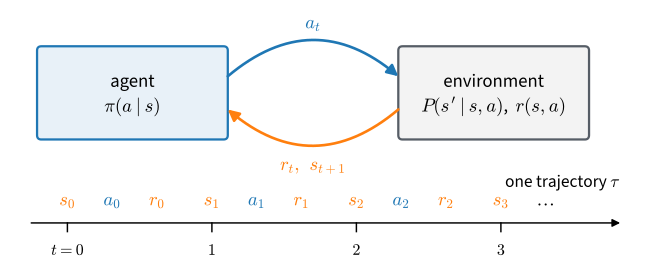
Figure 14.1 shows this interaction. Unrolling the agent–environment loop over time produces a trajectory \(\tau=(s_0,a_0,r_0,s_1,\ldots)\). This feedback introduces the central difficulties studied in this chapter: exploration determines which data are collected, errors alter later state distributions, and policy updates change the distribution used for subsequent learning. The same formulation also applies to language-model generation, where the context is a state and the next token is an action; Section 15.7 develops that correspondence.
The sections progress from settings with the most information to settings with the least. Section 14.1 defines the Markov decision process, and Section 14.2 solves a known finite MDP by dynamic programming. Section 14.3 replaces the model with expert demonstrations. Section 14.4 then removes the expert and learns action values from sampled transitions. Section 14.5 optimizes the policy directly, while Section 14.6 develops lower-variance estimators. Finally, Section 14.7 replaces tabular representations with neural networks for continuous state and action spaces.
Chapter 15 continues with bootstrapped critics, controlled reuse of on-policy data, replay buffers, regularized objectives, and offline learning. Figure 14.2 organizes the methods in both chapters by what they learn and which data they use.
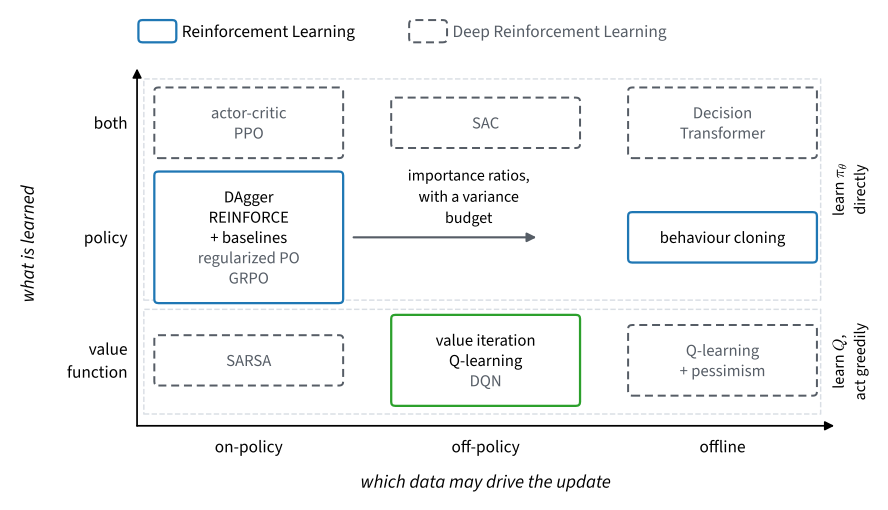
Table 14.1 provides a more detailed guide to the algorithms in both chapters. It records what each method estimates, which data it can use, and where it is introduced.
| algorithm | what it estimates | which data may drive the update | where |
|---|---|---|---|
| value iteration | \(V^*\) exactly, by sweeping the Bellman operator | none: it consumes the kernel \(P\) and reward \(r\) | Section 14.2 |
| behavior cloning | \(\pi(a \mid s)\) by cross-entropy on demonstrations | a fixed expert dataset | Section 14.3 |
| DAgger | the same fit | the learner’s own states, relabeled by an expert on call | Section 14.3 |
| Q-learning (tabular) | \(Q^*\) from sampled backups | any behavior’s transitions (off-policy) | Section 14.4 |
| SARSA | the behavior’s own \(Q\), exploration included | its own transitions (on-policy) | named in Section 14.4 |
| UCB, Thompson sampling | arm means plus their uncertainty | its own pulls (the bandit) | Section 14.4 |
| REINFORCE | \(\nabla_\theta J\) by the score function | fresh trajectories from the current policy only | Section 14.5 |
| REINFORCE with baselines, RLOO | the same gradient at lower variance | fresh trajectories from the current policy | Section 14.6 |
| GRPO | group-normalized advantages, no value network | fresh groups of responses per prompt | weights in Section 14.6; machinery in Chapter 15 |
| REINFORCE with a learned critic, on networks | \(\pi_\theta\) and \(\hat{V}\) as networks | fresh trajectories from the current policy | Section 14.7 |
| actor-critic (A2C) | \(\pi_\theta\) plus a bootstrapped critic | fresh, near-current trajectories | Section 15.1 |
| PPO | \(\pi_\theta\) under a clipped probability ratio | one batch, reused for a few steps | Section 15.2 |
| KL-regularized policy optimization, RLHF | a policy tilted from a reference by reward | rollouts scored by a learned reward | Chapter 15 |
| DQN, Double DQN | \(Q\) as a network | a replay buffer of stale experience | Section 15.4 |
| Rainbow | DQN plus its measured components | a replay buffer | named in Section 15.4 |
| DDPG, TD3 | a critic, and a deterministic actor trained to maximize it | a replay buffer (off-policy) | named in Section 14.7 and Section 15.5 |
| SAC | twin soft critics, and a stochastic squashed actor maximizing reward plus entropy | a replay buffer (off-policy) | Section 15.5 |
| offline Q-learning with pessimism, CQL | \(Q\) penalized where the data is thin | a fixed logged dataset, no interaction at all | Section 15.6 |
| Decision Transformer | a return-conditioned sequence model | a fixed logged dataset | named in Section 15.6 |
| MuZero, Dreamer | a learned model of the environment, to plan or imagine in | its own interaction, replayed through the model | named in Chapter 15 |
| DPO | the regularized optimum directly from preferences | a fixed preference dataset | Chapter 15 and the Language Models part |
The experiments use small environments so that results can be evaluated against exact solutions and repeated across random seeds on a CPU. Numerical conclusions are reported with their relevant uncertainty and limitations in the sections where they arise. This chapter does not cover multi-agent, meta-, hierarchical, or goal-conditioned reinforcement learning, and it introduces partial observability only briefly. Model-based learning, large-scale RLHF, and preference optimization are treated elsewhere in the book.
Resources and Further Reading
The following freely available resources provide theoretical treatments, courses, implementations, and empirical guidance.
Textbooks
- Sutton and Barto, Reinforcement Learning: An Introduction (Sutton and Barto 2018) provides a comprehensive introduction to value methods, policy methods, planning, and function approximation. Sutton and Barto received the 2024 Turing Award for their foundational contributions to reinforcement learning.
- Szepesvári, Algorithms for Reinforcement Learning (Szepesvári 2010) states this chapter’s algorithms and their guarantees in under a hundred pages.
- Bertsekas, A Course in Reinforcement Learning (Bertsekas 2025) develops reinforcement learning from the perspective of optimal control and dynamic programming.
- Agarwal, Jiang, Kakade, and Sun, Reinforcement Learning: Theory and Algorithms (Agarwal et al. 2019) supplies the sample-complexity rates this chapter states qualitatively.
- Lattimore and Szepesvári, Bandit Algorithms (Lattimore and Szepesvári 2020) is the full theory behind the exploration interlude of Section 14.4.
Courses
- Berkeley CS285: Deep Reinforcement Learning covers policy gradients, value methods, model-based learning, and offline reinforcement learning at the graduate level.
- Stanford CS234: Reinforcement Learning is the course closest in scope to this chapter: foundations, exploration, and policy gradients with their guarantees.
- Stanford CS224R: Deep Reinforcement Learning covers the practice, imitation and offline methods included.
- CMU 10-703: Deep Reinforcement Learning and Control pairs the algorithms with control and physical embodiment.
- MIT 6.7920: Reinforcement Learning: Foundations and Methods develops the dynamic-programming theory introduced in Section 14.2.
Annotated implementations
- CleanRL (Huang, Rousslan F. J. Dossa, et al. 2022) provides single-file, benchmarked implementations of the major deep reinforcement learning algorithms discussed after Section 14.7.
- Stable-Baselines3 (Raffin et al. 2021) provides library implementations of the same algorithms, with tuned hyperparameters in its accompanying zoo.
- Gymnasium (Towers et al. 2024) documents the environment interface used throughout these chapters.
Empirical practice
- Spinning Up in Deep RL (Achiam 2018) is a short curriculum from the score function to SAC, written to be read beside running code.
- The 37 Implementation Details of Proximal Policy Optimization (Huang, Rousslan Fernand Julien Dossa, et al. 2022) documents how implementation choices omitted from algorithm descriptions affect PPO performance and reproducibility.