from d2l import tensorflow as d2l
import tensorflow as tf
import mathDecay coefficients
Visualize \gamma^t for several \gamma — choosing \gamma is choosing an effective time horizon:
Demo on the anisotropic quadratic:
d2l.set_figsize()
gammas = [0.95, 0.9, 0.8, 0.7]
for gamma in gammas:
    x = d2l.numpy(d2l.arange(40))
    d2l.plt.plot(x, (1-gamma) * gamma ** x, label=f'gamma = {gamma:.2f}')
d2l.plt.xlabel('time');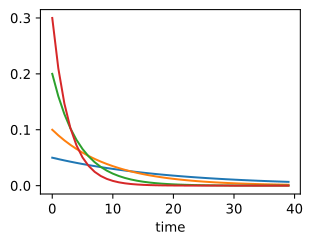
From-scratch RMSProp
Same skeleton as Adagrad, but the accumulator update is now an EMA. One extra hyperparameter (\gamma):
def rmsprop_2d(x1, x2, s1, s2):
    g1, g2, eps = 0.2 * x1, 4 * x2, 1e-6
    s1 = gamma * s1 + (1 - gamma) * g1 ** 2
    s2 = gamma * s2 + (1 - gamma) * g2 ** 2
    x1 -= eta / math.sqrt(s1 + eps) * g1
    x2 -= eta / math.sqrt(s2 + eps) * g2
    return x1, x2, s1, s2

def f_2d(x1, x2):
    return 0.1 * x1 ** 2 + 2 * x2 ** 2

eta, gamma = 0.4, 0.9
d2l.show_trace_2d(f_2d, d2l.train_2d(rmsprop_2d))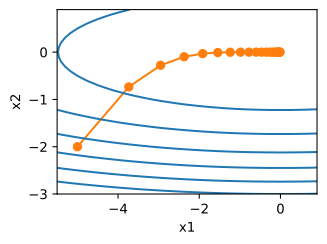
epoch 20, x1: -0.010599, x2: 0.000000def init_rmsprop_states(feature_dim):
s_w = tf.Variable(d2l.zeros((feature_dim, 1)))
s_b = tf.Variable(d2l.zeros(1))
return (s_w, s_b)def rmsprop(params, grads, states, hyperparams):
gamma, eps = hyperparams['gamma'], 1e-6
for p, s, g in zip(params, states, grads):
s[:].assign(gamma * s + (1 - gamma) * tf.math.square(g))
p[:].assign(p - hyperparams['lr'] * g / tf.math.sqrt(s + eps))data_iter, feature_dim = d2l.get_data_ch11(batch_size=10)
d2l.train_ch11(rmsprop, init_rmsprop_states(feature_dim),
{'lr': 0.01, 'gamma': 0.9}, data_iter, feature_dim);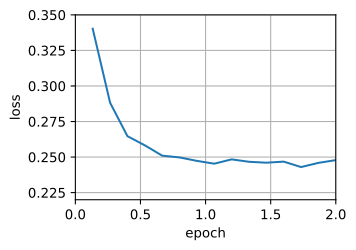
loss: 0.248, 1.209 sec/epochConcise: framework RMSProp
trainer = tf.keras.optimizers.RMSprop
d2l.train_concise_ch11(trainer, {'learning_rate': 0.01, 'rho': 0.9},
                       data_iter)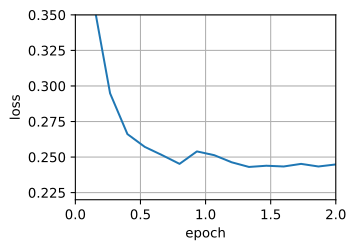
loss: 0.245, 1.373 sec/epoch