%matplotlib inline
from d2l import tensorflow as d2l
import math
import tensorflow as tfSetup and demo
Same anisotropic quadratic. Adagrad self-adapts the step sizes per coordinate:
Bigger learning rate is now safe — the \sqrt{\mathbf{s}_t} divisor handles the dynamic range:
def adagrad_2d(x1, x2, s1, s2):
    eps = 1e-6
    g1, g2 = 0.2 * x1, 4 * x2
    s1 += g1 ** 2
    s2 += g2 ** 2
    x1 -= eta / math.sqrt(s1 + eps) * g1
    x2 -= eta / math.sqrt(s2 + eps) * g2
    return x1, x2, s1, s2

def f_2d(x1, x2):
    return 0.1 * x1 ** 2 + 2 * x2 ** 2

eta = 0.4
d2l.show_trace_2d(f_2d, d2l.train_2d(adagrad_2d))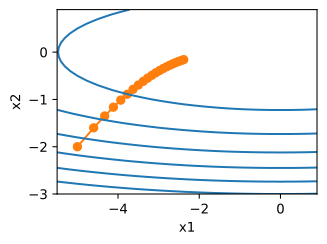
epoch 20, x1: -2.382563, x2: -0.158591eta = 2
d2l.show_trace_2d(f_2d, d2l.train_2d(adagrad_2d))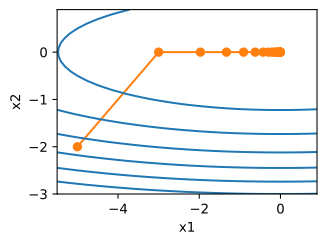
epoch 20, x1: -0.002295, x2: -0.000000From-scratch Adagrad
Carry one accumulator \mathbf{s} per parameter. Add \epsilon to avoid division by zero on the first step:
def init_adagrad_states(feature_dim):
    s_w = tf.Variable(d2l.zeros((feature_dim, 1)))
    s_b = tf.Variable(d2l.zeros(1))
    return (s_w, s_b)

def adagrad(params, grads, states, hyperparams):
    eps = 1e-6
    for p, s, g in zip(params, states, grads):
        s[:].assign(s + tf.math.square(g))
        p[:].assign(p - hyperparams['lr'] * g / tf.math.sqrt(s + eps))
data_iter, feature_dim = d2l.get_data_ch11(batch_size=10)
d2l.train_ch11(adagrad, init_adagrad_states(feature_dim),
{'lr': 0.1}, data_iter, feature_dim);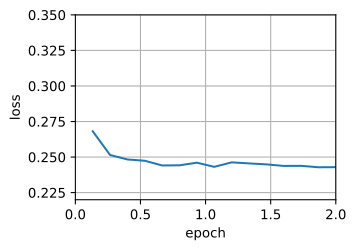
loss: 0.243, 1.107 sec/epochConcise: framework Adagrad
trainer = tf.keras.optimizers.Adagrad
d2l.train_concise_ch11(trainer, {'learning_rate' : 0.1}, data_iter)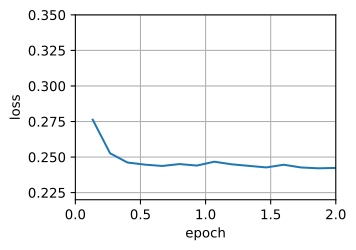
loss: 0.242, 1.131 sec/epoch