# Use CUDA's async stream-ordered allocator instead of TF's default BFC pool.
# BFC grows in doubling chunks and never releases, so the spiky backward pass
# over the vocabulary-sized MLM logits leaves ~5 GiB reserved-but-unused; the
# async allocator returns freed blocks, making the footprint track live usage.
import os
os.environ['TF_GPU_ALLOCATOR'] = 'cuda_malloc_async'
from d2l import tensorflow as d2l
import tensorflow as tf
from tensorflow import kerasTraining loop
Standard SGD with warmup; on this tiny corpus a few hundred steps is enough to see both losses drop. MLM loss stays higher than NSP because it predicts a large vocabulary rather than a binary label:
def train_bert(train_iter, net, vocab_size, devices, num_steps, num_micro=2):
    optimizer = keras.optimizers.Adam(learning_rate=1e-4)
    step, timer = 0, d2l.Timer()
    animator = d2l.Animator(xlabel='step', ylabel='loss',
                            xlim=[1, num_steps], legend=['mlm', 'nsp'])
    # Sum of masked language modeling losses, sum of next sentence prediction
    # losses, no. of sentence pairs, count
    metric = d2l.Accumulator(4)
    num_steps_reached = False
    while step < num_steps and not num_steps_reached:
        for batch in train_iter:
            timer.start()
            # TF's eager autodiff holds the whole batch's vocabulary-sized MLM
            # activations and gradients live at once, which is why this step is
            # ~5x heavier here than in the other frameworks. Split the batch
            # into `num_micro` micro-batches and accumulate their averaged
            # gradients: mathematically the same update, but the peak MLM
            # tensors shrink to 1/num_micro of a full batch's.
            splits = [tf.split(t, num_micro, axis=0) for t in batch]
            accum, mlm_sum, nsp_sum = None, 0., 0.
            for j in range(num_micro):
                (tokens_X, segments_X, valid_lens_x, pred_positions_X,
                 mlm_weights_X, mlm_Y, nsp_y) = [s[j] for s in splits]
                with tf.GradientTape() as tape:
                    mlm_l, nsp_l, l = _get_batch_loss_bert(
                        net, vocab_size, tokens_X, segments_X, valid_lens_x,
                        pred_positions_X, mlm_weights_X, mlm_Y, nsp_y,
                        training=True)
                    l = l / num_micro
                grads = tape.gradient(l, net.trainable_variables)
                # Embedding grads come back as IndexedSlices; densify so they
                # accumulate (dense (vocab_size, num_hiddens) is small).
                grads = [tf.convert_to_tensor(g) for g in grads]
                accum = grads if accum is None else [
                    a + g for a, g in zip(accum, grads)]
                mlm_sum += float(mlm_l) / num_micro
                nsp_sum += float(nsp_l) / num_micro
            optimizer.apply_gradients(zip(accum, net.trainable_variables))
            metric.add(mlm_sum, nsp_sum, batch[0].shape[0], 1)
            timer.stop()
            animator.add(step + 1,
                         (metric[0] / metric[3], metric[1] / metric[3]))
            step += 1
            if step == num_steps:
                num_steps_reached = True
                break

    print(f'MLM loss {metric[0] / metric[3]:.3f}, '
          f'NSP loss {metric[1] / metric[3]:.3f}')
    print(f'{metric[2] / timer.sum():.1f} sentence pairs/sec on '
          f'{len(devices)} devices')
devices = d2l.try_all_gpus()
train_bert(train_iter, net, len(vocab), devices, 50)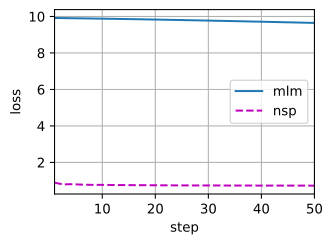
MLM loss 9.658, NSP loss 0.721
1011.6 sentence pairs/sec on 1 devices