class MLPScratch(d2l.Classifier):
    def __init__(self, num_inputs, num_outputs, num_hiddens, lr, sigma=0.01):
        super().__init__()
        self.save_hyperparameters()
        self.W1 = tf.Variable(
            tf.random.normal((num_inputs, num_hiddens)) * sigma)
        self.b1 = tf.Variable(tf.zeros(num_hiddens))
        self.W2 = tf.Variable(
            tf.random.normal((num_hiddens, num_outputs)) * sigma)
self.b2 = tf.Variable(tf.zeros(num_outputs))The MLP architecture
What we are building
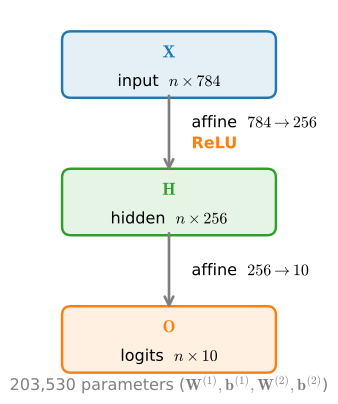
A batched image is flattened to 784 features, mapped by an affine layer + ReLU to a 256-dim hidden vector, then by a second affine layer to 10 logits.
- One hidden layer, one nonlinearity.
- Same loss, loaders, and
Traineras softmax regression.
That ReLU between the two affine maps, together with the hidden layer, is the entire difference from a linear classifier like softmax regression.
Why these sizes?
Design choices
Fashion-MNIST: 784 inputs, 10 classes. We pick 256 hidden units, giving \approx 200\text{k} parameters.
- Width 256: a representative capacity for this example.
- A power of 2: often favorable for accelerator kernels, although performance depends on hardware and precision.
- One hidden layer suffices here; spatial structure waits for convolutions.
Depth, width, and learning rate are hyperparameters: chosen by hand, not learned.
Training the from-scratch model
From Scratch
The loss, the loaders, and the Trainer are unchanged from softmax regression. Only the model class is new:
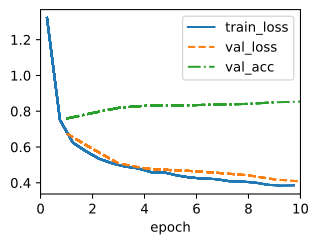
In this run, validation accuracy settles around \approx 0.87 over 30 epochs, a modest gain over the softmax regression baseline on the same data, for a model with one hidden layer and a ReLU.
Reusing the training loop
Concise
The concise model reuses the same trainer and data. Its trajectory can differ because its initializer is different:
model = MLP(num_outputs=10, num_hiddens=256, lr=0.1)
trainer.fit(model, data)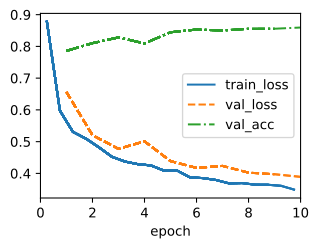
Same architecture, different init (framework default vs \mathcal{N}(0, 0.01^2)), so trajectories differ slightly.