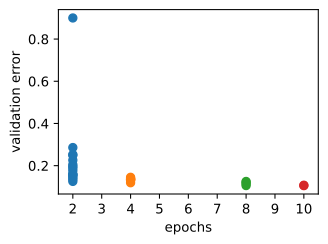
Successive halving — algorithm

Multi-Fidelity Hyperparameter Optimization

Multi-Fidelity HPO

Random search wastes most of its compute on bad configs — training each one to convergence to find out. But you often know after a few epochs that a config is hopeless: the training loss curve barely moves.

Multi-fidelity HPO uses cheap, low-fidelity evaluations (few epochs, small subset of data) to prune bad configs early, spending the saved compute on the promising ones.
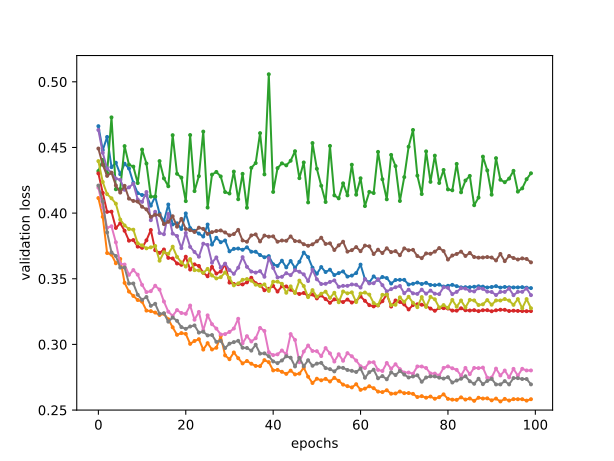
Learning curves of random configs: most diverge fast; a few rise to the top.

The classic algorithm: successive halving. Run N configs for a small budget; keep the top 1/\eta, run for \eta\times longer; repeat.
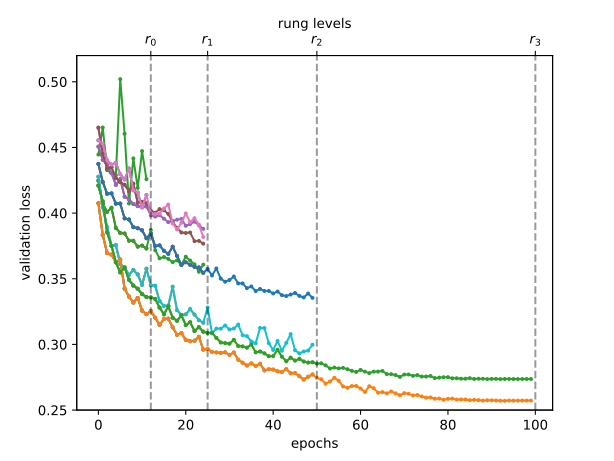
Successive halving: prune bad configs at every rung, double the budget for survivors.

Setup

import tensorflow as tf
tf.config.set_visible_devices([], 'GPU')
from d2l import tensorflow as d2l
import numpy as np
from scipy import stats
from collections import defaultdict
d2l.set_figsize()

Discretize budget into rungs r_1 < r_2 < \ldots. At rung i:

  1. Train all surviving configs to budget r_i epochs.
  2. Sort by validation error.
  3. Keep the top 1/\eta. Discard the rest.

Continue to the next rung with \eta \times the budget, 1/\eta the number of configs. Total compute roughly constant per rung.

If n_i \approx n_0/\eta^i and r_i=r_0\eta^i, then n_i r_i \approx n_0 r_0: later rungs spend the same budget on fewer, better configurations.

Implementation

class SuccessiveHalvingScheduler(d2l.HPOScheduler):
    def __init__(self, searcher, eta, r_min, r_max, prefact=1):
        self.save_hyperparameters()
        # Compute K, which is later used to determine the number of configurations
        self.K = int(np.log(r_max / r_min) / np.log(eta))
        # Define the rungs
        self.rung_levels = [r_min * eta ** k for k in range(self.K + 1)]
        if r_max not in self.rung_levels:
            # The final rung should be r_max
            self.rung_levels.append(r_max)
            self.K += 1
        # Bookkeeping
        self.observed_error_at_rungs = defaultdict(list)
        self.all_observed_error_at_rungs = defaultdict(list)
        # Our processing queue
        self.queue = []
@d2l.add_to_class(SuccessiveHalvingScheduler)
def suggest(self):
    if len(self.queue) == 0:
        # Start a new round of successive halving
        # Number of configurations for the first rung:
        n0 = int(self.prefact * self.eta ** self.K)
        for _ in range(n0):
            config = self.searcher.sample_configuration()
            config["max_epochs"] = self.r_min  # Set r = r_min
            self.queue.append(config)
    # Return an element from the queue
    return self.queue.pop()

Implementation (cont.)

@d2l.add_to_class(SuccessiveHalvingScheduler)
def update(self, config: dict, error: float, info=None):
    ri = int(config["max_epochs"])  # Rung r_i
    # Update our searcher, e.g if we use Bayesian optimization later
    self.searcher.update(config, error, additional_info=info)
    self.all_observed_error_at_rungs[ri].append((config, error))
    if ri < self.r_max:
        # Bookkeeping
        self.observed_error_at_rungs[ri].append((config, error))
        # Determine how many configurations should be evaluated on this rung
        ki = self.K - self.rung_levels.index(ri)
        ni = int(self.prefact * self.eta ** ki)
        # If we observed all configuration on this rung r_i, we estimate the
        # top 1 / eta configuration, add them to queue and promote them for
        # the next rung r_{i+1}
        if len(self.observed_error_at_rungs[ri]) >= ni:
            kiplus1 = ki - 1
            niplus1 = int(self.prefact * self.eta ** kiplus1)
            best_performing_configurations = self.get_top_n_configurations(
                rung_level=ri, n=niplus1
            )
            riplus1 = self.rung_levels[self.K - kiplus1]  # r_{i+1}
            # Queue may not be empty: insert new entries at the beginning
            self.queue = [
                dict(config, max_epochs=riplus1)
                for config in best_performing_configurations
            ] + self.queue
            self.observed_error_at_rungs[ri] = []  # Reset
@d2l.add_to_class(SuccessiveHalvingScheduler)
def get_top_n_configurations(self, rung_level, n):
    rung = self.observed_error_at_rungs[rung_level]
    if not rung:
        return []
    sorted_rung = sorted(rung, key=lambda x: x[1])
    return [x[0] for x in sorted_rung[:n]]

Running it

min_number_of_epochs = 2
max_number_of_epochs = 10
eta = 2
num_gpus=1

config_space = {
    "learning_rate": stats.loguniform(1e-2, 1),
    "batch_size": stats.randint(32, 256),
}
initial_config = {
    "learning_rate": 0.1,
    "batch_size": 128,
}

The run evaluates 30 configurations across increasing budgets. For lecture, keep the code visible but suppress the intermediate animation frames; the next slide shows the resulting incumbent trajectory.

Recap

  • Successive halving = aggressive early stopping based on partial-training scores.
  • Hyperparameter \eta (typical: 3 or 4) controls how aggressive the halving is.
  • Total budget per rung stays constant; survivors get exponentially more compute.
  • The asynchronous variant (ASHA, next deck) generalizes this to parallel workers without idle time.