Deep Convolutional Generative Adversarial Networks
DCGAN
DCGAN (Radford, Metz, Chintala 2015) — the recipe that made image GANs work in practice. Architectural rules that became standard:
- All-convolutional generator (transposed convs to upsample, no fully connected layers).
- All-convolutional discriminator (strided convs to downsample).
- Batch normalization in both networks.
- ReLU in generator (Tanh on output), LeakyReLU in discriminator.
- Adam optimizer, learning rate 0.0002, \beta_1 = 0.5.
These choices transformed GANs from “interesting but unstable” to a workable image-generation tool.
This deck trains a DCGAN to generate Pokémon sprites.
Pokémon dataset
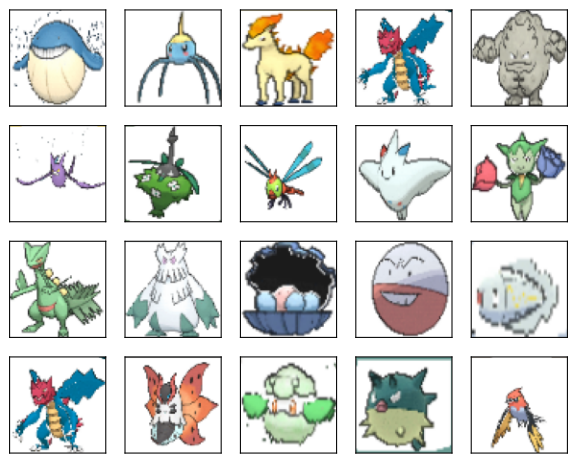
Small image dataset — perfect size for a teaching demo of DCGAN. Resize to 64×64, normalize to [-1, 1] (matches generator’s tanh output range):
- images are resized to 64 \times 64;
- pixel values are scaled to [-1, 1];
- the generator’s last activation is
tanh, so real and generated images live in the same numeric range.
Inspecting samples
Use these real images to calibrate the task: low resolution, centered objects, and normalized colors. The generator only has to match this sprite distribution, not produce arbitrary photographs.
Generator block
TransposedConv → BatchNorm → ReLU. Stack five of these to upsample 1 \times 1 noise to 64 \times 64 pixels:
- each block doubles spatial resolution;
- BatchNorm stabilizes feature scales;
- ReLU keeps gradients healthy;
- the final block uses
tanh instead of ReLU.
Generator architecture
Five generator blocks; final layer projects to 3 channels with tanh:
\mathbf{z}\in\mathbb{R}^{d}
\rightarrow 4{\times}4
\rightarrow 8{\times}8
\rightarrow 16{\times}16
\rightarrow 32{\times}32
\rightarrow 64{\times}64{\times}3.
Pedagogically: the generator learns an upsampling map from a latent code to an image, not a pixel-by-pixel lookup table.
Discriminator block
Conv → BatchNorm → LeakyReLU. Mirrored architecture: five blocks downsampling 64 \times 64 to 1 \times 1:
- strided convolutions replace pooling;
- LeakyReLU avoids dead activations;
- BatchNorm is skipped on the input layer;
- the output is a real/fake logit.
Discriminator architecture
64{\times}64{\times}3
\rightarrow 32{\times}32
\rightarrow 16{\times}16
\rightarrow 8{\times}8
\rightarrow 4{\times}4
\rightarrow 1.
This is a learned critic: high score for real images, low score for generated images. The generator trains against this signal.
Training
Same minimax loss as basic GAN; per-step alternation of D then G updates with the DCGAN-recommended Adam hyperparameters:
- update D on real images labeled 1;
- update D on generated images labeled 0;
- update G so generated images make D predict 1.
This alternating game is why GAN training is unstable: the target distribution moves every time either player improves.
Training trace
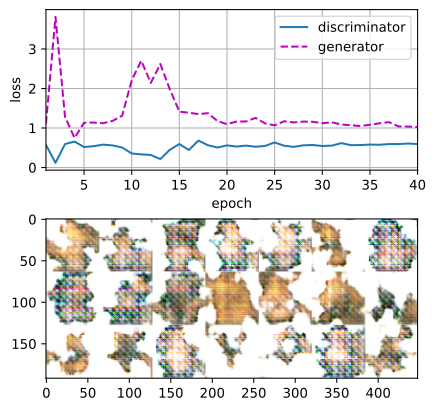
Read the loss curves together with the generated samples. Healthy training usually shows neither player instantly winning forever; the more important sign is that generated sprites become sharper and more Pokemon-like over epochs.
loss_D 0.133, loss_G 3.379, 10746.3 examples/sec on /GPU:0
Recap
- DCGAN = standard architectural recipe for image GANs: all-conv generator/discriminator, BatchNorm, Tanh/LeakyReLU.
- Adam(0.0002, \beta_1=0.5) is the magic LR/momentum combo that stabilized training in 2015.
- Modern image generators (StyleGAN, BigGAN, diffusion models) supersede DCGAN; the architectural lessons (all-conv, normalization, careful activation choice) carry over.