from d2l import tensorflow as d2l
import tensorflow as tfPooling
Pooling summarizes local evidence
Pooling is a parameter-free downsampling operation: slide a window, replace it with a single summary value (max or mean).
Two reasons to use it:
- Spatial aggregation — summarize over locations to answer “is there a cat anywhere in the image?”.
- Local translation tolerance — a 1-pixel shift doesn’t usually change the max of a small window. Robust to small spatial perturbations.
2×2 pool with stride 2 — halves resolution, the canonical example.
Max-Pooling Selects the Largest Local Response
Same sliding-window pattern as a convolution, but the operation is max instead of multiply-and-sum:
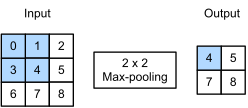
2×2 max-pool: each output = max of a 2×2 input window. \max(0, 1, 3, 4) = 4.
Average pooling replaces max with mean. Local max-pooling was the standard downsampler in early CNNs and remains in some stems. Modern networks more often use strided convolutions for learned downsampling and global average pooling in the classification head.
Implementation
A few lines implement the operation: no kernel, only a reduction over each window. Two modes: max and avg.
def pool2d(X, pool_size, mode='max'):
    p_h, p_w = pool_size
    Y = tf.Variable(tf.zeros((X.shape[0] - p_h + 1, X.shape[1] - p_w +1)))
    for i in range(Y.shape[0]):
        for j in range(Y.shape[1]):
            if mode == 'max':
                Y[i, j].assign(tf.reduce_max(X[i: i + p_h, j: j + p_w]))
            elif mode =='avg':
                Y[i, j].assign(tf.reduce_mean(X[i: i + p_h, j: j + p_w]))
    return Y
Verify against the figure
Max-pooling returns 4, 5, 7, 8, matching the diagram:
<tf.Variable 'Variable:0' shape=(2, 2) dtype=float32, numpy=
array([[4., 5.],
[7., 8.]], dtype=float32)>Why max gives local translation tolerance
A 2×2 max-pool window on [0, 1, 3, 4] returns 4. Shift the input by a pixel; window now sees [1, 0, 4, 0] — still 4.
A small shift moves which element fires, not whether some element in the window fires. As long as the feature stays inside the window, the output is unchanged.
Modern alternative: a strided convolution does the same downsampling but learns its own “pool” function.
Padding and stride for pooling
Pooling uses the same padding and stride controls as convolution, but a framework MaxPool2d typically matches the stride to the window size to create non-overlapping windows and reduce resolution.
<tf.Tensor: shape=(1, 4, 4, 1), dtype=float32, numpy=
array([[[[ 0.],
         [ 1.],
         [ 2.],
         [ 3.]],

...
         [11.]],

        [[12.],
         [13.],
         [14.],
[15.]]]], dtype=float32)>Overlapping and asymmetric pools
Override the defaults when you want overlapping pools:
<tf.Tensor: shape=(1, 2, 2, 1), dtype=float32, numpy=
array([[[[ 5.],
         [ 7.]],

        [[13.],
         [15.]]]], dtype=float32)>
Or asymmetric pools per axis:
<tf.Tensor: shape=(1, 2, 2, 1), dtype=float32, numpy=
array([[[[ 5.],
         [ 7.]],

        [[13.],
         [15.]]]], dtype=float32)>
Multi-channel pooling
Convs combine channels (input channels feed every output channel). Pooling does not:
- Each input channel is pooled independently.
- Output channel count = input channel count.
- Pooling has no notion of channel mixing.
<tf.Tensor: shape=(1, 4, 4, 2), dtype=float32, numpy=
array([[[[ 0.,  1.],
         [ 1.,  2.],
         [ 2.,  3.],
         [ 3.,  4.]],

...
         [11., 12.]],

        [[12., 13.],
         [13., 14.],
         [14., 15.],
[15., 16.]]]], dtype=float32)><tf.Tensor: shape=(1, 2, 2, 2), dtype=float32, numpy=
array([[[[ 5., 6.],
[ 7., 8.]],
[[13., 14.],
[15., 16.]]]], dtype=float32)>Where pooling sits in modern architectures
- Classic CNNs (LeNet, AlexNet, VGG): pool every few conv layers to halve spatial dims; final stack is fully connected.
- ResNet / modern: pool less often — strided convs (
stride=2) handle most downsampling. One initial max-pool, then strided convs. - Global average pooling: at the very end, average the entire feature map per channel. Replaces the fully connected stack with a linear classifier, reducing the parameter count. ResNet uses this design.
Recap
- Pooling = window-slide reduction (max or mean), no learnable parameters.
- 2×2 max-pool with stride 2 is the classic spatial downsampler.
- Provides limited translation tolerance: the output unchanged under sub-window shifts.
- Per-channel — no channel mixing.
- Modern nets downsample mostly with strided convs; pooling survives as global average pooling at the head, plus a max-pool in some stems.