import tensorflow as tf
from d2l import tensorflow as d2lVGG (Simonyan & Zisserman, 2014) is AlexNet taken seriously: stack more layers, but make them regular.
The contribution wasn’t a clever architecture — it was a design principle: regular blocks of 3×3 conv + ReLU, ending in a 2×2 max-pool. Whole network = a sequence of such blocks at growing channel counts.
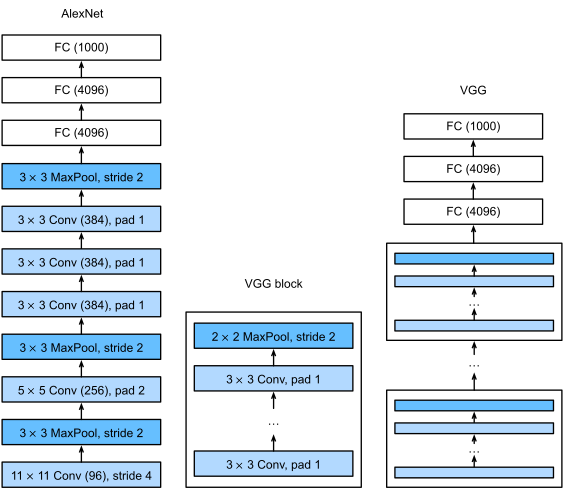
From AlexNet’s hand-tuned layers to VGG’s repeated 3×3 blocks.
(n_convs, channels) pairs; pass a different tuple for VGG-13/16/19.Stacking small kernels grows the visible patch without paying for a large kernel in one step.
For stride 1 and no dilation:
r_L = 1 + \sum_{\ell=1}^L (k_\ell - 1).
Two 3×3 convolutions see
1 + (3 - 1) + (3 - 1) = 5
pixels across: the same 5×5 receptive field as one 5×5 conv, but with two ReLUs and fewer weights.
A reusable subunit: n_convs consecutive Conv-ReLU pairs at out_channels, followed by a 2×2 MaxPool:
A whole VGG-11 (the smallest variant) is just five blocks at growing channel counts (64, 128, 256, 512, 512) plus a 3-layer dense head:
class VGG(d2l.Classifier):
def __init__(self, arch, lr=0.1, num_classes=10):
super().__init__()
self.save_hyperparameters()
self.net = tf.keras.models.Sequential()
for (num_convs, num_channels) in arch:
self.net.add(vgg_block(num_convs, num_channels))
self.net.add(
tf.keras.models.Sequential([
tf.keras.layers.Flatten(),
tf.keras.layers.Dense(4096, activation='relu'),
tf.keras.layers.Dropout(0.5),
tf.keras.layers.Dense(4096, activation='relu'),
tf.keras.layers.Dropout(0.5),
tf.keras.layers.Dense(num_classes)]))Sequential output shape: (1, 112, 112, 64)
Sequential output shape: (1, 56, 56, 128)
Sequential output shape: (1, 28, 28, 256)
Sequential output shape: (1, 14, 14, 512)
Sequential output shape: (1, 7, 7, 512)
Sequential output shape: (1, 10)
The “named architecture” is just a tuple of (n_convs, channels) pairs — passing a different tuple gives you VGG-13/16/19.
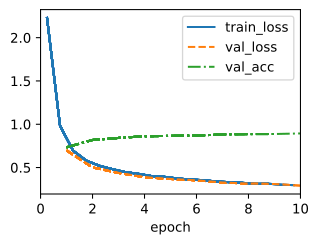
Full VGG-11 is heavy for a notebook. Train a thinned version (channels 16/32/64/128/128) on Fashion-MNIST as a smoke test:
Validates the block-at-scale design principle without melting your GPU.
((1, 64), (1, 128), (2, 256), …)) is everywhere — VGG, ResNet, EfficientNet, ConvNeXt all use it.