from d2l import tensorflow as d2l
import tensorflow as tfDense block
Densely Connected Networks (DenseNet)
DenseNet concatenates features
DenseNet (Huang et al., 2017) takes the residual idea one step further: instead of adding skip connections, concatenate them.
\mathbf{x}_\ell = f_\ell\bigl([\mathbf{x}_0, \mathbf{x}_1, \dots, \mathbf{x}_{\ell-1}]\bigr).
Every layer in a dense block sees the concatenation of all preceding outputs.
Dense block + transition
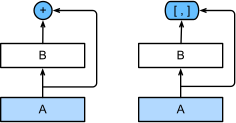
Dense block grows channels by concatenation; transition layers (1×1 conv + pool) reset channels between blocks.
Pros: maximum feature reuse, fewer parameters than ResNet for similar accuracy. Cons: memory grows linearly with depth within a block — handled by transitions.
Conv block
A small conv block (BN → ReLU → 3×3 conv) is the unit; a DenseBlock will reuse it repeatedly.
class ConvBlock(tf.keras.layers.Layer):
    def __init__(self, num_channels):
        super(ConvBlock, self).__init__()
        self.bn = tf.keras.layers.BatchNormalization()
        self.relu = tf.keras.layers.ReLU()
        self.conv = tf.keras.layers.Conv2D(
            filters=num_channels, kernel_size=(3, 3), padding='same')

        self.listLayers = [self.bn, self.relu, self.conv]

    def call(self, x):
        y = x
        for layer in self.listLayers:
            y = layer(y)
        y = tf.keras.layers.concatenate([x,y], axis=-1)
        return y
Now stack the conv blocks. After each block, concatenate its new features onto the running input, so later blocks see everything computed so far.
Channel growth
A DenseBlock(num_convs=2, num_channels=10) on a 3-channel input grows channels by num_convs * num_channels per block:
TensorShape([4, 8, 8, 23])Transition layer
Stops the channel explosion between dense blocks: 1×1 conv halves channels, 2×2 avg-pool halves spatial dims:
class TransitionBlock(tf.keras.layers.Layer):
    def __init__(self, num_channels, **kwargs):
        super(TransitionBlock, self).__init__(**kwargs)
        self.batch_norm = tf.keras.layers.BatchNormalization()
        self.relu = tf.keras.layers.ReLU()
        self.conv = tf.keras.layers.Conv2D(num_channels, kernel_size=1)
        self.avg_pool = tf.keras.layers.AvgPool2D(pool_size=2, strides=2)

    def call(self, x):
        x = self.batch_norm(x)
        x = self.relu(x)
        x = self.conv(x)
return self.avg_pool(x)The DenseNet model
A standard “stem → dense block → transition → dense block → transition → … → global avg-pool → linear” pipeline:
def __init__(self, num_channels=64, growth_rate=32, arch=(4, 4, 4, 4),
             lr=0.1, num_classes=10):
    super(DenseNet, self).__init__()
    self.save_hyperparameters()
    self.net = self.b1()
    for i, num_convs in enumerate(arch):
        self.net.add(DenseBlock(num_convs, growth_rate))
        # The number of output channels in the previous dense block
        num_channels += num_convs * growth_rate
        # A transition layer that halves the number of channels is added
        # between the dense blocks
        if i != len(arch) - 1:
            num_channels //= 2
            self.net.add(TransitionBlock(num_channels))
    self.net.add(tf.keras.models.Sequential([
        tf.keras.layers.BatchNormalization(),
        tf.keras.layers.ReLU(),
        tf.keras.layers.GlobalAvgPool2D(),
        tf.keras.layers.Flatten(),
        tf.keras.layers.Dense(num_classes)]))
Training
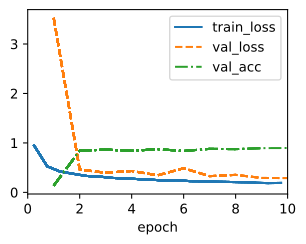
DenseNet hits competitive ImageNet accuracy with far fewer parameters than equivalent ResNets — the concatenation reuse genuinely helps.
Recap
- ResNet adds skip connections; DenseNet concatenates them.
- Inside a dense block, layer \ell sees all of layers 0, …, \ell-1 — maximum feature reuse.
- Transition layers between dense blocks rein in the channel-count explosion via 1×1 conv + pool.
- Same parameter count → typically better accuracy than ResNet; same accuracy → fewer parameters.