import tensorflow as tf
from d2l import tensorflow as d2lTransposed Convolution
A standard convolution + pooling stack reduces spatial resolution. For dense prediction (semantic segmentation, generative models, super-resolution) we need to go the other way — upsample features back to image resolution.
The standard tool: transposed convolution, also called “deconvolution” (a misnomer — it’s not a true inverse). Each input element broadcasts a full kernel into the output, contributions from neighbors get summed:
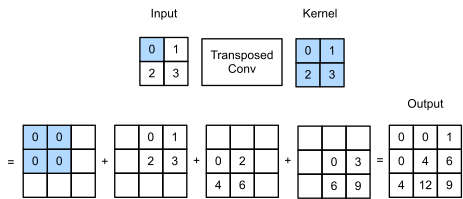
A 2 \times 2 transposed convolution: each input element scatters its kernel into the output.
Output shape grows: with stride 1, kernel k, no padding, n_{\text{out}} = n_{\text{in}} + k - 1. With stride s, multiplied accordingly.
Padding, stride, channels
Padding here removes output rows/columns instead of adding them — it’s the inverse interpretation.
Stride > 1 inserts zeros between input elements before the scatter — that’s how transposed conv upsamples:
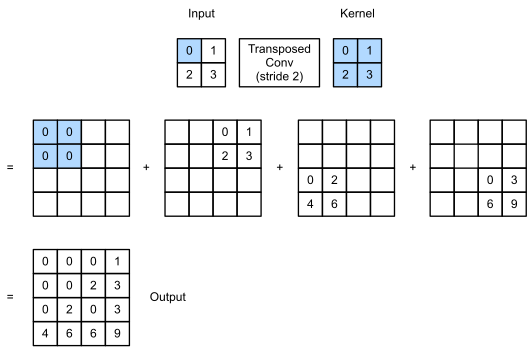
Stride-2 transposed conv: each input element’s kernel is placed at twice-spaced positions, then summed.
Multi-channel works as expected: input channels reduce-add through the kernel, output channels stack in parallel: