%matplotlib inline
from d2l import tensorflow as d2l
import tensorflow as tf
import kerasTraining on Multiple GPUs
Scaling beyond one GPU
A single GPU can train ResNet on ImageNet — slowly. Modern large models need many GPUs. Three ways to split work:
- Network partitioning — different layers on different GPUs. Hard to balance; rarely used alone today.
- Layerwise partitioning — split each layer’s parameters across GPUs (model parallelism). For giant models whose weights don’t fit on one GPU.
- Data parallelism — replicate the model on every GPU; each processes a different minibatch chunk; gradients averaged across GPUs.
Data parallelism is the default for everyday training.
Strategies side by side
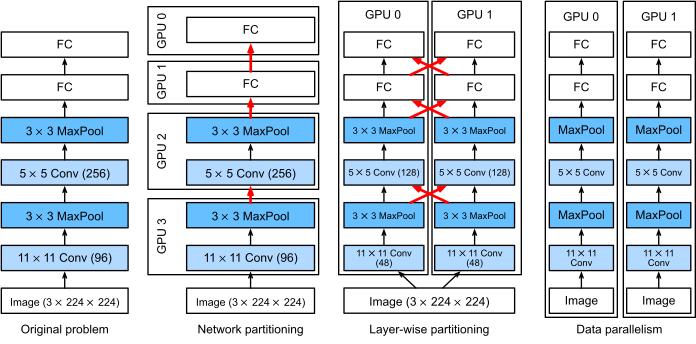
Original, network partitioning, layerwise partitioning, data parallelism.
Data parallelism
Each GPU computes a forward + backward pass on its slice of the minibatch. After the backward pass, gradients are averaged across GPUs (all_reduce). Optimizer step then runs identically on every GPU, keeping replicas in sync.
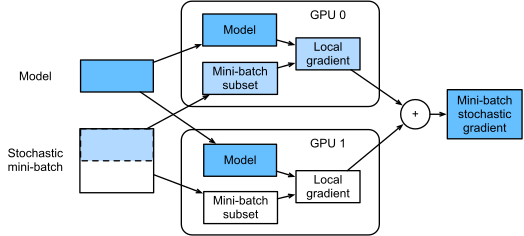
Data-parallel SGD on 2 GPUs: split data, compute gradients independently, all-reduce, then update.
Toy network
Tiny LeNet for the demo — small enough to fit on each GPU many times over:
# Initialize model parameters (NHWC layout for TF)
scale = 0.01
# W shape: (H, W, in_channels, out_channels) for TF conv2d
W1 = tf.Variable(tf.random.normal(shape=(3, 3, 1, 20)) * scale)
b1 = tf.Variable(tf.zeros(20))
W2 = tf.Variable(tf.random.normal(shape=(5, 5, 20, 50)) * scale)
b2 = tf.Variable(tf.zeros(50))
W3 = tf.Variable(tf.random.normal(shape=(800, 128)) * scale)
b3 = tf.Variable(tf.zeros(128))
W4 = tf.Variable(tf.random.normal(shape=(128, 10)) * scale)
b4 = tf.Variable(tf.zeros(10))
params = [W1, b1, W2, b2, W3, b3, W4, b4]

# Define the model (inputs in NHWC format)
def lenet(X, params):
    h1_conv = tf.nn.conv2d(X, params[0], strides=1, padding='VALID') + params[1]
    h1_activation = tf.nn.relu(h1_conv)
    h1 = tf.nn.avg_pool2d(h1_activation, ksize=2, strides=2, padding='VALID')
    h2_conv = tf.nn.conv2d(h1, params[2], strides=1, padding='VALID') + params[3]
    h2_activation = tf.nn.relu(h2_conv)
    h2 = tf.nn.avg_pool2d(h2_activation, ksize=2, strides=2, padding='VALID')
    h2 = tf.reshape(h2, (tf.shape(h2)[0], -1))
    h3_linear = tf.linalg.matmul(h2, params[4]) + params[5]
    h3 = tf.nn.relu(h3_linear)
    y_hat = tf.linalg.matmul(h3, params[6]) + params[7]
    return y_hat

# Cross-entropy loss function
loss = tf.keras.losses.SparseCategoricalCrossentropy(from_logits=True,
                                                      reduction='none')
Distribute parameters
Replicate the parameter list onto each device:
b1 weight: [0. 0. 0. 0. 0. 0. 0. 0. 0. 0. 0. 0. 0. 0. 0. 0. 0. 0. 0. 0.]
b1 grad: <tf.Variable 'Variable:0' shape=(20,) dtype=float32, numpy=
array([0., 0., 0., 0., 0., 0., 0., 0., 0., 0., 0., 0., 0., 0., 0., 0., 0.,
       0., 0., 0.], dtype=float32)>
all_reduce
Sum vectors across GPUs and broadcast the result back — the gradient-averaging primitive of data-parallel SGD. NCCL implements this efficiently in production:
def allreduce(data):
    """Sum tensors from all devices and broadcast the result back."""
    # Accumulate on the device of data[0]
    with tf.device(data[0].device):
        total = tf.add_n([tf.identity(d) for d in data])
    # Broadcast to all devices in-place
    for i in range(len(data)):
        with tf.device(data[i].device):
data[i].assign(tf.identity(total))before allreduce:
[[1. 1.]]
[[2. 2.]]
after allreduce:
[[3. 3.]]
[[3. 3.]]Distribute the minibatch
Split a tensor evenly across devices:
input : [[ 0.  1.  2.  3.  4.]
 [ 5.  6.  7.  8.  9.]
 [10. 11. 12. 13. 14.]
 [15. 16. 17. 18. 19.]]
load into ['/device:GPU:0', '/device:GPU:1']
output: [array([[0., 1., 2., 3., 4.],
       [5., 6., 7., 8., 9.]], dtype=float32), array([[10., 11., 12., 13., 14.],
[15., 16., 17., 18., 19.]], dtype=float32)]One step of multi-GPU training
Forward + backward on each replica → all_reduce gradients → update parameters identically:
def train_batch(X, y, device_params, devices, lr):
    X_shards, y_shards = split_batch(X, y, devices)
    # Compute loss and gradients independently on each GPU
    grads_list = []
    for X_shard, y_shard, device_W in zip(X_shards, y_shards, device_params):
        with tf.device(device_W[0].device):
            with tf.GradientTape() as tape:
                # SparseCategoricalCrossentropy: loss(y_true, y_pred)
                l = tf.reduce_sum(loss(y_shard, lenet(X_shard, device_W)))
            grads_list.append(tape.gradient(l, device_W))
    # All-reduce: sum gradients from every GPU onto GPU 0, then broadcast.
    # grads_list[c][i] is a plain Tensor (not a Variable), so we sum them
    # with tf.add_n and write the aggregated gradient into every replica.
    num_params = len(device_params[0])
    num_dev = len(devices)
    agg_grads = []
    for i in range(num_params):
        with tf.device(device_params[0][i].device):
            agg_grads.append(tf.add_n([
                tf.identity(grads_list[c][i]) for c in range(num_dev)]))
    # Apply SGD update on each GPU using the aggregated (all-reduced) gradient
    for device_W in device_params:
        for p, g in zip(device_W, agg_grads):
            with tf.device(p.device):
                # Denominator X.shape[0] normalizes for batch size.
                # Invariant: loss uses tf.reduce_sum (not mean) and
                # all-reduce uses tf.add_n (not mean), so dividing by
                # batch size here gives the correct per-sample gradient.
                p.assign_sub(lr / X.shape[0] * tf.identity(g))
def train(num_gpus, batch_size, lr):
train_iter, test_iter = d2l.load_data_fashion_mnist(batch_size)
devices = tf.config.list_logical_devices('GPU')[:num_gpus]
# Copy model parameters to each GPU
device_params = [get_params(params, d.name) for d in devices]
num_epochs = 10
animator = d2l.Animator('epoch', 'test acc', xlim=[1, num_epochs])
timer = d2l.Timer()
for epoch in range(num_epochs):
timer.start()
for X, y in train_iter:
# TF data pipelines yield NHWC tensors — compatible with our lenet
train_batch(X, y, device_params, devices, lr)
timer.stop()
# Evaluate the model on GPU 0
animator.add(epoch + 1, (d2l.evaluate_accuracy(
lambda x: lenet(x, device_params[0]), test_iter),))
print(f'test acc: {animator.Y[0][-1]:.2f}, {timer.avg():.1f} sec/epoch '
f'on {str([d.name for d in devices])}')Single-GPU baseline
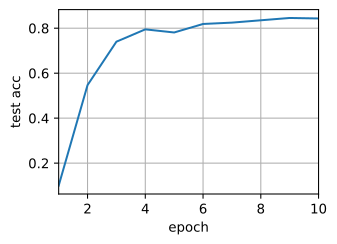
test acc: 0.83, 2.6 sec/epoch on ['/device:GPU:0']This gives the wall-clock reference point: one model copy, one minibatch stream, no gradient synchronization.
Two GPUs
On this small model the second GPU is ~30% slower — naive data parallelism’s worst case (LeNet runs each minibatch in microseconds, so the hand-rolled allreduce and Python orchestration dominate). Larger models amortize the sync cost and the second GPU pays for itself:
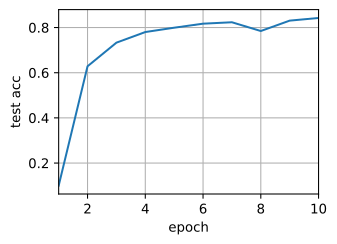
test acc: 0.84, 6.5 sec/epoch on ['/device:GPU:0', '/device:GPU:1']Recap
- Data parallelism is the default: replicate model, split minibatch, all-reduce gradients, identical optimizer step on every GPU.
all_reduceis the workhorse — implemented as a ring reduction in NCCL; bandwidth-optimal for k GPUs.- Model parallelism is for huge models that don’t fit on a single GPU; tensor / pipeline parallelism are modern variants.