from d2l import tensorflow as d2l
import tensorflow as tfGPUs
Working on GPUs
GPUs are the reason modern deep learning works at scale. A single 4090 does ~80 TFLOPs of FP16 — about a thousand times faster than a CPU on the matmul-heavy ops convolutions and attention need.
The cost: every tensor and every parameter has a device. Mix devices in one operation and you crash.
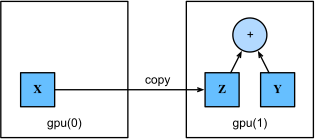
Add tensors from different devices: implicit copies are forbidden, you must copy explicitly.
The two-and-a-half rules
RuntimeError: Expected all tensors to be on the same device,
but found at least two devices, cuda:0 and cpu!- Tensors live on a device. Cross-device operations require an explicit copy.
- Model parameters live on a device. Move the model to the GPU before training; the optimizer’s state follows.
- Cross-device copies are slow. Avoid them in the inner loop — copy at the boundary, keep the loop on one device.
What hardware do we have?
(<tensorflow.python.eager.context._EagerDeviceContext at 0x792d00e68c80>,
 <tensorflow.python.eager.context._EagerDeviceContext at 0x792d00e0bf40>,
<tensorflow.python.eager.context._EagerDeviceContext at 0x792d00c34180>)Portable device handle
try_gpu(i) returns GPU i if it exists, else CPU. Same code runs on a laptop, a workstation, or a multi-GPU box — the device object swaps but the code stays the same:
(<tensorflow.python.eager.context._EagerDeviceContext at 0x792cfbf35d40>,
 <tensorflow.python.eager.context._EagerDeviceContext at 0x792cfbf35b00>,
 [<tensorflow.python.eager.context._EagerDeviceContext at 0x792cfbf35ac0>,
  <tensorflow.python.eager.context._EagerDeviceContext at 0x792cfbf35a80>,
  <tensorflow.python.eager.context._EagerDeviceContext at 0x792cfbf35a40>,
  <tensorflow.python.eager.context._EagerDeviceContext at 0x792cfbf35a00>])
Tensors carry a device
Every tensor has a .device attribute:
'/job:localhost/replica:0/task:0/device:GPU:0'Create directly on a device — avoids an unnecessary CPU → GPU copy:
<tf.Tensor: shape=(2, 3), dtype=float32, numpy=
array([[1., 1., 1.],
[1., 1., 1.]], dtype=float32)>Cross-device math: copy, then operate
Tensors on different devices can’t be combined directly. The fix: explicit copy with .cuda(i) or .to(device):
tf.Tensor(
[[1. 1. 1.]
 [1. 1. 1.]], shape=(2, 3), dtype=float32)
tf.Tensor(
[[1. 1. 1.]
[1. 1. 1.]], shape=(2, 3), dtype=float32)<tf.Tensor: shape=(2, 3), dtype=float32, numpy=
array([[1.1338689, 1.1451421, 1.2139267],
[1.2060641, 1.1670239, 1.2071997]], dtype=float32)>.cuda(i) on a tensor already on GPU i is a no-op — the framework checks first:
TrueWhy this matters: a .to(device) in your training inner loop adds a cudaMemcpy round trip that can dwarf the actual computation. Copy at the boundary; keep everything inside the loop on one device.
Models on the GPU
The model is a tree of Parameter tensors. Move them all in one shot with .to(device):
<tf.Tensor: shape=(2, 1), dtype=float32, numpy=
array([[0.07944381],
[0.07944381]], dtype=float32)>Where to put the device move
The training-loop sweet spot:
device = try_gpu(0)
model = MyModel().to(device)         # once, before training
opt = SGD(model.parameters(), …)     # picks up device

for batch in loader:
    X, y = batch[0].to(device), batch[1].to(device)
    # ... forward, loss, backward, step ...
The Trainer baseline does exactly this — patch prepare_batch to call .to(device) and prepare_model to move parameters once:
@d2l.add_to_class(d2l.Trainer)
def __init__(self, max_epochs, num_gpus=0, gradient_clip_val=0):
    self.save_hyperparameters()
    self.gpus = [d2l.gpu(i) for i in range(min(num_gpus, d2l.num_gpus()))]

@d2l.add_to_class(d2l.Trainer)
def prepare_batch(self, batch):
    if self.gpus:
        # tf.data.Dataset emits batches on CPU. Re-wrap them inside the
        # GPU device context so subsequent ops keep their inputs on-device
        # rather than incurring an implicit copy each step.
        with self.gpus[0]:
            batch = [tf.identity(a) for a in batch]
    return batch
Common mistakes
- Forgetting one tensor. Every tensor in the forward pass has to be on the same device. Custom buffers are the usual culprit — use
register_bufferso they move with.to(device). - Creating tensors with
torch.zeros((10,))mid-forward defaults to CPU. Usetorch.zeros((10,), device=x.device)to follow the input. - Optimizer set up before move. Construct the optimizer after
.to(device)— otherwise its state lives on the wrong side. .numpy()mid-loop forces a sync to CPU. The asynchronous CUDA stream stalls. Defer all conversions to the end of the epoch.
Recap
- Tensors and parameters carry a device; cross-device operations require an explicit copy.
- Move the model to the GPU once, before training; the optimizer follows its parameters.
try_gpu(i)keeps code portable across hardware.- Cross-device copies are expensive — keep the inner loop device-clean.
- Use
register_bufferso non-trainable state moves alongside parameters.