import tensorflow as tfLayers and Modules
Modules as Building Blocks
Modern networks aren’t flat stacks. ResNet-152 has 152 conv layers, organized into a handful of repeating patterns. Transformers stack 12, 24, 96 identical blocks. Writing them one layer at a time would be miserable.
The module abstraction (nn.Module in PyTorch, flax.linen.Module in JAX) handles the recursion. A module can be a single layer, a block of layers, or the whole model — all three are the same Python class.
Modules compose recursively
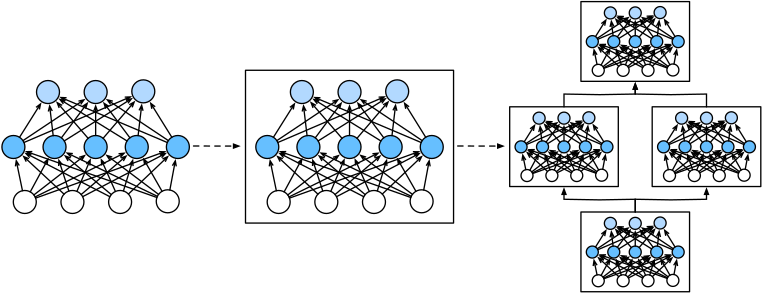
Layers compose into modules; modules compose into models.
What every module must do
The framework asks five things of every module:
- Take input via
forward(x). - Return output (possibly a different shape).
- Compute gradients of output w.r.t. input (autograd does this for free).
- Store and expose its parameters.
- Initialize them (or accept user init).
Subclass nn.Module, write __init__ + forward, and the base class supplies the bookkeeping automatically.
The simple way: nn.Sequential
For a linear chain of layers, nn.Sequential does everything. Construct, call, done:
TensorShape([2, 10])Sequential is a module. Internally it stores its children in a list and the forward walks them in order. “List of layers, run them in sequence” — that’s all.
Hand-rolled MLP module
Sequential is good when the topology is a chain. For anything else, define your own subclass. The pattern: name sub-modules in __init__, write forward to use them:
class MLP(tf.keras.Model):
    def __init__(self):
        # Call the constructor of the parent class tf.keras.Model to perform
        # the necessary initialization
        super().__init__()
        self.hidden = tf.keras.layers.Dense(units=256, activation=tf.nn.relu)
        self.out = tf.keras.layers.Dense(units=10)

    # Define the forward propagation of the model, that is, how to return the
    # required model output based on the input X
    def call(self, X):
        return self.out(self.hidden(X))
The two attributes self.hidden and self.out aren’t ordinary fields — assigning a Module to a Module attribute registers it as a child. From this moment on:
net.parameters()includes both layers’ weights/biases.net.to('cuda')moves both to GPU.net.state_dict()gives a flat dict of every parameter.
Total user code: ~6 lines.
Building a Sequential ourselves
What does nn.Sequential actually do? Almost nothing — its implementation in 4 lines:
forward is just Python
This is the superpower of the module abstraction: forward is normal Python. Use loops, conditionals, random tensors, anything you’d write in numpy:
class FixedHiddenMLP(tf.keras.Model):
    def __init__(self):
        super().__init__()
        self.flatten = tf.keras.layers.Flatten()
        # Random weight parameters created with tf.constant are not updated
        # during training (i.e., constant parameters)
        self.rand_weight = tf.constant(tf.random.uniform((20, 20)))
        self.dense = tf.keras.layers.Dense(20, activation=tf.nn.relu)

    def build(self, input_shape):
        self.flatten.build(input_shape)
        self.dense.build((input_shape[0], 20))
        super().build(input_shape)

    def call(self, inputs):
        X = self.flatten(inputs)
        # Use the created constant parameters, as well as the relu and
        # matmul functions
        X = tf.nn.relu(tf.matmul(X, self.rand_weight) + 1)
        # Reuse the fully connected layer. This is equivalent to sharing
        # parameters with two fully connected layers
        X = self.dense(X)
        # Control flow
        while tf.reduce_sum(tf.math.abs(X)) > 1:
            X /= 2
        return tf.reduce_sum(X)

    def compute_output_shape(self, input_shape):
        return (input_shape[0],)
The while loop, the fixed rand_weight, even reusing self.linear twice (parameter sharing!) all work, and all flow gradients correctly:
<tf.Tensor: shape=(), dtype=float32, numpy=0.9014120101928711>Composition: modules all the way down
Modules nest to any depth. A NestMLP holds a Sequential; a top-level Sequential holds a NestMLP + a Linear + a FixedHiddenMLP:
class NestMLP(tf.keras.Model):
    def __init__(self):
        super().__init__()
        self.net = tf.keras.Sequential()
        self.net.add(tf.keras.layers.Dense(64, activation=tf.nn.relu))
        self.net.add(tf.keras.layers.Dense(32, activation=tf.nn.relu))
        self.dense = tf.keras.layers.Dense(16, activation=tf.nn.relu)

    def call(self, inputs):
        return self.dense(self.net(inputs))

chimera = tf.keras.Sequential()
chimera.add(NestMLP())
chimera.add(tf.keras.layers.Dense(20))
chimera.add(FixedHiddenMLP())
chimera(X)
<tf.Tensor: shape=(), dtype=float32, numpy=0.905106782913208>The framework recursively walks this tree to find every parameter. Every modern architecture is built this way: ResNet = blocks of ResBlocks of conv+BN+ReLU. Transformer = blocks of attention+FFN. Same recursion every time.
Recap
- A module is one Python class that represents a layer, a block, or a whole model.
- Children assigned to attributes are auto-registered for parameter tracking, device placement, serialization.
Sequentialis a 4-line module that runs children in order; for arbitrary topologies, subclass and writeforward.forwardis plain Python — control flow, parameter sharing, fixed buffers all welcome.- Modules compose recursively; that recursion is what lets ResNet-152 be 50 lines instead of 5000.