class MoELayer(nn.Module):
"""Mixture-of-experts FFN: a token-choice top-k router over E experts."""
def __init__(self, num_hiddens, num_experts, num_active):
super().__init__()
self.num_experts, self.num_active = num_experts, num_active
self.router = nn.Linear(num_hiddens, num_experts, bias=False)
self.experts = nn.ModuleList([d2l.FeedForward(num_hiddens)
for _ in range(num_experts)])
self.register_buffer('expert_bias', torch.zeros(num_experts))
self.register_buffer('usage', torch.zeros(num_experts))
def forward(self, X):
probs = F.softmax(self.router(X), -1) # (B, T, E)
scores = probs + self.expert_bias # selection only
idx = scores.topk(self.num_active, -1).indices # (B, T, k)
mask = torch.zeros_like(probs).scatter(-1, idx, 1.0)
gates = probs * mask # weight = p_i
Y = torch.stack([e(X) for e in self.experts], -1) # (B, T, d, E)
out = (Y * gates.unsqueeze(-2)).sum(-1)
frac = mask.sum((0, 1)) / mask.sum() # realized load
self.usage += mask.sum((0, 1)).detach()
self.aux_loss = self.num_experts * (frac * probs.mean((0, 1))).sum()
return outMixture of Experts
Dive into Deep Learning · §11.6
Mixture of experts
stored and active parameters · token-choice routing · load balancing · MoE in a GPT
Conditional computation
- In a dense model, every token uses every layer parameter.
- MoE breaks the lockstep at the FFN (two thirds of each block): store E experts, route each token to k of them.
- MoE separates stored capacity from active parameters and per-token FLOPs.
Stored and Active Parameter Counts
        ours:   16.8M in experts,   2.1M active per token, ratio  8.0x
Mixtral 8x7B:   45.1B in experts,  11.3B active per token, ratio  4.0x
     with attention and embeddings: 46.7B total, 12.9B active
 DeepSeek-V3:  656.5B in experts,  23.1B active per token, ratio 28.4x
(656463101952, 23095410688)- Mixtral 8x7B: our census + attention + embeddings = 46.7B / 12.9B — the model card, reproduced.
- DeepSeek-V3: 656B of 671B sits in experts; a token touches 23B — a 28x capacity-to-compute gap.
A token-choice top-k layer
\mathrm{MoE}(\mathbf{x}) = \sum_{i \in \mathcal{E}_k(\mathbf{x})} p_i(\mathbf{x})\, \mathrm{FFN}_i(\mathbf{x}), \qquad \mathbf{p} = \mathrm{softmax}(\mathbf{W}_r \mathbf{x})
- Selection (argmax): no gradient. The weight p_i: gradient — that is how the router learns (Switch convention).
- Teaching implementation: compute all experts, mask by the gate — exact math, none of the FLOPs savings (real systems: scatter/gather with capacity limits).
Replacing the Block FFN
Experts are d2l.FeedForward; the layer maps (n, d) \to (n, d), so it enters d2l.TransformerBlock through ffn_factory — the seam the block was built with:
router 2048, per expert 524544, total 4198400, active 1051136
usage at initialization: 0.13 0.14 0.15 0.10 0.12 0.12 0.11 0.13
At initialization: usage nearly uniform. Training will not keep it so.
Positive feedback in routing
- A slightly-lucky expert improves on its tokens and gains routing probability — more tokens, more gradient, more probability.
- Less-used experts receive fewer updates, which can amplify load imbalance. In routing collapse, a few experts receive most assignments.
- Sparse MoE systems commonly add capacity constraints or balancing methods (Shazeer et al., 2017).
Two repairs
Auxiliary loss (GShard, Switch): penalize load-probability correlation, \mathcal{L}_{\mathrm{balance}} = E \sum_i f_i\, \bar{p}_i — differentiable, but it adds a gradient term to the language-model objective.
Auxiliary-loss-free bias (Wang et al., 2024; DeepSeek-V3): a controller, \mathcal{E}_k = \operatorname{argtop}_k(p_i + b_i), \qquad b_i \leftarrow b_i + u\,\mathrm{sign}(\bar{f} - f_i) — steers selection only; the loss contains no balancing term at all.
Balancing methods at fixed compute
The runs share their initialization, data, and 800-step budget; only the balancing method differs:
  no balancing: training loss 0.72, experts under 2% usage: 5 of 16
auxiliary loss: training loss 0.66, experts under 2% usage: 0 of 16
          bias: training loss 0.54, experts under 2% usage: 0 of 16
Experimental results
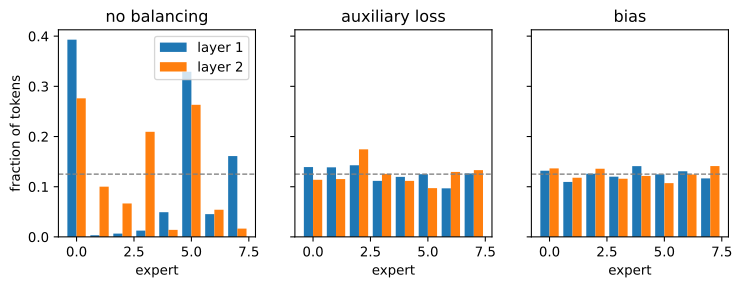
<matplotlib.legend.Legend at 0x7b98db7ec7a0>- No balancing: in the displayed seed, several experts receive less than 2% of assignments.
- Both repairs: the displayed loads are closer to the uniform reference and training loss is lower than in the unbalanced run.
- One run per method gives no uncertainty interval and does not distinguish auxiliary loss from bias control.
Fine-grained and shared experts
- DeepSeek: same budget, narrower experts, larger E and k — \binom{64}{8} \approx 4 \times 10^9 combinations vs. \binom{8}{2} = 28: specialists that compose.
- Plus one shared expert, always on: common processing lives once; routed width spent purely on specialization.
| Model | Experts | k | width/d | shared |
|---|---|---|---|---|
| Mixtral 8x7B | 8 | 2 | 3.5 | none |
| DeepSeek-V3 | 256 | 8 | 0.29 | 1 |
| Qwen3-235B | 128 | 8 | 0.38 | none |
| gpt-oss-120b | 128 | 4 | 1.0 | none |
MoE in our GPT
Swap every block’s FFN (moe_gpt), balance with the bias controller, match active parameters against the dense GPT of the previous sections:
dense:  3.16M parameters (3.16M active), best validation 1.51, final training loss 0.21
MoE: 17.85M parameters (3.16M active), best validation 1.52, final training loss 0.19- 5–6 times the stored parameters at the same active parameter count.
- In the fixed-seed run, best validation losses are both near 1.5 and the MoE ends with slightly lower training loss; neither equivalence nor cause is established.
- Published large-scale systems use the same conditional-computation mechanism; this small experiment does not estimate their quality or efficiency gains.
Recap
- MoE = E FFNs + a router; parameters scale with E, FLOPs with k — Mixtral 46.7B/12.9B, DeepSeek-V3 a 28x gap.
- Positive feedback can concentrate routing on a small subset of experts.
- An auxiliary loss changes the training objective; a bias controller changes selection without adding a gradient term. Both reduce imbalance in the fixed-seed experiment.
- Fine-grained experts provide more routing combinations at a fixed active budget; a shared expert handles processing common to all tokens.
- In our GPT: several times the stored parameters at matched active parameter count; quality comparisons remain local to the teaching experiment.