from d2l import torch as d2l
import torch
import osDownloading the Tatoeba corpus
Machine Translation and the Dataset
Machine Translation Data
Language modeling predicts one sequence. Translation maps between sequences — different lengths, different word orders. This unaligned source-to-target structure is the sequence-to-sequence (seq2seq) setting that drives the rest of this chapter and most of the attention chapter.
This deck builds the data plumbing for English→French:
- download a parallel corpus from Tatoeba,
- normalize and word-tokenize both sides,
- build separate source / target vocabularies,
- pad and truncate to fixed length, with
<bos>/<eos>/<pad>/<unk>special tokens.
Tab-separated bilingual sentence pairs — one English, one French per line:
Preprocessing
Lower-case, replace non-breaking spaces, insert a space before punctuation so ,.!? become their own tokens:
@d2l.add_to_class(MTFraEng)
def _preprocess(self, text):
    # Replace non-breaking space with space
    text = text.replace('\u202f', ' ').replace('\xa0', ' ')
    # Insert space between words and punctuation marks
    no_space = lambda char, prev_char: char in ',.!?' and prev_char != ' '
    out = [' ' + char if i > 0 and no_space(char, text[i - 1]) else char
           for i, char in enumerate(text.lower())]
return ''.join(out)Word-level tokenization
Word tokens (modern systems use BPE / WordPiece). Append <eos> so the model knows when to stop generating.
@d2l.add_to_class(MTFraEng)
def _tokenize(self, text, max_examples=None):
    src, tgt = [], []
    for i, line in enumerate(text.split('\n')):
        if max_examples and i >= max_examples: break
        parts = line.split('\t')
        if len(parts) == 2:
            # Skip empty tokens
            src.append([t for t in f'{parts[0]} <eos>'.split(' ') if t])
            tgt.append([t for t in f'{parts[1]} <eos>'.split(' ') if t])
    return src, tgt
Two parallel lists: src[i] and tgt[i] are the i-th English sentence and its French translation:
([['go', '.', '<eos>'],
  ['hi', '.', '<eos>'],
  ['run', '!', '<eos>'],
  ['run', '!', '<eos>'],
  ['who', '?', '<eos>'],
  ['wow', '!', '<eos>']],
 [['va', '!', '<eos>'],
  ['salut', '!', '<eos>'],
  ['cours', '!', '<eos>'],
  ['courez', '!', '<eos>'],
  ['qui', '?', '<eos>'],
  ['ça', 'alors', '!', '<eos>']])
Length distribution
Most sentences are short — under 20 tokens. That justifies a small fixed num_steps and pad/truncate strategy.
def show_list_len_pair_hist(legend, xlabel, ylabel, xlist, ylist):
    """Plot the histogram for list length pairs."""
    d2l.set_figsize()
    _, _, patches = d2l.plt.hist(
        [[len(l) for l in xlist], [len(l) for l in ylist]])
    d2l.plt.xlabel(xlabel)
    d2l.plt.ylabel(ylabel)
    for patch in patches[1].patches:
        patch.set_hatch('/')
    d2l.plt.legend(legend)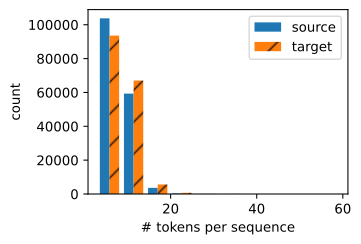
Padding to fixed length
Truncate long sequences, pad short ones with <pad>. Track valid_len (real tokens, no padding) — the model needs it to mask attention/loss later. Target sequences get a <bos> prefix; the label is the target shifted by one.
@d2l.add_to_class(MTFraEng)
def _build_arrays(self, raw_text, src_vocab=None, tgt_vocab=None):
    def _build_array(sentences, vocab, is_tgt=False):
        pad_or_trim = lambda seq, t: (
            seq[:t-1] + ['<eos>'] if len(seq) > t else seq + ['<pad>'] * (t - len(seq)))
        sentences = [pad_or_trim(s, self.num_steps) for s in sentences]
        if is_tgt:
            sentences = [['<bos>'] + s for s in sentences]
        if vocab is None:
            vocab = d2l.Vocab(sentences, min_freq=2)
        array = d2l.tensor([vocab[s] for s in sentences])
        valid_len = d2l.reduce_sum(
            d2l.astype(array != vocab['<pad>'], d2l.int32), 1)
        return array, vocab, valid_len
    src, tgt = self._tokenize(self._preprocess(raw_text),
                              self.num_train + self.num_val)
    src_array, src_vocab, src_valid_len = _build_array(src, src_vocab)
    tgt_array, tgt_vocab, _ = _build_array(tgt, tgt_vocab, True)
    return ((src_array, tgt_array[:,:-1], src_valid_len, tgt_array[:,1:]),
            src_vocab, tgt_vocab)
Dataloader
Standard split — first num_train examples for training, the rest for validation:
A minibatch end to end
Source IDs, decoder input (target shifted right with <bos>), valid length, label (target shifted left):
data = MTFraEng(batch_size=3)
src, tgt, src_valid_len, label = next(iter(data.train_dataloader()))
print('source:', d2l.astype(src, d2l.int32))
print('decoder input:', d2l.astype(tgt, d2l.int32))
print('source len excluding pad:', d2l.astype(src_valid_len, d2l.int32))
print('label:', d2l.astype(label, d2l.int32))
source: tensor([[14, 26, 3, 2, 1, 1, 1, 1, 1],
[25, 33, 5, 2, 1, 1, 1, 1, 1],
[65, 13, 5, 2, 1, 1, 1, 1, 1]], dtype=torch.int32)
decoder input: tensor([[ 2, 22, 0, 5, 3, 1, 1, 1, 1],
[ 2, 14, 116, 33, 74, 5, 3, 1, 1],
[ 2, 30, 0, 5, 3, 1, 1, 1, 1]], dtype=torch.int32)
source len excluding pad: tensor([4, 4, 4], dtype=torch.int32)
label: tensor([[ 22, 0, 5, 3, 1, 1, 1, 1, 1],
[ 14, 116, 33, 74, 5, 3, 1, 1, 1],
[ 30, 0, 5, 3, 1, 1, 1, 1, 1]], dtype=torch.int32)Convert IDs back to tokens for inspection:
source: ['hi', '.', '<eos>', '<pad>', '<pad>', '<pad>', '<pad>', '<pad>', '<pad>']
target: ['<bos>', 'salut', '.', '<eos>', '<pad>', '<pad>', '<pad>', '<pad>', '<pad>']
Recap
- Translation = pairs of unaligned sequences (different lengths, possibly different word orders).
- Word-level tokenization → much larger vocab than character; treat rare tokens as
<unk>to keep it manageable. - Pad/truncate to fixed
num_stepsfor batching; recordvalid_lento mask later. - Decoder input is target with
<bos>prefix; label is target shifted left by one — that’s teacher forcing setup.