Gated Recurrent Units (GRU)
Gated Recurrent Units
LSTMs work, but they’re heavy: three gates, an input node, a separate cell state. Cho et al. (2014) asked whether the gating idea could be kept while collapsing the bookkeeping.
GRU = two gates, no separate cell state, a single hidden state. Often matches LSTM quality at lower compute.
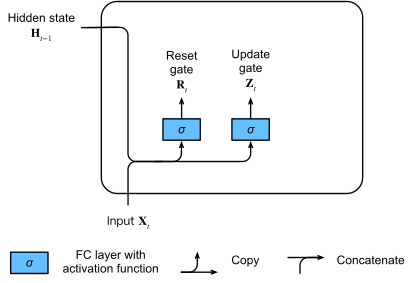
Reset gate \mathbf{R}_t — how much of the past to mix into the candidate hidden state.Update gate \mathbf{Z}_t — convex blend between old hidden state and new candidate.
Setup
from d2l import torch as d2limport torchfrom torch import nn
The gates are sigmoid heads of X_t and H_{t-1} :
\mathbf{R}_t = \sigma(\mathbf{X}_t \mathbf{W}_{xr} + \mathbf{H}_{t-1} \mathbf{W}_{hr} + \mathbf{b}_r),\quad
\mathbf{Z}_t = \sigma(\mathbf{X}_t \mathbf{W}_{xz} + \mathbf{H}_{t-1} \mathbf{W}_{hz} + \mathbf{b}_z).
Computing the reset and update gates.
Candidate hidden state
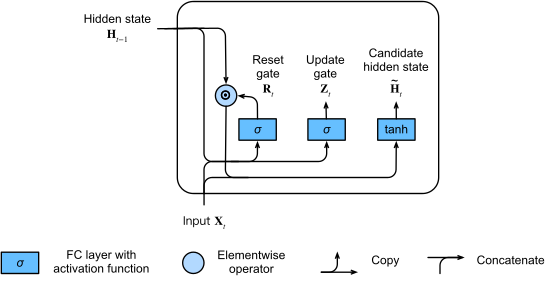
Like a vanilla RNN cell, but \mathbf{H}_{t-1} is filtered by \mathbf{R}_t before entering the recurrence:
\tilde{\mathbf{H}}_t = \tanh(\mathbf{X}_t \mathbf{W}_{xh} + (\mathbf{R}_t \odot \mathbf{H}_{t-1}) \mathbf{W}_{hh} + \mathbf{b}_h).
Computing the candidate hidden state \tilde{\mathbf{H}}_t .
Final hidden state
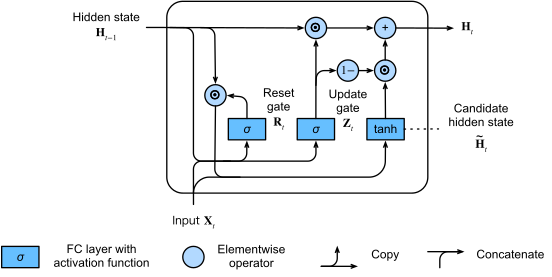
Convex combination of old state and candidate, ruled by \mathbf{Z}_t :
\mathbf{H}_t = \mathbf{Z}_t \odot \mathbf{H}_{t-1} + (1 - \mathbf{Z}_t) \odot \tilde{\mathbf{H}}_t.
\mathbf{Z}_t \to 1 : skip this step. \mathbf{Z}_t \to 0 : fully replace with the candidate. \mathbf{R}_t \to 1 recovers a vanilla RNN.
Computing the hidden state \mathbf{H}_t .
From scratch: parameters
Nine matrices and three biases, grouped by gate:
class GRUScratch(d2l.Module):def __init__ (self , num_inputs, num_hiddens, sigma= 0.01 ):super ().__init__ ()self .save_hyperparameters()= lambda * shape: nn.Parameter(d2l.randn(* shape) * sigma)= lambda : (init_weight(num_inputs, num_hiddens),self .W_xz, self .W_hz, self .b_z = triple() # Update gate self .W_xr, self .W_hr, self .b_r = triple() # Reset gate self .W_xh, self .W_hh, self .b_h = triple() # Candidate hidden state
Forward pass
One step computes \mathbf{Z}_t , \mathbf{R}_t , the candidate, and the convex blend — five matmuls per time step versus eight in an LSTM.
def forward(self , inputs, H= None ):if H is None :# Initial state with shape: (batch_size, num_hiddens) = d2l.zeros((inputs.shape[1 ], self .num_hiddens),= inputs.device)= []for X in inputs:= d2l.sigmoid(d2l.matmul(X, self .W_xz) + self .W_hz) + self .b_z)= d2l.sigmoid(d2l.matmul(X, self .W_xr) + self .W_hr) + self .b_r)= d2l.tanh(d2l.matmul(X, self .W_xh) + * H, self .W_hh) + self .b_h)= Z * H + (1 - Z) * H_tildereturn outputs, H
Training
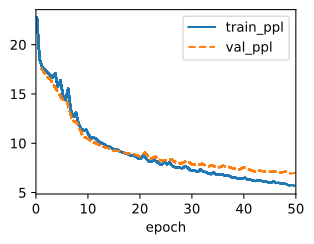
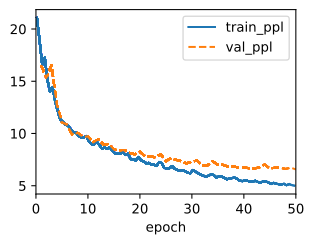
Same RNNLMScratch head, same Trainer. Often converges to the same perplexity as the LSTM with fewer parameters.
= d2l.TimeMachine(batch_size= 1024 , num_steps= 32 )= GRUScratch(num_inputs= len (data.vocab), num_hiddens= 32 )= d2l.RNNLMScratch(gru, vocab_size= len (data.vocab), lr= 4 )= d2l.Trainer(max_epochs= 50 , gradient_clip_val= 1 , num_gpus= 1 )
Concise: nn.GRU
Library cell drops into the same RNN scaffold:
class GRU(d2l.RNN):def __init__ (self , num_inputs, num_hiddens):__init__ (self )self .save_hyperparameters()self .rnn = nn.GRU(num_inputs, num_hiddens)
Train it:
= GRU(num_inputs= len (data.vocab), num_hiddens= 32 )= d2l.RNNLM(gru, vocab_size= len (data.vocab), lr= 4 )
Decode:
'it has' , 20 , data.vocab, d2l.try_gpu())
'it has experifice and the '
Recap
GRU = LSTM with one gate fewer and no separate cell state.
Reset gate gates the past before the recurrence; update gate convex-blends old vs. new.
Recovers vanilla RNN (\mathbf{R}_t = 1 , \mathbf{Z}_t = 0 ) and identity (\mathbf{Z}_t = 1 ) as limit cases.
Roughly 25 % fewer parameters than LSTM at the same width; comparable perplexity on most LM tasks.