from d2l import torch as d2l
import torch
from torch import nn
import numpy as npOnly observed ratings contribute to reconstruction error
Standard SGD; the masked loss is the trick that turns autoencoder loss into a recommender:
devices = d2l.try_all_gpus()
# Load the MovieLens 100K dataset
df, num_users, num_items = d2l.read_data_ml100k()
train_data, test_data = d2l.split_data_ml100k(df, num_users, num_items)
_, _, _, train_inter_mat = d2l.load_data_ml100k(train_data, num_users,
                                                num_items)
_, _, _, test_inter_mat = d2l.load_data_ml100k(test_data, num_users,
                                               num_items)
train_inter_mat_t = torch.tensor(train_inter_mat, dtype=torch.float32)
test_inter_mat_np = np.array(test_inter_mat)
train_iter = torch.utils.data.DataLoader(train_inter_mat_t, shuffle=True,
                                         drop_last=True, batch_size=256,
                                         num_workers=d2l.get_dataloader_workers())
test_iter = torch.utils.data.DataLoader(train_inter_mat_t, shuffle=False,
                                        batch_size=1024,
                                        num_workers=d2l.get_dataloader_workers())
# Model initialization, training, and evaluation
net = AutoRec(500, num_users)
nn.init.normal_(net.encoder.weight, std=0.01)
nn.init.normal_(net.decoder.weight, std=0.01)
net = net.to(devices[0])
lr, num_epochs, wd = 0.002, 25, 1e-5
loss = nn.MSELoss(reduction='sum')
optimizer = torch.optim.Adam(net.parameters(), lr=lr, weight_decay=wd)
timer = d2l.Timer()
animator = d2l.Animator(xlabel='epoch', xlim=[1, num_epochs], ylim=[0, 2],
                        legend=['train loss', 'test RMSE'])
for epoch in range(num_epochs):
    net.train()
    total_loss, n = 0., 0
    for i, values in enumerate(train_iter):
        timer.start()
        values = values.to(devices[0])
        optimizer.zero_grad()
        preds = net(values)
        # The model already zeros out predictions where the input rating is
        # 0 (unobserved). Comparing against `values` directly therefore
        # gives a loss that only penalizes observed entries, matching the
        # masked-loss formulation used in the MXNet branch.
        l = loss(preds, values)
        l.backward()
        optimizer.step()
        total_loss += l.item()
        n += values.shape[0]
        timer.stop()
    test_rmse = evaluator(net, test_iter, test_inter_mat_np, devices)
    train_l = total_loss / n
    animator.add(epoch + 1, (train_l, test_rmse))
print(f'train loss {total_loss / n:.3f}, test RMSE {test_rmse:.3f}')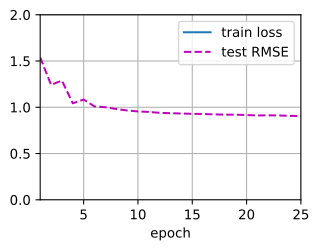
train loss 38.668, test RMSE 0.904Watch the plot for two signals: training loss should fall, and test RMSE should stabilize rather than diverge. Overfitting shows up when reconstruction keeps improving but held-out RMSE worsens.