def adagrad_2d(x1, x2, s1, s2):
    eps = 1e-6
    g1, g2 = 0.2 * x1, 4 * x2
    s1 += g1 ** 2
    s2 += g2 ** 2
    x1 -= eta / math.sqrt(s1 + eps) * g1
    x2 -= eta / math.sqrt(s2 + eps) * g2
    return x1, x2, s1, s2

def f_2d(x1, x2):
    return 0.1 * x1 ** 2 + 2 * x2 ** 2

eta = 0.4
d2l.show_trace_2d(f_2d, d2l.train_2d(adagrad_2d))AdaGrad on the valley
On the quadratic from the momentum section, \eta = 0.4 produces a smooth trajectory without oscillation, but the accumulated \mathbf{s}_t makes later steps progressively smaller:
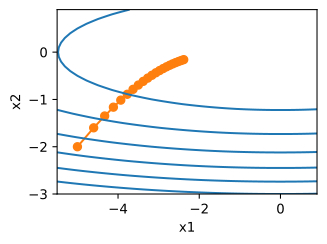
epoch 20, x1: -2.382563, x2: -0.158591The scaling is adaptive, so a formerly unthinkable \eta = 2 is safe:
eta = 2
d2l.show_trace_2d(f_2d, d2l.train_2d(adagrad_2d))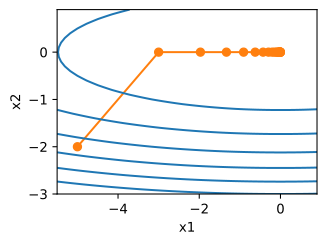
epoch 20, x1: -0.002295, x2: -0.000000RMSProp: an exponential average
AdaGrad never forgets: \mathbf{s}_t grows forever, steps decay like t^{-1/2} by construction. This rate suits its original convex setting but can prevent substantial late movement in deep-network training.
RMSProp (Hinton, 2012): same rule, leaky average instead of sum,
\mathbf{v}_t = \beta_2 \mathbf{v}_{t-1} + (1-\beta_2)\, \mathbf{g}_t^2,
with memory \approx 1/(1-\beta_2) steps. The learning rate becomes an independent knob (→ schedules).
def rmsprop_2d(x1, x2, v1, v2):
    g1, g2, eps = 0.2 * x1, 4 * x2, 1e-6
    v1 = beta2 * v1 + (1 - beta2) * g1 ** 2
    v2 = beta2 * v2 + (1 - beta2) * g2 ** 2
    x1 -= eta / math.sqrt(v1 + eps) * g1
    x2 -= eta / math.sqrt(v2 + eps) * g2
    return x1, x2, v1, v2

eta, beta2 = 0.4, 0.9
d2l.show_trace_2d(f_2d, d2l.train_2d(rmsprop_2d))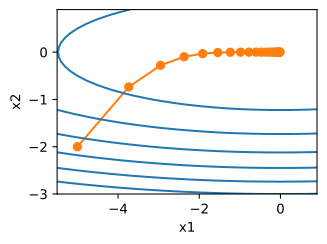
epoch 20, x1: -0.010599, x2: 0.000000From scratch
Two buffers per parameter plus a step counter:
def init_adam_states(feature_dim):
    m_w, m_b = d2l.zeros((feature_dim, 1)), d2l.zeros(1)
    v_w, v_b = d2l.zeros((feature_dim, 1)), d2l.zeros(1)
    return ((m_w, v_w), (m_b, v_b))

def adam(params, states, hyperparams):
    beta1, beta2, eps = 0.9, 0.999, 1e-6
    for p, (m, v) in zip(params, states):
        with torch.no_grad():
            m[:] = beta1 * m + (1 - beta1) * p.grad
            v[:] = beta2 * v + (1 - beta2) * torch.square(p.grad)
            m_hat = m / (1 - beta1 ** hyperparams['t'])
            v_hat = v / (1 - beta2 ** hyperparams['t'])
            p[:] -= hyperparams['lr'] * m_hat / (torch.sqrt(v_hat) + eps)
        p.grad.zero_()
    hyperparams['t'] += 1
d2l.train_ch11(adam, init_adam_states(feature_dim),
{'lr': 0.01, 't': 1}, data_iter, feature_dim);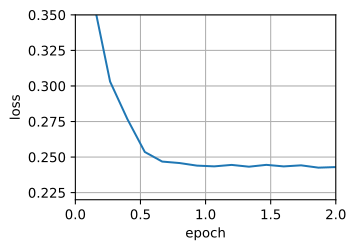
loss: 0.243, 0.100 sec/epochTuned SGD and Adam on a language model
The comparison uses the same model, initialization, 2,000-step budget, and constant learning-rate protocol. Each method receives a four-point grid and is compared at its lowest final training loss.
On the language model:
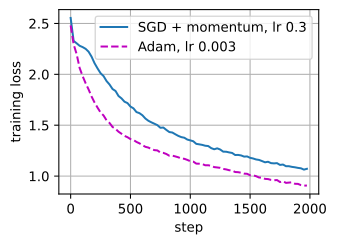
final perplexity: SGD 2.92, Adam 2.49- SGD’s best lr sits one grid point below divergence; Adam’s optimum is interior.
- The gap opens early and no rate in our grid closes it.
Tuned SGD and Adam on a CNN
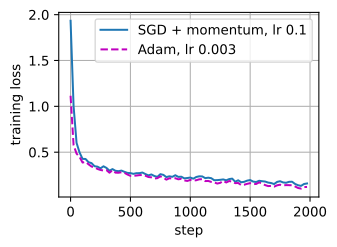
test accuracy: SGD 0.904, Adam 0.919- Curves nearly coincide; test accuracy within a point or two, either way.
- The small difference is consistent with the long use of SGD in computer vision. Optimizer rankings depend on the model as well as the tuning.