%matplotlib inline
from d2l import torch as d2l
import torch

def init_adadelta_states(feature_dim):
    s_w, s_b = d2l.zeros((feature_dim, 1)), d2l.zeros(1)
    delta_w, delta_b = d2l.zeros((feature_dim, 1)), d2l.zeros(1)
    return ((s_w, delta_w), (s_b, delta_b))

def adadelta(params, states, hyperparams):
    rho, eps = hyperparams['rho'], 1e-5
    for p, (s, delta) in zip(params, states):
        with torch.no_grad():
            # In-place updates via [:]
            s[:] = rho * s + (1 - rho) * torch.square(p.grad)
            g = (torch.sqrt(delta + eps) / torch.sqrt(s + eps)) * p.grad
            p[:] -= g
            delta[:] = rho * delta + (1 - rho) * g * g
p.grad.data.zero_()Training the airfoil model
From-scratch implementation
Two state buffers per parameter (s and delta):
data_iter, feature_dim = d2l.get_data_ch11(batch_size=10)
d2l.train_ch11(adadelta, init_adadelta_states(feature_dim),
               {'rho': 0.9}, data_iter, feature_dim);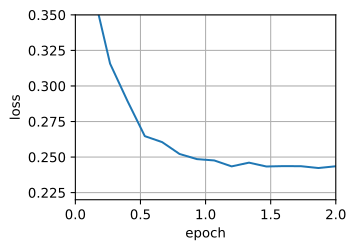
loss: 0.243, 0.100 sec/epochThe loss curve should be read as a scale-adaptation demo: Adadelta trains without the hand-picked global learning rate that earlier optimizers needed.
Concise: framework Adadelta
trainer = torch.optim.Adadelta
d2l.train_concise_ch11(trainer, {'rho': 0.9}, data_iter)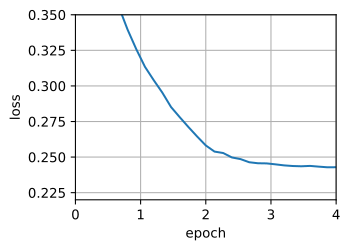
loss: 0.243, 0.079 sec/epoch