Reading IMDb

Sentiment Analysis and the Dataset

Sentiment Analysis Data

Sentiment analysis — predict positive/negative from a movie review. Classic text-classification benchmark; the hello-world for applying deep learning to NLP.

This chapter uses IMDb: 25k positive + 25k negative movie reviews, balanced. The next two decks build an RNN and a CNN classifier on top of this pipeline; the deck after fine-tunes BERT on it.

This deck is just the data plumbing.

from d2l import torch as d2l
import torch
from torch import nn
import os

Each review is a separate text file. Walk the directory, one folder per label:

d2l.DATA_HUB['aclImdb'] = (d2l.DATA_URL + 'aclImdb_v1.tar.gz', 
                          '01ada507287d82875905620988597833ad4e0903')

data_dir = d2l.download_extract('aclImdb', 'aclImdb')
def read_imdb(data_dir, is_train):
    """Read the IMDb review dataset text sequences and labels."""
    data, labels = [], []
    for label in ('pos', 'neg'):
        folder_name = os.path.join(data_dir, 'train' if is_train else 'test',
                                   label)
        for file in os.listdir(folder_name):
            with open(os.path.join(folder_name, file), 'rb') as f:
                review = f.read().decode('utf-8').replace('\n', '')
                data.append(review)
                labels.append(1 if label == 'pos' else 0)
    return data, labels

train_data = read_imdb(data_dir, is_train=True)
print('# training examples:', len(train_data[0]))
for x, y in zip(train_data[0][:3], train_data[1][:3]):
    print('label:', y, 'review:', x[:60])
# training examples: 25000
label: 1 review: Zentropa has much in common with The Third Man, another noir
label: 1 review: Zentropa is the most original movie I've seen in years. If y
label: 1 review: Lars Von Trier is never backward in trying out new technique

Preprocessing

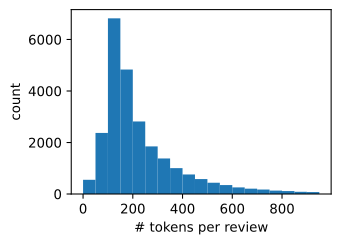
Tokenize words, build a vocabulary with frequency cutoff, truncate or pad each review to a fixed length:

train_tokens = d2l.tokenize(train_data[0], token='word')
vocab = d2l.Vocab(train_tokens, min_freq=5, reserved_tokens=['<pad>'])
d2l.set_figsize()
d2l.plt.xlabel('# tokens per review')
d2l.plt.ylabel('count')
d2l.plt.hist([len(line) for line in train_tokens], bins=range(0, 1000, 50));
num_steps = 500  # sequence length
train_features = d2l.tensor([d2l.truncate_pad(
    vocab[line], num_steps, vocab['<pad>']) for line in train_tokens])
print(train_features.shape)
torch.Size([25000, 500])

Data loaders

train_iter = d2l.load_array((train_features, torch.tensor(train_data[1])), 64)

for X, y in train_iter:
    print('X:', X.shape, ', y:', y.shape)
    break
print('# batches:', len(train_iter))
X: torch.Size([64, 500]) , y: torch.Size([64])
# batches: 391
def load_data_imdb(batch_size, num_steps=500):
    """Return data iterators and the vocabulary of the IMDb review dataset."""
    data_dir = d2l.download_extract('aclImdb', 'aclImdb')
    train_data = read_imdb(data_dir, True)
    test_data = read_imdb(data_dir, False)
    train_tokens = d2l.tokenize(train_data[0], token='word')
    test_tokens = d2l.tokenize(test_data[0], token='word')
    vocab = d2l.Vocab(train_tokens, min_freq=5)
    train_features = torch.tensor([d2l.truncate_pad(
        vocab[line], num_steps, vocab['<pad>']) for line in train_tokens])
    test_features = torch.tensor([d2l.truncate_pad(
        vocab[line], num_steps, vocab['<pad>']) for line in test_tokens])
    train_iter = d2l.load_array((train_features, torch.tensor(train_data[1])),
                                batch_size)
    test_iter = d2l.load_array((test_features, torch.tensor(test_data[1])),
                               batch_size,
                               is_train=False)
    return train_iter, test_iter, vocab

Recap

  • IMDb: 25k+25k movie reviews, binary sentiment.
  • Standard preprocessing: tokenize, build vocab, truncate/pad, batch.
  • Output: (token_ids, label) minibatches, ready for the RNN, CNN, and BERT classifiers in the next decks.