Known ground truth

Synthetic Regression Data

Synthetic data with a known answer

Before we train a model we need data. For pedagogy, we’ll synthesize it — known weights, known noise, and a guaranteed correct answer to compare against:

\mathbf{y} = \mathbf{X} \mathbf{w} + b + \boldsymbol{\epsilon}, \quad \boldsymbol{\epsilon} \sim \mathcal{N}(0, \sigma^2 I).

This chapter:

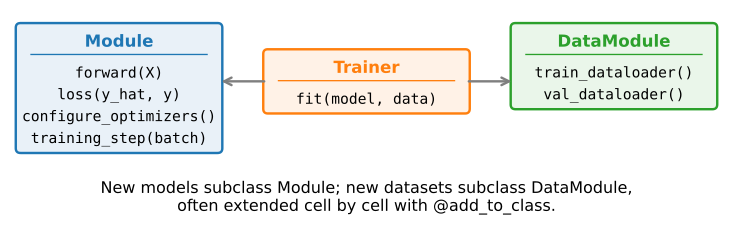
  • Subclass DataModule to generate the synthetic batch.
  • Roll a hand-written minibatch sampler (to see how it works).
  • Swap in the framework’s built-in dataloader (the version we’ll actually use).

Synthetic data module

A DataModule subclass that draws features and computes labels in __init__:

%matplotlib inline
from d2l import torch as d2l
import torch
import random
class SyntheticRegressionData(d2l.DataModule):
    """Synthetic data for linear regression."""
    def __init__(self, w, b, noise=0.01, num_train=1000, num_val=1000, 
                 batch_size=32):
        super().__init__()
        self.save_hyperparameters()
        n = num_train + num_val
        self.X = d2l.randn(n, len(w))
        noise = d2l.randn(n, 1) * noise
        self.y = d2l.matmul(self.X, d2l.reshape(w, (-1, 1))) + b + noise

Instantiate with the true w = [2, -3.4], b = 4.2:

data = SyntheticRegressionData(w=d2l.tensor([2, -3.4]), b=4.2)

Inspecting one example

Each row of features is a vector in \mathbb{R}^2; the corresponding label is a scalar:

print('features:', data.X[0],'\nlabel:', data.y[0])
features: tensor([-1.4973,  0.0215]) 
label: tensor([1.1283])

A handwritten dataloader

get_dataloader shuffles indices, then yields minibatches of size batch_size:

def get_dataloader(self, train):
    if train:
        indices = list(range(0, self.num_train))
        # The examples are read in random order
        random.shuffle(indices)
    else:
        indices = list(range(self.num_train, self.num_train+self.num_val))
    for i in range(0, len(indices), self.batch_size):
        batch_indices = d2l.tensor(indices[i: i+self.batch_size])
        yield self.X[batch_indices], self.y[batch_indices]
X, y = next(iter(data.train_dataloader()))
print('X shape:', X.shape, '\ny shape:', y.shape)
X shape: torch.Size([32, 2]) 
y shape: torch.Size([32, 1])

Educational, but slow — Python loops over indices, no prefetching, no parallelism.

The framework dataloader

For real work, wrap features and labels in the framework’s built-in dataset / dataloader (workers, prefetch, GPU pinning):

@d2l.add_to_class(d2l.DataModule)
def get_tensorloader(self, tensors, train, indices=slice(0, None)):
    tensors = tuple(a[indices] for a in tensors)
    dataset = torch.utils.data.TensorDataset(*tensors)
    return torch.utils.data.DataLoader(dataset, self.batch_size,
                                       shuffle=train)
@d2l.add_to_class(SyntheticRegressionData)
def get_dataloader(self, train):
    i = slice(0, self.num_train) if train else slice(self.num_train, None)
    return self.get_tensorloader((self.X, self.y), train, i)

Same minibatch interface

Identical iteration protocol from the caller’s POV:

X, y = next(iter(data.train_dataloader()))
print('X shape:', X.shape, '\ny shape:', y.shape)
X shape: torch.Size([32, 2]) 
y shape: torch.Size([32, 1])

len(dl) reports the number of batches per epoch — convenient for progress bars:

len(data.train_dataloader())
32

Recap

  • Synthetic data → ground-truth w, b you can compare against later.
  • DataModule subclasses encapsulate “where do batches come from?” once, reusable across models.
  • Hand-rolled iterator vs. framework dataloader — same protocol; framework version wins on speed and ergonomics.