Objective: train + evaluate

What Is Hyperparameter Optimization?

What Is HPO?

Hyperparameters are the knobs you tune outside gradient descent: learning rate, batch size, depth, dropout rate. Usually 5–20 of them; the validation loss is non-convex, noisy, and expensive — one full training run per setting.

Hyperparameter optimization (HPO) automates the tuning. Simplest variant: random search — sample configurations from a prior, evaluate, keep the best.

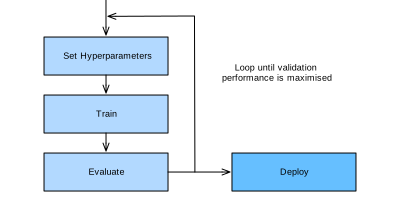
The HPO workflow

Train multiple models with different hyperparameters; pick the best.

Random search beats grid search and most hand-tuning. Smarter algorithms (Bayesian opt, Hyperband) come next.

Formalizing HPO

Find \mathbf{x}^* = \arg\min_{\mathbf{x} \in \mathcal{X}} f(\mathbf{x}) where f is the validation error after training with hyperparameters \mathbf{x}, and \mathcal{X} is the configuration space — a structured product of discrete and continuous ranges.

from d2l import torch as d2l
import numpy as np
import torch
from torch import nn
from scipy import stats

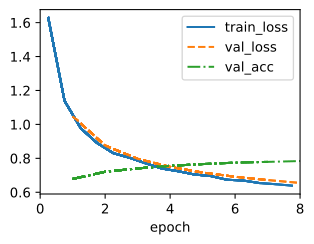
The “function” we’re optimizing is “train a model with this config, return validation error”. Wrap that into a clean callable:
class HPOTrainer(d2l.Trainer):
    def validation_error(self):
        self.model.eval()
        accuracy = 0
        val_batch_idx = 0
        for batch in self.val_dataloader:
            with torch.no_grad():
                x, y = self.prepare_batch(batch)
                y_hat = self.model(x)
                accuracy += self.model.accuracy(y_hat, y)
            val_batch_idx += 1
        return 1 - accuracy / val_batch_idx
def hpo_objective_softmax_classification(config, max_epochs=8):
    learning_rate = config["learning_rate"]
    trainer = d2l.HPOTrainer(max_epochs=max_epochs)
    data = d2l.FashionMNIST(batch_size=16)
    model = d2l.SoftmaxRegression(num_outputs=10, lr=learning_rate)
    trainer.fit(model=model, data=data)
    return d2l.numpy(trainer.validation_error())

Configuration space

A structured space — log-uniform for learning rate (spans orders of magnitude), uniform integer for layer counts, categorical for activations:

config_space = {"learning_rate": stats.loguniform(1e-4, 1)}

Recap

  • HPO = optimize a noisy, expensive black-box function over a structured config space.
  • Random search ≫ grid search at modest budget — Bergstra & Bengio 2012 settled this empirically.
  • Random search is also the natural baseline every fancy HPO algorithm has to beat.
  • Coming up: API abstraction, asynchronous parallel search, multi-fidelity (Hyperband, ASHA).