logits, y = d2l.tensor([[10.0, 0.0, 0.0]]), d2l.tensor([0])
for epsilon in (0.0, 0.1):
    loss = F.cross_entropy(logits, y, label_smoothing=epsilon)
print(f'epsilon={epsilon}: loss={float(loss):.4f}')Cosine schedule with warmup
Two phases: linear warmup (a fresh network produces large, badly scaled gradients), then a half-cosine decay to zero. No drop times to tune.
def step_decay(epoch, max_epochs, base_lr):
    """Recipe A: multiply the rate by 0.1 at 60% and 85% of the budget."""
    return base_lr * 0.1 ** sum(epoch >= int(f * max_epochs)
                                for f in (0.6, 0.85))

def cosine_warmup(epoch, max_epochs, base_lr, warmup=3):
    """Recipe B: linear warmup, then a half-cosine decay to zero."""
    if epoch < warmup:
        return base_lr * (epoch + 1) / warmup
    t = (epoch - warmup) / (max_epochs - warmup)
    return base_lr * 0.5 * (1 + math.cos(math.pi * t))

epochs = list(range(45))
d2l.plot(epochs, [[step_decay(e, 45, 0.1) for e in epochs],
                  [cosine_warmup(e, 45, 0.1) for e in epochs]],
         xlabel='epoch', ylabel='learning rate',
         legend=['step decay', 'cosine with warmup'])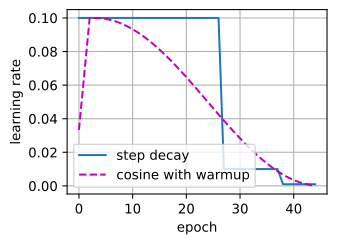
Mixed images
data = d2l.FashionMNIST(batch_size=8)
X, y = next(iter(data.train_dataloader()))
X_mix, y_a, y_b, lam = mixup(X, y, alpha=2.0)
d2l.show_images(torch.cat([X, X_mix]).squeeze(1), 2, 8)
print(f'lambda = {float(lam):.2f}')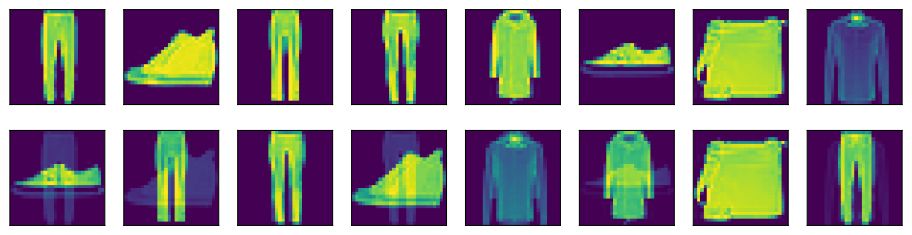
lambda = 0.90CutMix is the spatial sibling: paste a rectangle instead of blending, mix labels by area. Modern recipes alternate both.
EMA: evaluate the average, not the last step
SGD iterates jitter around a good region. A shadow copy \bar{\theta} \leftarrow \beta \bar{\theta} + (1-\beta) \theta cancels the jitter for the price of one parameter copy:
class EMA:
    """A shadow copy of a model's parameters, updated after each step."""
    def __init__(self, model, decay=0.99):
        self.decay = decay
        self.shadow = {k: v.detach().clone()
                       for k, v in model.state_dict().items()}

    def update(self, model):
        for k, v in model.state_dict().items():
            if v.dtype.is_floating_point:
                self.shadow[k].mul_(self.decay).add_(v, alpha=1 - self.decay)
            else:
                self.shadow[k].copy_(v)  # e.g., batch-norm step counters

net = nn.Linear(1, 1, bias=False)
ema, raw, avg = EMA(net, decay=0.9), [], []
for t in range(100):
    with torch.no_grad():  # Simulate noisy SGD iterates around 1.0
        net.weight.copy_(1 + 0.3 * torch.randn(1, 1))
    ema.update(net)
    raw.append(float(net.weight.detach()))
    avg.append(float(ema.shadow['weight']))
d2l.plot(list(range(100)), [raw, avg], xlabel='step', ylabel='weight',
         legend=['raw iterates', 'EMA'])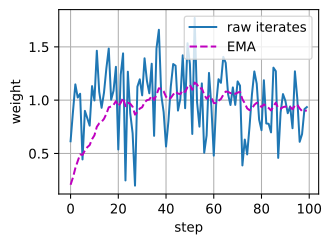
Recipe A: 2015
SGD + momentum, step decay, plain cross-entropy, 30 epochs:
data = FashionMNIST10k()
torch.manual_seed(1)
model = ClassicRecipe(lr=0.05)
trainer = RecipeTrainer(max_epochs=30, num_gpus=1)
model.apply_init([next(iter(data.get_dataloader(True)))[0]], d2l.init_cnn)
trainer.fit(model, data)
classic_score = val_accuracy(model, data, trainer)
classic_score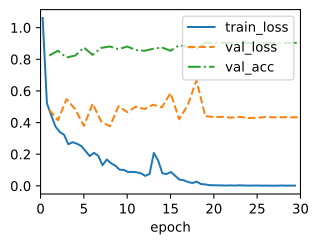
0.9027Recipe B: modern
AdamW + cosine warmup + label smoothing + Mixup, 45 epochs:
torch.manual_seed(1)
model = ModernRecipe(lr=2e-3)
trainer = RecipeTrainer(max_epochs=45, num_gpus=1)
model.apply_init([next(iter(data.get_dataloader(True)))[0]], d2l.init_cnn)
trainer.fit(model, data)
modern_score = val_accuracy(model, data, trainer)
modern_score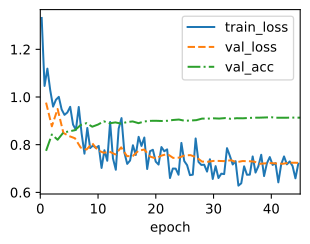
0.9139