You’ll rarely train a vision model from scratch. Transfer learning — start from weights pretrained on a big dataset (ImageNet) and adapt to your small one — is the default recipe.
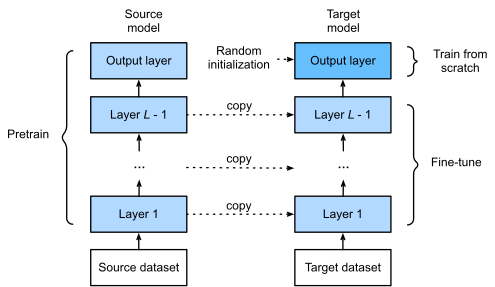
Fine-tuning: pretrained backbone + new task-specific head.
The standard recipe
Take a pretrained network (ResNet, ViT, etc.).
Replace the output layer with a head for your task.
Optionally freeze early layers; train the rest.
Small LR on the pretrained part, larger LR on the new head.
Setup
%matplotlib inlinefrom d2l import torch as d2lfrom torch import nnimport torchimport torchvisionimport os
The hot-dog dataset
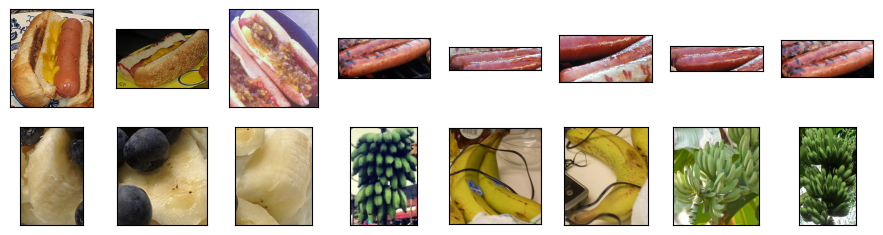
A tiny binary classification dataset (hot dog / not hot dog) — too small to train a CNN from scratch, perfect for transfer learning:
hotdogs = [train_imgs[i][0] for i inrange(8)]not_hotdogs = [train_imgs[-i -1][0] for i inrange(8)]d2l.show_images(hotdogs + not_hotdogs, 2, 8, scale=1.4);
Augmentation pipelines
Standard ImageNet recipe — random resized crop + flip for training, center crop for eval. Match the preprocessing convention that the pretrained model expects:
# Specify the means and standard deviations of the three RGB channels to# standardize each channelnormalize = torchvision.transforms.Normalize( [0.485, 0.456, 0.406], [0.229, 0.224, 0.225])train_augs = torchvision.transforms.Compose([ torchvision.transforms.RandomResizedCrop(224), torchvision.transforms.RandomHorizontalFlip(), torchvision.transforms.ToTensor(), normalize])test_augs = torchvision.transforms.Compose([ torchvision.transforms.Resize([256, 256]), torchvision.transforms.CenterCrop(224), torchvision.transforms.ToTensor(), normalize])
Inspect the pretrained head
The source model was trained for 1000 ImageNet classes. Its convolutional body is reusable; the final classifier is task-specific and will be replaced:
The helper hides framework details: parameter groups, optimizer construction, metric logging, and the scratch/fine-tune switch. The four-step pattern is:
build the pretrained backbone and new head;
assign a small learning rate to backbone parameters;
assign a larger learning rate to the randomly initialized head;
train and compare against a scratch baseline.
Run fine-tuning
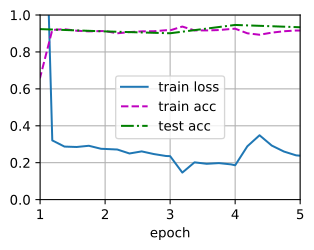
With matched ImageNet preprocessing and a small base LR, the pretrained model should reach useful accuracy quickly. The point is not just a better final score; it is much less data and compute than training the same network cold.
train_fine_tuning(finetune_net, 5e-5)
loss 0.163, train acc 0.940, test acc 0.943
1730.9 examples/sec on [device(type='cuda', index=0)]
From-scratch baseline
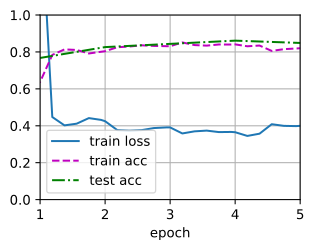
Same architecture, no pretraining. Much worse on this small dataset — illustrates why transfer learning is the default:
loss 0.379, train acc 0.837, test acc 0.836
1521.4 examples/sec on [device(type='cuda', index=0)]
What to vary
The natural ablations are: freeze more or fewer layers, change the backbone/head learning-rate ratio, and compare against the source ImageNet “hotdog” class weights.
for param in finetune_net.parameters(): param.requires_grad =False