%matplotlib inline
from d2l import torch as d2l
import torchBounding Boxes
Image classification answers “what’s in the image”. Object detection answers “what’s in the image and where” — locate one or more objects and return both class labels and bounding boxes.
A bounding box is a rectangle. Two equivalent parameterizations:
- Corner: (x_1, y_1, x_2, y_2) — top-left and bottom-right.
- Center: (c_x, c_y, w, h) — center plus width and height.
Models predict one or the other; we need conversion helpers. This deck sets up the basic plumbing; later sections build SSD and R-CNN on top.
d2l.set_figsize()
img = d2l.plt.imread('../img/catdog.jpg')
d2l.plt.imshow(img);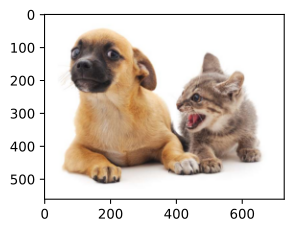
Drawing boxes
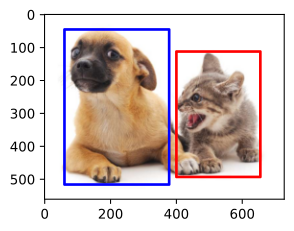
A small helper to render a list of (x1, y1, x2, y2) boxes on a matplotlib axis. We’ll reuse it everywhere in this chapter:
def bbox_to_rect(bbox, color):
    """Convert bounding box to matplotlib format."""
    # Convert the bounding box (upper-left x, upper-left y, lower-right x,
    # lower-right y) format to the matplotlib format: ((upper-left x,
    # upper-left y), width, height)
    return d2l.plt.Rectangle(
        xy=(bbox[0], bbox[1]), width=bbox[2]-bbox[0], height=bbox[3]-bbox[1],
        fill=False, edgecolor=color, linewidth=2)
fig = d2l.plt.imshow(img)
fig.axes.add_patch(bbox_to_rect(dog_bbox, 'blue'))
fig.axes.add_patch(bbox_to_rect(cat_bbox, 'red'));