from d2l import torch as d2l
import torchTwo GPUs, two independent jobs
Automatic Parallelism
Once the framework runs asynchronously and tracks dependencies, two kinds of parallelism happen for free:
- Independent ops on different devices — if op A doesn’t depend on op B, the scheduler can run them in parallel on GPU 0 and GPU 1.
- Computation overlapped with communication — while the GPUs reduce gradients across the network, the next layer’s forward pass can start running.
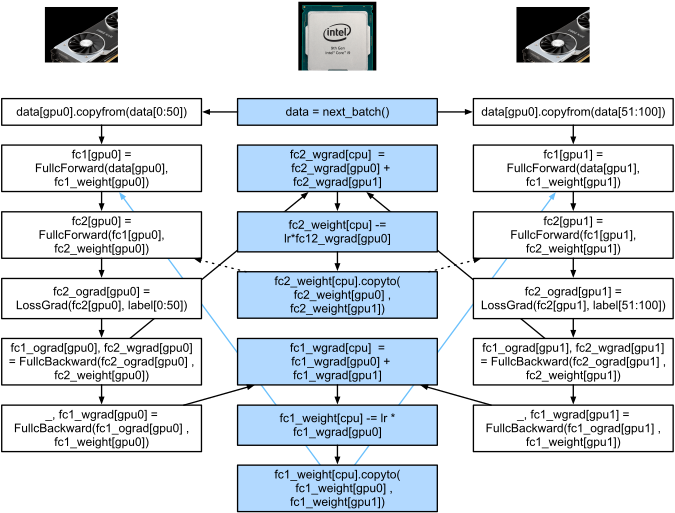
Two-layer MLP scheduled across CPU and 2 GPUs — independent branches run in parallel.
You don’t write any threads. The dependency tracker does it for you. This deck quantifies the speedup.
Run the same matmul on GPU 0 and GPU 1 separately, then run both at the same time:
devices = d2l.try_all_gpus()
def run(x):
    return [x.mm(x) for _ in range(50)]

x_gpu1 = torch.rand(size=(4000, 4000), device=devices[0])
x_gpu2 = torch.rand(size=(4000, 4000), device=devices[1])
run(x_gpu1)
run(x_gpu2) # Warm-up all devices
torch.cuda.synchronize(devices[0])
torch.cuda.synchronize(devices[1])
with d2l.Benchmark('GPU1 time'):
run(x_gpu1)
torch.cuda.synchronize(devices[0])
with d2l.Benchmark('GPU2 time'):
run(x_gpu2)
torch.cuda.synchronize(devices[1])GPU1 time: 0.1195 sec
GPU2 time: 0.1189 secwith d2l.Benchmark('GPU1 & GPU2'):
run(x_gpu1)
run(x_gpu2)
torch.cuda.synchronize()GPU1 & GPU2: 0.1216 secConcurrent run is roughly the time of one GPU — the scheduler used both in parallel.