Dive into Deep Learning · §10.6
What attention computes
the residual stream · QK and OV circuits · induction heads · in-context learning in miniature
Not where a model attends — what the attending computes
Each position carries a d-dimensional vector from embedding to logits. Layers never overwrite it; heads only add:
\mathbf{h}_i^{(\ell)} = \mathbf{h}_i^{(\ell-1)} + \sum_{h=1}^{H} \sum_{j \leq i} \alpha_{ij}^{\ell h}\, \mathbf{W}_{\mathrm{OV}}^{\ell h}\, \mathbf{h}_j^{(\ell-1)}
Attention-only, no FFN, no LayerNorm (Elhage et al., 2021): with the patterns fixed, embeddings → logits is linear — fully analyzable. TinyCharLM was built for exactly this.
Every head is two matrices you can read off the checkpoint:
s_{ij} = \frac{\mathbf{h}_i^\top \mathbf{W}_{\mathrm{QK}} \mathbf{h}_j}{\sqrt{d_h}}, \qquad \mathbf{W}_{\mathrm{QK}} = \mathbf{W}_q^\top \mathbf{W}_k, \qquad \mathbf{W}_{\mathrm{OV}} = \mathbf{W}_o \mathbf{W}_v
W_QK: shape (128, 128), rank 32
W_OV: shape (128, 128), rank 32
With attention patterns as if–then rules, the one-layer logits expand into paths:
\mathbf{z}_i = \underbrace{\mathbf{E}\,\mathbf{e}_{x_i}}_{\textrm{low-rank bigram}} + \sum_{h}\sum_{j \leq i} \alpha_{ij}^{h}\; \underbrace{\mathbf{E}\,\mathbf{W}_{\mathrm{OV}}^{h}\,\mathbf{e}_{x_j}}_{\textrm{skip-trigram}}
Layer 1 writes each token’s predecessor into its stream; layer 2 matches “I am [\mathrm{A}]” against “follows [\mathrm{A}]” and copies. Whether gradient descent finds this circuit is an empirical question.
Random patterns, tiled; fresh every batch. No corpus statistics — the only way to predict later copies is retrieval from context:
pattern lengths: [6, 6]
tensor([[4, 0, 3, 4, 0, 0, 4, 0, 3, 4, 0, 0, 4, 0, 3, 4],
[1, 0, 3, 5, 0, 7, 1, 0, 3, 5, 0, 7, 1, 0, 3, 5]])
Fixed pattern length 32 — and the model our theory says is too shallow gets a perfect score (note bias=True; the reason is on the next slide):
first copy 4.42 nats, second copy 0.09 nats, second-copy accuracy 1.00
Probe: same model, patterns of length 24.
patterns of length 24: second-copy accuracy 0.02
attention mass at offset 31: 0.96
attention mass at offset 23: 0.00
qkv bias makes that head cheap: a constant, content-free query. Biases off — as in every model we analyze — the shortcut only half-forms.A synthetic benchmark rewards the cheapest circuit it admits, not the mechanism its designer had in mind. Fix: make the period unpredictable.
Pattern length now uniform in 16–32; no fixed offset works.
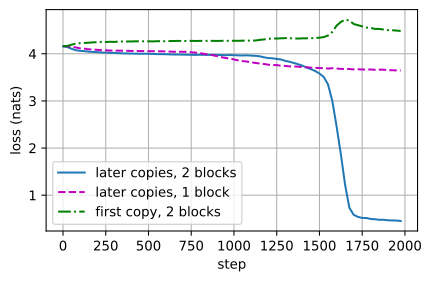
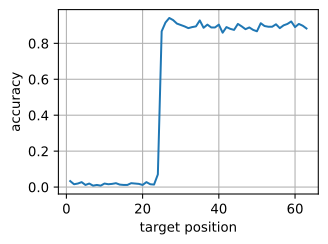
2 blocks: first copy 4.50, later copies 0.45, accuracy 0.87
1 block: first copy 4.34, later copies 3.65, accuracy 0.11
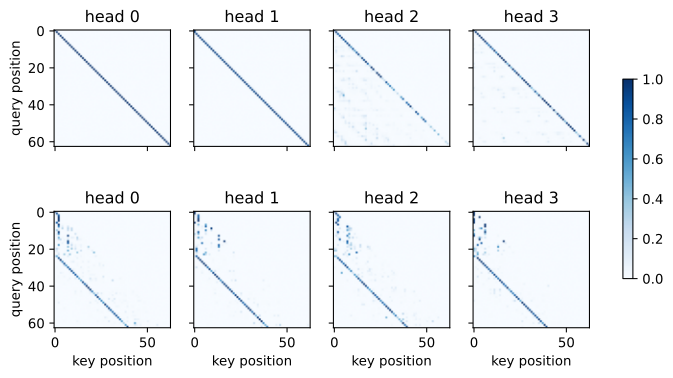
Block 1: a sharp line one step below the diagonal — a previous-token head. Block 2: a stripe at offset L-1, starting where the second copy starts — the induction stripe.
Average mass on the previous token vs. on the induction target j = i + 1 - L:
block 1: previous token 0.00 0.95 0.02 0.01 | induction target 0.00 0.00 0.01 0.00
block 2: previous token 0.04 0.05 0.04 0.04 | induction target 0.67 0.71 0.66 0.65
Every evaluation pattern is new — no pair it copies was ever in training. The weights store an algorithm, not associations:
One exposure suffices; the restart itself is unpredictable in principle.
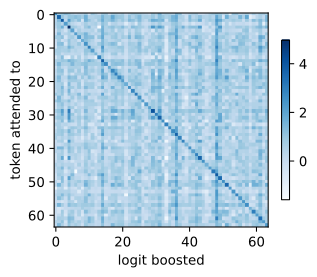
If block 2 copies, attending to token a should boost logit a: C_{ab} = \mathbf{e}_b^\top \mathbf{W}_{\mathrm{OV}} \mathbf{e}_a should be diagonal-dominant — checkable without a forward pass:
rows whose largest entry is the diagonal: 0.94 (chance 1/64)
In full transformers (FFN, LayerNorm, superposition) each step becomes a research problem: mechanistic interpretability. A handful of circuits — induction heads first — are understood at this level. Most are not.
TinyCharLM finds the induction circuit in a phase change; a fixed-period task is solved by a positional shortcut instead.