class MultiHeadAttention(d2l.Module):
"""Multi-head attention."""
def __init__(self, num_hiddens, num_heads, dropout, bias=False, **kwargs):
super().__init__()
assert num_hiddens % num_heads == 0, 'heads must divide num_hiddens'
self.num_heads = num_heads
self.attention = d2l.DotProductAttention(dropout)
self.W_q = nn.LazyLinear(num_hiddens, bias=bias)
self.W_k = nn.LazyLinear(num_hiddens, bias=bias)
self.W_v = nn.LazyLinear(num_hiddens, bias=bias)
self.W_o = nn.LazyLinear(num_hiddens, bias=bias)
def forward(self, queries, keys, values, valid_lens):
# Shape of queries, keys, or values:
# (batch_size, no. of queries or key-value pairs, num_hiddens)
# Shape of valid_lens: (batch_size,) or (batch_size, no. of queries)
queries = self.transpose_qkv(self.W_q(queries))
keys = self.transpose_qkv(self.W_k(keys))
values = self.transpose_qkv(self.W_v(values))
if valid_lens is not None:
# On axis 0, copy the first item (scalar or vector) for num_heads
# times, then copy the next item, and so on
valid_lens = torch.repeat_interleave(
valid_lens, repeats=self.num_heads, dim=0)
# Shape of output: (batch_size * num_heads, no. of queries,
# num_hiddens / num_heads)
output = self.attention(queries, keys, values, valid_lens)
# Shape of output_concat: (batch_size, no. of queries, num_hiddens)
output_concat = self.transpose_output(output)
return self.W_o(output_concat)Multi-Head and Cross-Attention
Dive into Deep Learning · §10.3
Multi-head and cross-attention
single-head limitations · multi-head computation · self- and cross-attention
A single head provides one mixture
A limiting example
Two positions hold random values \mathbf{v}_1, \mathbf{v}_2; keys mark positions only. One query must report both: \mathbf{t} = [\mathbf{v}_1; \mathbf{v}_2].
A head can only output \mathbf{W}_o(\alpha_1 \mathbf{v}_1 + \alpha_2 \mathbf{v}_2) — one convex mixture per query.
Proposition. Best achievable relative squared error = 1/2, for every choice of (\alpha_1, \alpha_2).
Changing the weights cannot create a second independent mixture.
The bound, numerically
single head, weights (0.5, 0.5): relative error 0.706
single head, weights (0.7, 0.3): relative error 0.706
single head, weights (0.9, 0.1): relative error 0.706
single head, weights (1.0, 0.0): relative error 0.707
theory: sqrt(1/2) = 0.707- Best linear readout via least squares, attention split swept from (0.5, 0.5) to (1, 0).
- Error pinned at \sqrt{1/2} \approx 0.707 across the whole range.
Two heads suffice
two heads, weights (1.00, 0.00) and (0.00, 1.00): relative error 1.4e-06
two heads, weights (0.88, 0.12) and (0.12, 0.88): relative error 6.0e-07- The error falls to the solver’s floating-point precision.
- Soft heads with weights (0.88, 0.12) also recover both values. Two different mixtures let the readout invert the 2 \times 2 mixing matrix; the weights need not be one-hot.
Multi-head attention
Learn the heads: each gets its own projections, then ordinary scaled dot product attention
\mathbf{h}_i = f\big(\mathbf W_i^{(q)}\mathbf q, \mathbf W_i^{(k)}\mathbf k, \mathbf W_i^{(v)}\mathbf v\big), \qquad \textrm{output} = \mathbf W_o [\mathbf h_1; \ldots; \mathbf h_h].
Cost of multiple heads
Per-head width p = d/h ⇒ for n tokens:
\underbrace{8nd^2}_{\textrm{projections}} + \underbrace{4n^2 d}_{\textrm{scores, mixing}} \ \textrm{FLOPs}, \qquad 4d^2 \ \textrm{parameters}
The expression is independent of h. The leading FLOP and parameter counts remain fixed, although kernel efficiency varies with head count.
What does change with h: the attention map — h distributions per query instead of one.
Implementation
One d \times d projection each for Q, K, V; reshape into h heads; fold the head axis into the batch axis:
Folding heads into the batch axis
(batch, len, d) → (batch, len, h, d/h) → (batch·h, len, d/h): The attention code treats heads as extra batch entries and requires no loop over heads.
@d2l.add_to_class(MultiHeadAttention)
def transpose_qkv(self, X):
    """Transposition for parallel computation of multiple attention heads."""
    # Shape of input X: (batch_size, no. of queries or key-value pairs,
    # num_hiddens). Shape of output X: (batch_size, no. of queries or
    # key-value pairs, num_heads, num_hiddens / num_heads)
    X = X.reshape(X.shape[0], X.shape[1], self.num_heads, -1)
    # Shape of output X: (batch_size, num_heads, no. of queries or key-value
    # pairs, num_hiddens / num_heads)
    X = X.permute(0, 2, 1, 3)
    # Shape of output: (batch_size * num_heads, no. of queries or key-value
    # pairs, num_hiddens / num_heads)
    return X.reshape(-1, X.shape[2], X.shape[3])

@d2l.add_to_class(MultiHeadAttention)
def transpose_output(self, X):
    """Reverse the operation of transpose_qkv."""
    X = X.reshape(-1, self.num_heads, X.shape[1], X.shape[2])
    X = X.permute(0, 2, 1, 3)
    return X.reshape(X.shape[0], X.shape[1], -1)
Shape and cost checks
num_hiddens, num_heads = 100, 5
attention = MultiHeadAttention(num_hiddens, num_heads, 0.5)
batch_size, num_queries, num_kvpairs = 2, 4, 6
valid_lens = d2l.tensor([3, 2])
X = d2l.ones((batch_size, num_queries, num_hiddens))
Y = d2l.ones((batch_size, num_kvpairs, num_hiddens))
d2l.check_shape(attention(X, Y, Y, valid_lens),
                (batch_size, num_queries, num_hiddens))
1 heads: 262144 parameters
2 heads: 262144 parameters
4 heads: 262144 parameters
8 heads: 262144 parametersSelf- vs. cross-attention: two wirings
Self-attention and cross-attention differ only in the sources of their arguments.
- Self-attention:
attention(X, X, X)— one sequence queries itself; output shape = input shape (the stackable case). - Cross-attention:
attention(A, B, B)— sequence A asks, sequence B answers; output length = query length.
A cross-attention alignment
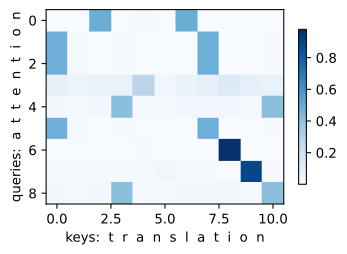
Letters of “attention” query letters of “translation” through raw dot product attention on shared random embeddings:
Three regimes in one map
i,o: unique partner → sharp attention.a,t,n: two copies → weight splits — the averaging of the construction, in miniature.e: no partner → diffuse row because softmax still normalizes over all keys.
A diffuse row may indicate that no key is relevant rather than that every key is relevant. This ambiguity limits attention maps as explanations.
Recap
- One head provides one softmax distribution and one value mixture per query; on the copy-both task its relative squared error is 1/2.
- Multi-head: h independently projected heads, concatenated, recombined by \mathbf{W}_o. With p = d/h, the leading parameter and FLOP counts equal those of one full-width head.
- Implementation folds heads into the batch axis: one batched matmul.
- Self-attention and cross-attention are the same code with different arguments; only the wiring differs.