from d2l import torch as d2l
import math
import torch
from torch import nnAttention pooling needs a scoring function a(\mathbf{q}, \mathbf{k}) that softmax turns into weights:
\alpha(\mathbf{q}, \mathbf{k}_i) = \frac{\exp\, a(\mathbf{q}, \mathbf{k}_i)}{\sum_j \exp\, a(\mathbf{q}, \mathbf{k}_j)}.
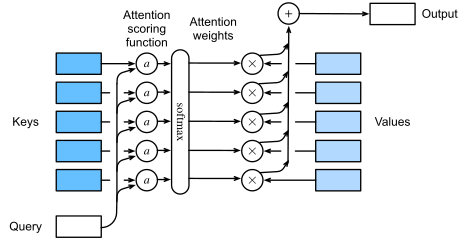
Output = weighted sum of values; weights = softmax of scoring function a.
Both feed into the same softmax + value-pooling pipeline.
For d-dimensional queries and keys with independent, zero-mean, unit-variance coordinates,
\operatorname{Var}(\mathbf{q}^\top\mathbf{k}) = \operatorname{Var}\left(\sum_{\ell=1}^d q_\ell k_\ell\right) = d.
As d grows, raw dot products become large in magnitude, softmax saturates, and gradients shrink. Scaling by 1/\sqrt d keeps the logit variance approximately constant:
a(\mathbf{q}, \mathbf{k}_i) = \mathbf{q}^\top \mathbf{k}_i / \sqrt{d}.
A Gaussian-kernel view gives useful geometric intuition, but the variance argument is the operational reason used in Transformers.
Padded sequences in a minibatch — we don’t want <pad> keys to receive attention mass. Set their pre-softmax scores to a large negative number so \exp flushes them to zero:
def masked_softmax(X, valid_lens):
"""Perform softmax operation by masking elements on the last axis."""
# X: 3D tensor, valid_lens: 1D or 2D tensor
def _sequence_mask(X, valid_len, value=0):
maxlen = X.size(1)
mask = torch.arange((maxlen), dtype=torch.float32,
device=X.device)[None, :] < valid_len[:, None]
# Out-of-place to avoid mutating the input tensor in-place, which
# autograd can flag and which interferes with downstream views.
return torch.where(mask, X, torch.full_like(X, value))
if valid_lens is None:
return nn.functional.softmax(X, dim=-1)
else:
shape = X.shape
if valid_lens.dim() == 1:
valid_lens = torch.repeat_interleave(valid_lens, shape[1])
else:
valid_lens = valid_lens.reshape(-1)
# On the last axis, replace masked elements with a very large negative
# value, whose exponentiation outputs 0
X = _sequence_mask(X.reshape(-1, shape[-1]), valid_lens, value=-1e6)
return nn.functional.softmax(X.reshape(shape), dim=-1)Random scores; specify a valid length per row:
tensor([[[0.4700, 0.5300, 0.0000, 0.0000],
[0.5927, 0.4073, 0.0000, 0.0000]],
[[0.4326, 0.3846, 0.1828, 0.0000],
[0.4712, 0.2526, 0.2762, 0.0000]]])
Attention runs in batches; weights × values is a batched matmul. bmm does the right thing — confirm shapes:
Stateless layer — no parameters, just \mathbf{Q}\mathbf{K}^\top/\sqrt d, masked softmax, then weighted sum of values:
class DotProductAttention(nn.Module):
"""Scaled dot product attention."""
def __init__(self, dropout):
super().__init__()
self.dropout = nn.Dropout(dropout)
# Shape of queries: (batch_size, no. of queries, d)
# Shape of keys: (batch_size, no. of key-value pairs, d)
# Shape of values: (batch_size, no. of key-value pairs, value dimension)
# Shape of valid_lens: (batch_size,) or (batch_size, no. of queries)
def forward(self, queries, keys, values, valid_lens=None):
d = queries.shape[-1]
# Swap the last two dimensions of keys with keys.transpose(1, 2)
scores = torch.bmm(queries, keys.transpose(1, 2)) / math.sqrt(d)
self.attention_weights = masked_softmax(scores, valid_lens)
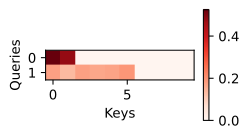
return torch.bmm(self.dropout(self.attention_weights), values)2 queries, 10 keys/values, valid lengths (2, 6) — only the first 2 / first 6 keys per batch get nonzero weight:
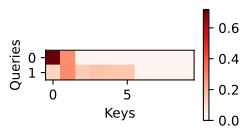
a(\mathbf{q}, \mathbf{k}) = \mathbf{w}_v^\top \tanh(\mathbf{W}_q\mathbf{q} + \mathbf{W}_k\mathbf{k}). Learnable \mathbf{W}_q, \mathbf{W}_k, \mathbf{w}_v. Lets queries and keys live in different feature spaces.
class AdditiveAttention(nn.Module):
"""Additive attention."""
def __init__(self, num_hiddens, dropout, **kwargs):
super(AdditiveAttention, self).__init__(**kwargs)
self.W_k = nn.LazyLinear(num_hiddens, bias=False)
self.W_q = nn.LazyLinear(num_hiddens, bias=False)
self.w_v = nn.LazyLinear(1, bias=False)
self.dropout = nn.Dropout(dropout)
def forward(self, queries, keys, values, valid_lens):
queries, keys = self.W_q(queries), self.W_k(keys)
# After dimension expansion, shape of queries: (batch_size, no. of
# queries, 1, num_hiddens) and shape of keys: (batch_size, 1, no. of
# key-value pairs, num_hiddens). Sum them up with broadcasting
features = queries.unsqueeze(2) + keys.unsqueeze(1)
features = torch.tanh(features)
# There is only one output of self.w_v, so we remove the last
# one-dimensional entry from the shape. Shape of scores: (batch_size,
# no. of queries, no. of key-value pairs)
scores = self.w_v(features).squeeze(-1)
self.attention_weights = masked_softmax(scores, valid_lens)
# Shape of values: (batch_size, no. of key-value pairs, value
# dimension)
return torch.bmm(self.dropout(self.attention_weights), values)Same shapes as before, with mismatched query/key dims allowed: