BiRNN classifier

Sentiment Analysis: Using Recurrent Neural Networks

Sentiment RNN

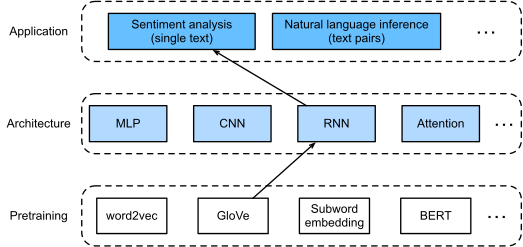
Sentiment classification on IMDb: pretrained word vectors → bidirectional LSTM → linear head. Standard pre-Transformer text-classification recipe.

The encoder reads the review left-to-right and right-to-left; concatenated final hidden states feed a binary classifier. GloVe gives a strong initialization that the LSTM then specializes for sentiment.

Pipeline

GloVe embeddings → BiLSTM → output classifier.

Setup

from d2l import mxnet as d2l
from mxnet import gluon, init, np, npx
from mxnet.gluon import nn, rnn
npx.set_np()

batch_size = 64
train_iter, test_iter, vocab = d2l.load_data_imdb(batch_size)

Class definition: embedding -> bidirectional LSTM -> concatenate the first and last hidden states -> 2-way decoder. The decoder input has width 4h: two directions times two endpoint states.

class BiRNN(nn.Block):
    def __init__(self, vocab_size, embed_size, num_hiddens,
                 num_layers):
        super().__init__()
        self.embedding = nn.Embedding(vocab_size, embed_size)
        # Set `bidirectional` to True to get a bidirectional RNN
        self.encoder = rnn.LSTM(num_hiddens, num_layers=num_layers,
                                bidirectional=True, input_size=embed_size)
        self.decoder = nn.Dense(2)

    def forward(self, inputs):
        # The shape of `inputs` is (batch size, no. of time steps). Because
        # LSTM requires its input's first dimension to be the temporal
        # dimension, the input is transposed before obtaining token
        # representations. The output shape is (no. of time steps, batch size,
        # word vector dimension)
        embeddings = self.embedding(inputs.T)
        # Returns hidden states of the last hidden layer at different time
        # steps. The shape of `outputs` is (no. of time steps, batch size,
        # 2 * no. of hidden units)
        outputs = self.encoder(embeddings)
        # Concatenate the hidden states at the initial and final time steps as
        # the input of the fully connected layer. Its shape is (batch size,
        # 4 * no. of hidden units)
        encoding = np.concatenate((outputs[0], outputs[-1]), axis=1)
        outs = self.decoder(encoding)
        return outs

BiRNN instance

Instantiate a 2-layer BiLSTM with 100-dimensional embeddings and 100 hidden units. Frameworks initialize recurrent weights differently, but the model contract is the same:

embed_size, num_hiddens, num_layers, devices = 100, 100, 2, d2l.try_all_gpus()
net = BiRNN(len(vocab), embed_size, num_hiddens, num_layers)
# Per-block init: Gluon 2.0's Xavier rejects 1D weights, and the fused LSTM
# has 1D internal weights. Initialize Xavier on the 2D blocks; let the LSTM
# use its default initializer.
net.embedding.initialize(init.Xavier(), ctx=devices)
net.encoder.initialize(ctx=devices)
net.decoder.initialize(init.Xavier(), ctx=devices)

Loading pretrained GloVe

Use 100-dim GloVe vectors trained on Wikipedia + Gigaword. Initialize the embedding layer from them; freeze or fine-tune (we fine-tune):

glove_embedding = d2l.TokenEmbedding('glove.6b.100d')
embeds = glove_embedding[vocab.idx_to_token]
embeds.shape
net.embedding.weight.set_data(embeds)
for p in net.embedding.collect_params().values():
    p.grad_req = 'null'

Training

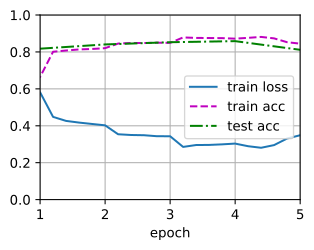
Standard cross-entropy + Adam. Watch validation accuracy, not just training loss; sentiment models overfit quickly on IMDb if the embedding and classifier are too large:

# lr divided by batch_size: gluon Trainer no longer rescales (issue 7 fix in d2l.train_batch_ch13)
lr, num_epochs = 1.5625e-4, 5
trainer = gluon.Trainer(net.collect_params(), 'adam', {'learning_rate': lr})
loss = gluon.loss.SoftmaxCrossEntropyLoss()
d2l.train_ch13(net, train_iter, test_iter, loss, trainer, num_epochs, devices)
def predict_sentiment(net, vocab, sequence):
    """Predict the sentiment of a text sequence."""
    sequence = np.array(vocab[sequence.split()], ctx=d2l.try_gpu())
    label = np.argmax(net(sequence.reshape(1, -1)), axis=1)
    return 'positive' if label == 1 else 'negative'

Predict on new reviews

The final check should classify clearly positive and clearly negative synthetic reviews differently. This is not a full evaluation, but it catches label/order mistakes in the pipeline.

predict_sentiment(net, vocab, 'this movie is so great')
predict_sentiment(net, vocab, 'this movie is so bad')

Recap

  • BiLSTM-on-GloVe: a strong pre-Transformer baseline for text classification.
  • Pretrained embeddings carry general-purpose word semantics; LSTM specializes for sentiment.
  • Easily beaten today by fine-tuned BERT, but a clean template for sequence-to-label tasks more broadly.