class LinearRegression(d2l.Module):
    """The linear regression model implemented with high-level APIs."""
    def __init__(self, lr):
        super().__init__()
        self.save_hyperparameters()
        self.net = nn.Dense(1)
self.net.initialize(init.Normal(sigma=0.01))The layer already is the model
The Model
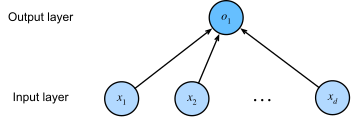
What we hand-rolled as w, b, and a matrix–vector product, every framework ships as a fully connected layer: each input wired to the one output: exactly the picture of linear regression.
The layer owns its parameters. We no longer allocate them, initialize them, or even know their shapes ahead of time.
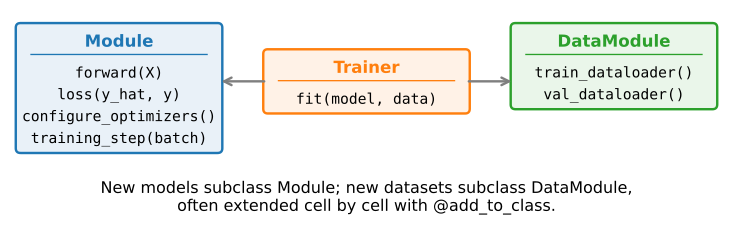
The Trainer uses the same model interface
Training
Our Trainer, Module, and DataModule from the object-oriented-design section don’t care that the model is now a built-in layer.
The training loop is identical to the from-scratch version.
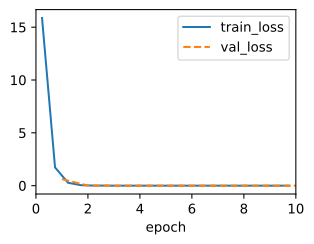
Fit: same data, same curve, a fraction of the code
Training
Same synthetic data, same ten epochs, same fit call as the linear-regression-from-scratch section:
model = LinearRegression(lr=0.03)
data = d2l.SyntheticRegressionData(w=d2l.tensor([2, -3.4]), b=4.2)
trainer = d2l.Trainer(max_epochs=10)
trainer.fit(model, data)
The two implementations use the same model, loss, data, and update rule; only the component implementations differ.