Neural Style Transfer

Neural Style Transfer

Neural style transfer (Gatys, Ecker, Bethge 2015): combine the content of one image with the style of another. No model training — just iterative optimization of pixel values against a loss defined over a frozen pretrained CNN.
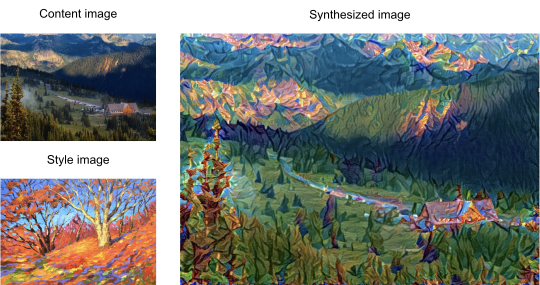
Content + style → synthesized image.

The key insight

In a pretrained ImageNet CNN:

  • Deeper layer activations capture content.
  • Gram matrices of activations capture style (textures, brush strokes, color palette).

Define a loss matching both; optimize over the synthesized image’s pixels.
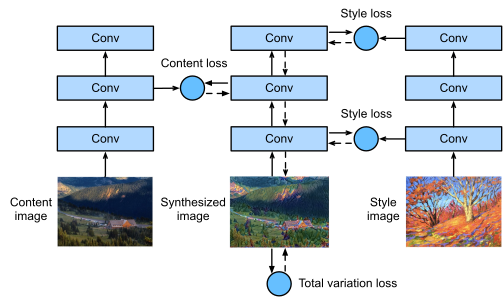
Pipeline: forward pass extracts content + style features; backprop into pixels.

Loading content and style
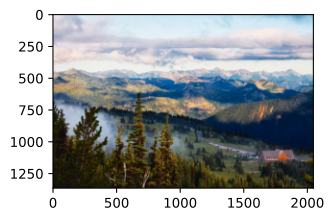
%matplotlib inline
from d2l import mxnet as d2l
from mxnet import autograd, gluon, image, init, np, npx
from mxnet.gluon import nn

npx.set_np()

d2l.set_figsize()
content_img = image.imread('../img/rainier.jpg')
d2l.plt.imshow(content_img.asnumpy());
style_img = image.imread('../img/autumn-oak.jpg')
d2l.plt.imshow(style_img.asnumpy());
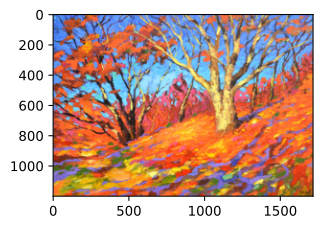
Preprocessing

ImageNet mean/std normalization in, inverse on the way out:

rgb_mean = np.array([0.485, 0.456, 0.406])
rgb_std = np.array([0.229, 0.224, 0.225])

def preprocess(img, image_shape):
    img = image.imresize(img, *image_shape)
    img = (img.astype('float32') / 255 - rgb_mean) / rgb_std
    return np.expand_dims(img.transpose(2, 0, 1), axis=0)

def postprocess(img):
    img = img[0].as_in_ctx(rgb_std.ctx)
    return (img.transpose(1, 2, 0) * rgb_std + rgb_mean).clip(0, 1)

Pretrained VGG-19 feature extractor

Style is a multi-scale phenomenon — match it across several VGG-19 layers (Conv1_1, 2_1, 3_1, 4_1, 5_1). Content is matched at one deeper layer (Conv4_2):

pretrained_net = gluon.model_zoo.vision.vgg19(pretrained=True)
style_layers, content_layers = [0, 5, 10, 19, 28], [25]
net = nn.Sequential()
for i in range(max(content_layers + style_layers) + 1):
    net.add(pretrained_net.features[i])

Feature extractor (cont.)

def extract_features(X, content_layers, style_layers):
    contents = []
    styles = []
    for i in range(len(net)):
        X = net[i](X)
        if i in style_layers:
            styles.append(X)
        if i in content_layers:
            contents.append(X)
    return contents, styles
def get_contents(image_shape, device):
    content_X = preprocess(content_img, image_shape).copyto(device)
    contents_Y, _ = extract_features(content_X, content_layers, style_layers)
    return content_X, contents_Y

def get_styles(image_shape, device):
    style_X = preprocess(style_img, image_shape).copyto(device)
    _, styles_Y = extract_features(style_X, content_layers, style_layers)
    return style_X, styles_Y

Content loss

Squared error between content and synthesized features at the content layer:

def content_loss(Y_hat, Y):
    return np.square(Y_hat - Y).mean()

Style loss

Squared error between Gram matrices of features at each style layer. Gram matrix G = F F^\top captures pairwise channel correlations, discarding spatial location:

def gram(X):
    num_channels, n = X.shape[1], d2l.size(X) // X.shape[1]
    X = d2l.reshape(X, (num_channels, n))
    return d2l.matmul(X, d2l.transpose(X)) / (num_channels * n)
def style_loss(Y_hat, gram_Y):
    return np.square(gram(Y_hat) - gram_Y).mean()

Total variation loss

Penalizes high-frequency noise; keeps the synthesized image smooth:

def tv_loss(Y_hat):
    return 0.5 * (d2l.reduce_mean(
        d2l.abs(Y_hat[:, :, 1:, :] - Y_hat[:, :, :-1, :])) +
                  d2l.reduce_mean(
        d2l.abs(Y_hat[:, :, :, 1:] - Y_hat[:, :, :, :-1])))

Combined loss

\mathcal{L} = \alpha\, \mathcal{L}_\text{content} + \beta\, \mathcal{L}_\text{style} + \gamma\, \mathcal{L}_\text{tv}.

The relative weights determine the visual style — high \beta pushes towards painterly, low \beta keeps photorealism.

content_weight, style_weight, tv_weight = 1, 1e4, 10

def compute_loss(X, contents_Y_hat, styles_Y_hat, contents_Y, styles_Y_gram):
    # Calculate the content, style, and total variance losses respectively
    contents_l = [content_loss(Y_hat, Y) * content_weight for Y_hat, Y in zip(
        contents_Y_hat, contents_Y)]
    styles_l = [style_loss(Y_hat, Y) * style_weight for Y_hat, Y in zip(
        styles_Y_hat, styles_Y_gram)]
    tv_l = tv_loss(X) * tv_weight
    # Add up all the losses
    l = sum(styles_l + contents_l + [tv_l])
    return contents_l, styles_l, tv_l, l

Initializing the synthesized image

Start from the content image (or noise — converges slower but works). The synthesized image is the optimization variable; the network parameters are frozen:

class SynthesizedImage(nn.Block):
    def __init__(self, img_shape):
        super(SynthesizedImage, self).__init__()
        self.weight = gluon.Parameter('weight', shape=img_shape)

    def forward(self):
        return self.weight.data()
def get_inits(X, device, lr, styles_Y):
    gen_img = SynthesizedImage(X.shape)
    gen_img.initialize(init.Constant(X), ctx=device, force_reinit=True)
    trainer = gluon.Trainer(gen_img.collect_params(), 'adam',
                            {'learning_rate': lr})
    styles_Y_gram = [gram(Y) for Y in styles_Y]
    return gen_img(), styles_Y_gram, trainer

Optimization loop

Adam (or LBFGS) optimizes the synthesized image itself. The CNN stays frozen; gradients flow through VGG features back to pixels:

def train(X, contents_Y, styles_Y, device, lr, num_epochs, lr_decay_epoch):
    X, styles_Y_gram, trainer = get_inits(X, device, lr, styles_Y)
    animator = d2l.Animator(xlabel='epoch', ylabel='loss',
                            xlim=[10, num_epochs], ylim=[0, 20],
                            legend=['content', 'style', 'TV'],
                            ncols=2, figsize=(7, 2.5))
    for epoch in range(num_epochs):
        with autograd.record():
            contents_Y_hat, styles_Y_hat = extract_features(
                X, content_layers, style_layers)
            contents_l, styles_l, tv_l, l = compute_loss(
                X, contents_Y_hat, styles_Y_hat, contents_Y, styles_Y_gram)
        l.backward()
        trainer.step(1)
        if (epoch + 1) % lr_decay_epoch == 0:
            trainer.set_learning_rate(trainer.learning_rate * 0.8)
        if (epoch + 1) % 10 == 0:
            animator.axes[1].imshow(postprocess(X).asnumpy())
            animator.add(epoch + 1, [float(sum(contents_l)),
                                     float(sum(styles_l)), float(tv_l)])
    return X

Optimization result

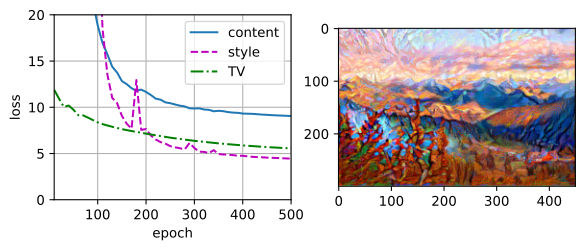
After a few hundred iterations, the content layout should remain recognizable while colors and local textures move toward the style image. The three plotted losses are weighted differently, so compare their trends rather than their raw magnitudes:

device, image_shape = d2l.try_gpu(), (450, 300)
net.reset_ctx(device)
content_X, contents_Y = get_contents(image_shape, device)
_, styles_Y = get_styles(image_shape, device)
output = train(content_X, contents_Y, styles_Y, device, 0.9, 500, 50)
Recap

  • Style transfer = optimize pixels to minimize a content loss + a Gram-matrix style loss + TV smoothness loss.
  • The CNN is frozen; we backprop into the image, not the weights.
  • Multi-layer style matching is what gives the recognizable texture-on-content look.
  • Modern variants: feedforward style nets (one pass per image), AdaIN, neural style with diffusion models — same idea, faster inference.