Coordinates and feature maps

Anchor Boxes

Anchor Boxes

A dense detector should not regress arbitrary boxes from scratch at every location. Anchor boxes turn the problem into residual regression around structured candidate boxes.

  1. Attach anchors to spatial locations, usually feature-map cells mapped back to image coordinates.
  2. For each anchor, predict class and box offset.
  3. After the forward pass, non-maximum suppression prunes overlapping high-confidence predictions.

Core of SSD, RetinaNet, and the region proposal network in Faster R-CNN. Some modern detectors are anchor-free, but the same ideas — dense classification, localization, and NMS — remain central.

Setup

%matplotlib inline
from d2l import mxnet as d2l
from mxnet import gluon, image, np, npx

np.set_printoptions(2)  # Simplify printing accuracy
npx.set_np()

Keep three coordinate systems separate:

  • image coordinates: box corners or centers measured in pixels;
  • feature-map cells: locations after CNN downsampling, each with a receptive field in the image;
  • normalized anchors: candidate boxes parameterized relative to image width/height or to a feature-map stride.

In toy code we generate anchors at image pixels for clarity. In production detectors, anchors are usually tied to feature-map locations so each prediction uses the local receptive field.

Generating anchors

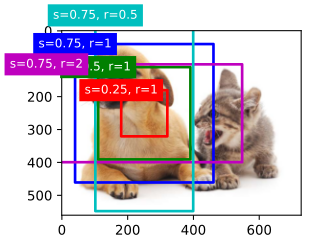
At each pixel center, generate boxes for n scales and m aspect ratios — but only those involving the smallest scale or smallest ratio, giving n + m - 1 boxes per pixel (not nm):

\text{anchor width} = w s\sqrt{r}, \quad \text{anchor height} = h s / \sqrt{r}.

def multibox_prior(data, sizes, ratios):
    """Generate anchor boxes with different shapes centered on each pixel."""
    in_height, in_width = data.shape[-2:]
    device, num_sizes, num_ratios = data.ctx, len(sizes), len(ratios)
    boxes_per_pixel = (num_sizes + num_ratios - 1)
    size_tensor = d2l.tensor(sizes, ctx=device)
    ratio_tensor = d2l.tensor(ratios, ctx=device)
    # Offsets are required to move the anchor to the center of a pixel. Since
    # a pixel has height=1 and width=1, we choose to offset our centers by 0.5
    offset_h, offset_w = 0.5, 0.5
    steps_h = 1.0 / in_height  # Scaled steps in y-axis
    steps_w = 1.0 / in_width  # Scaled steps in x-axis

    # Generate all center points for the anchor boxes
    center_h = (d2l.arange(in_height, ctx=device) + offset_h) * steps_h
    center_w = (d2l.arange(in_width, ctx=device) + offset_w) * steps_w
    shift_x, shift_y = d2l.meshgrid(center_w, center_h)
    shift_x, shift_y = shift_x.reshape(-1), shift_y.reshape(-1)

    # Generate `boxes_per_pixel` number of heights and widths that are later
    # used to create anchor box corner coordinates (xmin, xmax, ymin, ymax)
    w = np.concatenate((size_tensor * np.sqrt(ratio_tensor[0]),
                        sizes[0] * np.sqrt(ratio_tensor[1:]))) \
                        * in_height / in_width  # Handle rectangular inputs
    h = np.concatenate((size_tensor / np.sqrt(ratio_tensor[0]),
                        sizes[0] / np.sqrt(ratio_tensor[1:])))
    # Divide by 2 to get half height and half width
    anchor_manipulations = np.tile(np.stack((-w, -h, w, h)).T,
                                   (in_height * in_width, 1)) / 2

    # Each center point will have `boxes_per_pixel` number of anchor boxes, so
    # generate a grid of all anchor box centers with `boxes_per_pixel` repeats
    out_grid = d2l.stack([shift_x, shift_y, shift_x, shift_y],
                         axis=1).repeat(boxes_per_pixel, axis=0)
    output = out_grid + anchor_manipulations
    return np.expand_dims(output, axis=0)

Anchor tensor shape

For a h \times w feature map, total anchors = hw(n+m-1). Stored as a tensor of shape (1, num_anchors, 4):

img = image.imread('../img/catdog.jpg').asnumpy()
h, w = img.shape[:2]

print(h, w)
X = np.random.uniform(size=(1, 3, h, w))  # Construct input data
Y = multibox_prior(X, sizes=[0.75, 0.5, 0.25], ratios=[1, 2, 0.5])
Y.shape
boxes = Y.reshape(h, w, 5, 4)
boxes[250, 250, 0, :]

Anchors at one pixel

Visualize the n + m - 1 anchors centered at a single pixel — different scales and ratios:

def show_bboxes(axes, bboxes, labels=None, colors=None):
    """Show bounding boxes."""

    def make_list(obj, default_values=None):
        if obj is None:
            obj = default_values
        elif not isinstance(obj, (list, tuple)):
            obj = [obj]
        return obj

    labels = make_list(labels)
    colors = make_list(colors, ['b', 'g', 'r', 'm', 'c'])
    for i, bbox in enumerate(bboxes):
        color = colors[i % len(colors)]
        rect = d2l.bbox_to_rect(d2l.numpy(bbox), color)
        axes.add_patch(rect)
        if labels and len(labels) > i:
            text_color = 'k' if color == 'w' else 'w'
            axes.text(rect.xy[0], rect.xy[1], labels[i],
                      va='center', ha='center', fontsize=9, color=text_color,
                      bbox=dict(facecolor=color, lw=0))
d2l.set_figsize()
bbox_scale = d2l.tensor((w, h, w, h))
fig = d2l.plt.imshow(img)
show_bboxes(fig.axes, boxes[250, 250, :, :] * bbox_scale,
            ['s=0.75, r=1', 's=0.5, r=1', 's=0.25, r=1', 's=0.75, r=2',
             's=0.75, r=0.5'])
Intersection over Union

We need a similarity measure between two boxes to know which anchor matches which ground truth.

\text{IoU}(A, B) = \frac{|A \cap B|}{|A \cup B|}.
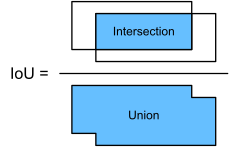
IoU = intersection area / union area.

def box_iou(boxes1, boxes2):
    """Compute pairwise IoU across two lists of anchor or bounding boxes."""
    box_area = lambda boxes: ((boxes[:, 2] - boxes[:, 0]) *
                              (boxes[:, 3] - boxes[:, 1]))
    # Shape of `boxes1`, `boxes2`, `areas1`, `areas2`: (no. of boxes1, 4),
    # (no. of boxes2, 4), (no. of boxes1,), (no. of boxes2,)
    areas1 = box_area(boxes1)
    areas2 = box_area(boxes2)
    # Shape of `inter_upperlefts`, `inter_lowerrights`, `inters`: (no. of
    # boxes1, no. of boxes2, 2)
    inter_upperlefts = np.maximum(boxes1[:, None, :2], boxes2[:, :2])
    inter_lowerrights = np.minimum(boxes1[:, None, 2:], boxes2[:, 2:])
    inters = (inter_lowerrights - inter_upperlefts).clip(min=0)
    # Shape of `inter_areas` and `union_areas`: (no. of boxes1, no. of boxes2)
    inter_areas = inters[:, :, 0] * inters[:, :, 1]
    union_areas = areas1[:, None] + areas2 - inter_areas
    return inter_areas / union_areas

Matching anchors to ground truth

For each anchor box, decide which ground-truth box (if any) it should learn to predict. Common rule: greedy assignment by highest IoU, with a threshold (e.g. 0.5) for “positive” matches:
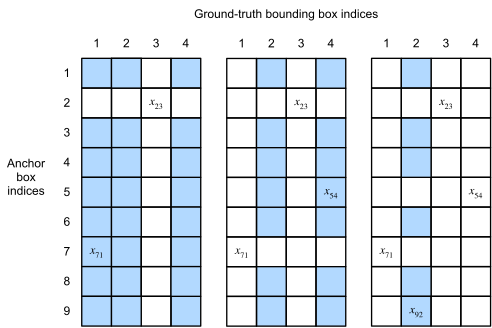
Anchor → GT assignment by IoU.

def assign_anchor_to_bbox(ground_truth, anchors, device, iou_threshold=0.5):
    """Assign closest ground-truth bounding boxes to anchor boxes."""
    num_anchors, num_gt_boxes = anchors.shape[0], ground_truth.shape[0]
    # Element x_ij in the i-th row and j-th column is the IoU of the anchor
    # box i and the ground-truth bounding box j
    jaccard = box_iou(anchors, ground_truth)
    # Initialize the tensor to hold the assigned ground-truth bounding box for
    # each anchor
    anchors_bbox_map = np.full((num_anchors,), -1, dtype=np.int32, ctx=device)
    # Assign ground-truth bounding boxes according to the threshold
    max_ious, indices = np.max(jaccard, axis=1), np.argmax(jaccard, axis=1)
    anc_i = np.nonzero(max_ious >= iou_threshold)[0]
    box_j = indices[max_ious >= iou_threshold]
    anchors_bbox_map[anc_i] = box_j
    col_discard = np.full((num_anchors,), -1)
    row_discard = np.full((num_gt_boxes,), -1)
    for _ in range(num_gt_boxes):
        max_idx = int(np.argmax(jaccard).item())  # Find the largest IoU
        box_idx = max_idx % num_gt_boxes
        anc_idx = max_idx // num_gt_boxes
        anchors_bbox_map[anc_idx] = box_idx
        jaccard[:, box_idx] = col_discard
        jaccard[anc_idx, :] = row_discard
    return anchors_bbox_map

Labels and offsets

A matched anchor learns:

  • Class = the ground-truth class.
  • Offset = the parameterized residual between anchor and ground truth, normalized by per-component mean/std:

\Big(\frac{(x_b{-}x_a)/w_a - \mu_x}{\sigma_x},\; \frac{(y_b{-}y_a)/h_a - \mu_y}{\sigma_y},\; \frac{\log(w_b/w_a) - \mu_w}{\sigma_w},\; \frac{\log(h_b/h_a) - \mu_h}{\sigma_h}\Big).

The log-scale on width/height keeps gradients stable for both small and large boxes.

def offset_boxes(anchors, assigned_bb, eps=1e-6):
    """Transform for anchor box offsets."""
    c_anc = d2l.box_corner_to_center(anchors)
    c_assigned_bb = d2l.box_corner_to_center(assigned_bb)
    offset_xy = 10 * (c_assigned_bb[:, :2] - c_anc[:, :2]) / c_anc[:, 2:]
    offset_wh = 5 * d2l.log(eps + c_assigned_bb[:, 2:] / c_anc[:, 2:])
    offset = d2l.concat([offset_xy, offset_wh], axis=1)
    return offset

Labeling implementation

def multibox_target(anchors, labels):
    """Label anchor boxes using ground-truth bounding boxes."""
    batch_size, anchors = labels.shape[0], anchors.squeeze(0)
    batch_offset, batch_mask, batch_class_labels = [], [], []
    device, num_anchors = anchors.ctx, anchors.shape[0]
    for i in range(batch_size):
        label = labels[i, :, :]
        anchors_bbox_map = assign_anchor_to_bbox(
            label[:, 1:], anchors, device)
        bbox_mask = np.tile((np.expand_dims((anchors_bbox_map >= 0),
                                            axis=-1)), (1, 4)).astype('int32')
        # Initialize class labels and assigned bounding box coordinates with
        # zeros
        class_labels = d2l.zeros(num_anchors, dtype=np.int32, ctx=device)
        assigned_bb = d2l.zeros((num_anchors, 4), dtype=np.float32,
                                ctx=device)
        # Label classes of anchor boxes using their assigned ground-truth
        # bounding boxes. If an anchor box is not assigned any, we label its
        # class as background (the value remains zero)
        indices_true = np.nonzero(anchors_bbox_map >= 0)[0]
        bb_idx = anchors_bbox_map[indices_true]
        class_labels[indices_true] = label[bb_idx, 0].astype('int32') + 1
        assigned_bb[indices_true] = label[bb_idx, 1:]
        # Offset transformation
        offset = offset_boxes(anchors, assigned_bb) * bbox_mask
        batch_offset.append(offset.reshape(-1))
        batch_mask.append(bbox_mask.reshape(-1))
        batch_class_labels.append(class_labels)
    bbox_offset = d2l.stack(batch_offset)
    bbox_mask = d2l.stack(batch_mask)
    class_labels = d2l.stack(batch_class_labels)
    return (bbox_offset, bbox_mask, class_labels)

Worked example

Hand-pick ground truth (dog, cat) and a few anchors; plot them:

ground_truth = d2l.tensor([[0, 0.1, 0.08, 0.52, 0.92],
                         [1, 0.55, 0.2, 0.9, 0.88]])
anchors = d2l.tensor([[0, 0.1, 0.2, 0.3], [0.15, 0.2, 0.4, 0.4],
                    [0.63, 0.05, 0.88, 0.98], [0.66, 0.45, 0.8, 0.8],
                    [0.57, 0.3, 0.92, 0.9]])

fig = d2l.plt.imshow(img)
show_bboxes(fig.axes, ground_truth[:, 1:] * bbox_scale, ['dog', 'cat'], 'k')
show_bboxes(fig.axes, anchors * bbox_scale, ['0', '1', '2', '3', '4']);
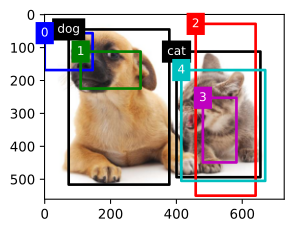
Run the labeler:

labels = multibox_target(np.expand_dims(anchors, axis=0),
                         np.expand_dims(ground_truth, axis=0))
labels[2]

Worked example (cont.)

The returned tensors are easier to read with the contract in mind: class label 0 means background, positive labels are shifted by one, and the offset mask zeros out anchors that should not contribute to the localization loss.

labels[1]
labels[0]

Inverse: offset → predicted box

At inference, the network spits out class scores and offset deltas; invert the offset to recover predicted boxes:

def offset_inverse(anchors, offset_preds):
    """Predict bounding boxes based on anchor boxes with predicted offsets."""
    anc = d2l.box_corner_to_center(anchors)
    pred_bbox_xy = (offset_preds[:, :2] * anc[:, 2:] / 10) + anc[:, :2]
    pred_bbox_wh = d2l.exp(offset_preds[:, 2:] / 5) * anc[:, 2:]
    pred_bbox = d2l.concat((pred_bbox_xy, pred_bbox_wh), axis=1)
    predicted_bbox = d2l.box_center_to_corner(pred_bbox)
    return predicted_bbox

Non-maximum suppression (NMS)

A single object generates many high-confidence anchors. NMS keeps the highest-scoring one and suppresses any with \text{IoU} > \tau to it:

  1. Sort boxes by confidence.
  2. Keep the current top box.
  3. Remove lower-scoring boxes whose IoU with it exceeds \tau.
  4. Repeat until no candidates remain.
def nms(boxes, scores, iou_threshold):
    """Sort confidence scores of predicted bounding boxes."""
    B = scores.argsort()[::-1]
    keep = []  # Indices of predicted bounding boxes that will be kept
    while B.size > 0:
        i = B[0]
        keep.append(i)
        if B.size == 1: break
        iou = box_iou(boxes[i, :].reshape(-1, 4),
                      boxes[B[1:], :].reshape(-1, 4)).reshape(-1)
        inds = np.nonzero(iou <= iou_threshold)[0]
        B = B[inds + 1]
    return np.array(keep, dtype=np.int32, ctx=boxes.ctx)
def multibox_detection(cls_probs, offset_preds, anchors, nms_threshold=0.5,
                       pos_threshold=0.009999999):
    """Predict bounding boxes using non-maximum suppression."""
    device, batch_size = cls_probs.ctx, cls_probs.shape[0]
    anchors = np.squeeze(anchors, axis=0)
    num_classes, num_anchors = cls_probs.shape[1], cls_probs.shape[2]
    out = []
    for i in range(batch_size):
        cls_prob, offset_pred = cls_probs[i], offset_preds[i].reshape(-1, 4)
        conf, class_id = np.max(cls_prob[1:], 0), np.argmax(cls_prob[1:], 0)
        predicted_bb = offset_inverse(anchors, offset_pred)
        keep = nms(predicted_bb, conf, nms_threshold)
        # Find all non-`keep` indices and set the class to background
        all_idx = np.arange(num_anchors, dtype=np.int32, ctx=device)
        combined = d2l.concat((keep, all_idx))
        unique, counts = np.unique(combined, return_counts=True)
        non_keep = unique[counts == 1]
        all_id_sorted = d2l.concat((keep, non_keep))
        class_id[non_keep] = -1
        class_id = class_id[all_id_sorted].astype('float32')
        conf, predicted_bb = conf[all_id_sorted], predicted_bb[all_id_sorted]
        # Here `pos_threshold` is a threshold for positive (non-background)
        # predictions
        below_min_idx = (conf < pos_threshold)
        class_id[below_min_idx] = -1
        conf[below_min_idx] = 1 - conf[below_min_idx]
        pred_info = d2l.concat((np.expand_dims(class_id, axis=1),
                                np.expand_dims(conf, axis=1),
                                predicted_bb), axis=1)
        out.append(pred_info)
    return d2l.stack(out)

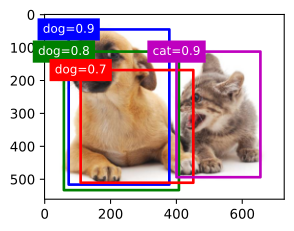
NMS demo

Four overlapping predictions; NMS picks the top-scoring one and suppresses the rest. If a lower-score box covers the same object, it should disappear; if it covers a different object, its IoU should be low enough to survive:

anchors = d2l.tensor([[0.1, 0.08, 0.52, 0.92], [0.08, 0.2, 0.56, 0.95],
                      [0.15, 0.3, 0.62, 0.91], [0.55, 0.2, 0.9, 0.88]])
offset_preds = d2l.tensor([0] * d2l.size(anchors))
cls_probs = d2l.tensor([[0] * 4,  # Predicted background likelihood 
                      [0.9, 0.8, 0.7, 0.1],  # Predicted dog likelihood 
                      [0.1, 0.2, 0.3, 0.9]])  # Predicted cat likelihood
fig = d2l.plt.imshow(img)
show_bboxes(fig.axes, anchors * bbox_scale,
            ['dog=0.9', 'dog=0.8', 'dog=0.7', 'cat=0.9'])
End-to-end output

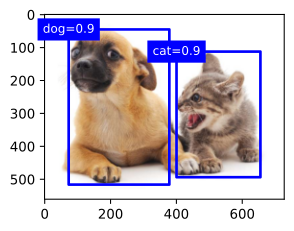
Each output row is (class_id, confidence, x1, y1, x2, y2). Rows with class -1 have been suppressed or filtered out; the remaining rows are the detector’s final boxes.

output = multibox_detection(np.expand_dims(cls_probs, axis=0),
                            np.expand_dims(offset_preds, axis=0),
                            np.expand_dims(anchors, axis=0),
                            nms_threshold=0.5)
output
fig = d2l.plt.imshow(img)
for i in d2l.numpy(output[0]):
    if i[0] == -1:
        continue
    label = ('dog=', 'cat=')[int(i[0])] + str(i[1])
    show_bboxes(fig.axes, [d2l.tensor(i[2:]) * bbox_scale], label)
Recap

  • Anchor boxes = densely tiled candidate rectangles; the network predicts class + offset per anchor.
  • IoU drives ground-truth assignment.
  • Offset parameterization (center delta normalized by width, log-scale for size) is what makes regression stable.
  • NMS at inference time prunes redundant high-scoring predictions to one box per object.
  • This whole pipeline is the substrate for SSD (next deck) and the RPN inside Faster R-CNN.