class PatchEmbedding(nnx.Module):
    """Image-to-sequence stem of the vision transformer."""
    def __init__(self, img_size=96, patch_size=16, num_hiddens=512,
                 num_channels=3, rngs=None):
        rngs = nnx.Rngs(0) if rngs is None else rngs
        def _make_tuple(x):
            if not isinstance(x, (list, tuple)):
                return (x, x)
            return x
        img_size, patch_size = _make_tuple(img_size), _make_tuple(patch_size)
        # A partial trailing patch would silently shrink the token grid
        assert img_size[0] % patch_size[0] == 0 and \
            img_size[1] % patch_size[1] == 0, \
            'image size must be divisible by the patch size'
        self.num_patches = (img_size[0] // patch_size[0]) * (
            img_size[1] // patch_size[1])
        self.conv = nnx.Conv(num_channels, num_hiddens, kernel_size=patch_size,
                             strides=patch_size, padding='VALID', rngs=rngs)

    def __call__(self, X):
        # Output shape: (batch size, no. of patches, no. of channels)
        X = self.conv(X)
return X.reshape((X.shape[0], -1, X.shape[3]))Vision Transformer
Dive into Deep Learning · §11.5
Vision transformer
patches as tokens · the pre-norm block at work · what small scale teaches
Convolutional Priors in Vision
A plain transformer block does not encode locality or translation equivariance
CNNs encode two useful structural assumptions: locality and translation equivariance.
Early hybrids kept them: specialized local self-attention (Ramachandran et al., 2019) was hard to run fast; Cordonnier et al. (2020) showed self-attention can learn to act like convolution — with 2×2 patches.
ViT (Dosovitskiy et al., 2021) uses 16×16 patches, one embedding per patch, an unmodified transformer encoder. Its JFT-300M comparison also changed model size, compute, augmentation, and pretraining, so it does not isolate a single causal factor.
Architecture
Patchify = one strided convolution
“Split into patches, then linearly project” is a single convolution with kernel_size = stride = patch_size — each output position sees exactly one patch:
Shape check
A 96×96 image with 16×16 patches becomes a sequence of (96/16)^2 = 36 tokens of width num_hiddens:
This is the entire interface between vision and the transformer.
The ViT block
The pre-norm block of the chapter, with two vision-era details: GELU in the MLP and dropout after each of its linear layers — dropout follows the ViT training recipe. No mask is needed because every patch attends to every patch.
class ViTBlock(nnx.Module):
    """Pre-norm transformer block with a GELU MLP."""
    def __init__(self, num_hiddens, mlp_num_hiddens, num_heads, dropout,
                 use_bias=False, rngs=None):
        rngs = nnx.Rngs(params=0, dropout=1) if rngs is None else rngs
        self.ln1 = nnx.LayerNorm(num_hiddens, rngs=rngs)
        self.attention = d2l.MultiHeadAttention(
            num_hiddens, num_heads, dropout, use_bias, rngs=rngs)
        self.ln2 = nnx.LayerNorm(num_hiddens, rngs=rngs)
        self.mlp = nnx.Sequential(
            nnx.Linear(num_hiddens, mlp_num_hiddens, rngs=rngs), nnx.gelu,
            nnx.Dropout(dropout, rngs=rngs),
            nnx.Linear(mlp_num_hiddens, num_hiddens, rngs=rngs),
            nnx.Dropout(dropout, rngs=rngs))

    def __call__(self, X, valid_lens=None):
        X_norm = self.ln1(X)
        X = X + self.attention(X_norm, X_norm, X_norm, valid_lens)[0]
        return X + self.mlp(self.ln2(X))
The full model
Patch embed → prepend learnable <cls> token → add learned position embeddings (initialized to small noise — no 2-D structure given!) → dropout → blocks → classify from the <cls> representation:
class ViT(d2l.Classifier):
    """Vision transformer."""
    def __init__(self, img_size, patch_size, num_hiddens, mlp_num_hiddens,
                 num_heads, num_blks, emb_dropout, blk_dropout, lr=0.1,
                 use_bias=False, num_classes=10, num_channels=1, rngs=None):
        super().__init__()
        self.save_hyperparameters(ignore=['rngs'])
        rngs = nnx.Rngs(params=0, dropout=1) if rngs is None else rngs
        self.patch_embedding = PatchEmbedding(
            img_size, patch_size, num_hiddens, num_channels, rngs=rngs)
        self.cls_token = nnx.Param(jnp.zeros((1, 1, num_hiddens)))
        num_steps = self.patch_embedding.num_patches + 1  # Add the cls token
        # Positional embeddings are learnable, initialized to small noise
        self.pos_embedding = nnx.Param(
            rngs.params.normal((1, num_steps, num_hiddens)) * 0.02)
        self.embedding_dropout = nnx.Dropout(emb_dropout, rngs=rngs)
        self.blks = nnx.List([
            ViTBlock(num_hiddens, mlp_num_hiddens, num_heads, blk_dropout,
                     use_bias, rngs=rngs) for _ in range(num_blks)])
        self.head = nnx.Sequential(
            nnx.LayerNorm(num_hiddens, rngs=rngs),
            nnx.Linear(num_hiddens, num_classes, rngs=rngs))

    def forward(self, X):
        X = self.patch_embedding(X)
        X = d2l.concat((jnp.tile(self.cls_token, (X.shape[0], 1, 1)), X), 1)
        X = self.embedding_dropout(X + self.pos_embedding)
        for blk in self.blks:
            X = blk(X)
        return self.head(X[:, 0])
Training on Fashion-MNIST
2 blocks, width 512, 8 heads — about 6.5M parameters; ten epochs, plain SGD, the recipe the CNNs of the Basics part used:
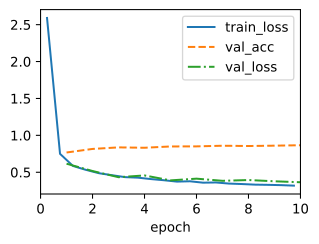
ViT: 6.5M parameters, validation accuracy 0.87Do the positions discover the grid?
Cosine similarity of each patch position’s embedding with all 36, reshaped into the 6×6 grid — position (i,j) shows its map at (i,j):
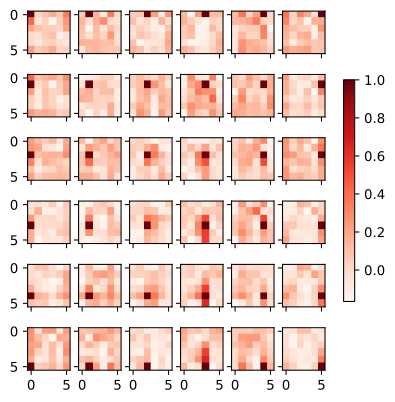
mean cosine similarity: grid neighbors 0.03, distant positions -0.02Learned Position-Embedding Similarity
- Fully trained ViTs show crisp row/column bands: 2-D structure inferred from data alone.
- After ten epochs: neighbors a few hundredths positive, far positions slightly negative — a faint halo, a weak column band here and there.
The embeddings contain weak row-and-column structure after this short training run.
A CNN at the same budget
The ResNet-style baseline uses the same parameter count, data, and ten-epoch budget:
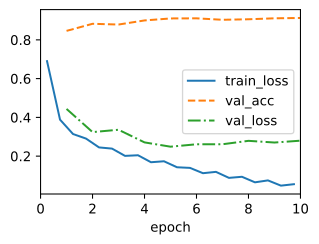
CNN: 6.5M parameters, validation accuracy 0.91
ViT: 6.5M parameters, validation accuracy 0.87
Effect of the convolutional prior
- The CNN includes locality and translation equivariance; the ViT must learn these properties from data.
- Under the ViT paper’s JFT-300M protocol, ViT variants exceeded its cited convolutional baselines; several factors changed together.
- DeiT: augmentation + distillation manufacture the missing invariances on ImageNet-1k alone.
- Swin: reinstate locality and hierarchy, escape quadratic attention at high resolution.
Recap
- ViT = strided-conv patchify → standard pre-norm encoder → classify from
<cls>; the block is untouched, only the tokenization is new. - Learned position embeddings start as noise; after this run their similarities show only weak two-dimensional grid structure.
- In this matched Fashion-MNIST run, the CNN performs better; the experiment does not predict the ranking under other data and training protocols.
- Plain ViTs, hierarchical transformers, and convolutional backbones all remain in use; the choice depends on task and deployment constraints.