class MiniBlock(nnx.Module):
    """Attention + MLP on a residual stream; norm placement as a flag."""
    def __init__(self, num_hiddens, pre_norm, rngs=None):
        rngs = nnx.Rngs(0) if rngs is None else rngs
        self.pre_norm = pre_norm
        self.attention = d2l.MultiHeadAttention(num_hiddens, 4, dropout=0,
                                                rngs=rngs)
        self.W_1 = nnx.Linear(num_hiddens, 4 * num_hiddens, rngs=rngs)
        self.W_2 = nnx.Linear(4 * num_hiddens, num_hiddens, rngs=rngs)
        self.norm1 = nnx.LayerNorm(num_hiddens, rngs=rngs)
        self.norm2 = nnx.LayerNorm(num_hiddens, rngs=rngs)

    def ffn(self, X):
        return self.W_2(nnx.gelu(self.W_1(X)))

    def __call__(self, X):
        if self.pre_norm:
            Y = self.norm1(X)
            X = X + self.attention(Y, Y, Y, None)[0]
            return X + self.ffn(self.norm2(X))
        X = self.norm1(X + self.attention(X, X, X, None)[0])
return self.norm2(X + self.ffn(X))The Transformer Block
Dive into Deep Learning · §11.1
The transformer block
a residual stream and two sublayers · where the norm goes · GELU to SwiGLU · one configurable class
Components of a transformer block
- Attention: the only place positions interact — each token queries the others and adds the retrieved mixture to its stream.
- FFN: per-position computation — and about two thirds of the parameters.
- Both read from the residual stream and add back; shape (n, d) in, (n, d) out — that is what makes stacking possible.
Two arrangements, two lines of code
Post-LN (2017): norm on the stream, after each addition \mathbf{h} = \mathrm{Norm}_1(\mathbf{x} + \mathrm{Attn}(\mathbf{x})), \qquad \mathbf{y} = \mathrm{Norm}_2(\mathbf{h} + \mathrm{FFN}(\mathbf{h}))
Pre-LN (modern): norm on the branch, stream untouched \mathbf{h} = \mathbf{x} + \mathrm{Attn}(\mathrm{Norm}_1(\mathbf{x})), \qquad \mathbf{y} = \mathbf{h} + \mathrm{FFN}(\mathrm{Norm}_2(\mathbf{h}))
Measure it before training it
Stack 32 freshly initialized blocks (Xavier, as in 2017), push a random sequence through — deterministic, seconds:
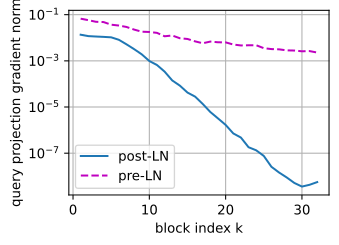
 post-LN: stream RMS at k=32:  1.00,  token spread at k=8,16,32:  3.5e-01  2.5e-02  2.0e-04
          grad norms at k=32: W_q 5.6e-09  W_k 4.9e-09  W_v 6.5e-02  W_o 6.6e-02
  pre-LN: stream RMS at k=32:  5.22,  token spread at k=8,16,32:  7.2e-01  5.3e-01  3.7e-01
          grad norms at k=32: W_q 2.3e-03  W_k 2.3e-03  W_v 8.2e-02  W_o 8.4e-02
Reading the experiment
- Stream RMS: post-LN pinned at 1; pre-LN grows like \sqrt{\textrm{depth}} — each successive block’s relative contribution shrinks.
- Token spread: uniform attention pulls tokens toward their mean; post-LN locks it in → geometric collapse (to 10^{-4} by block 32). Pre-LN dilutes it → polynomial.
- Gradients: identical tokens make the mixture independent of the query/key weights — post-LN’s upper \mathbf{W}_q, \mathbf{W}_k get ~10^{6}\times less gradient; value, output, and FFN weights stay healthy in both.
Initialization-time token contraction is related to rank collapse (Dong et al., 2021). Xiong et al. (2020) separately analyze post-LN sensitivity to warmup.
RMSNorm Omits Mean Centering
\mathrm{RMSNorm}(\mathbf{x}) = \frac{\mathbf{x}}{\sqrt{\tfrac{1}{d}\sum_i x_i^2 + \epsilon}} \odot \boldsymbol{\gamma}
ours vs. built-in: max deviation 9.5e-07
LayerNorm: 1.076 ms
RMSNorm: 0.732 ms
No centering, no bias, and one statistic. Quality and speed comparisons depend on the model, framework, and kernel (Zhang & Sennrich, 2019).
Four places for the norm
Post-LN (2017), pre-LN, post-sublayer off-stream (OLMo 2), pre-and-post (Gemma 3) — only post-LN interrupts the stream’s identity path:
QK-Norm Controls Query and Key Scale
- The block normalizers do not directly constrain the attention logits \mathbf{q}^\top\mathbf{k}/\sqrt{d}: if training inflates q and k, the softmax saturates and its gradient vanishes.
- QK-norm applies RMSNorm to queries and keys per head before the dot product.
- ViT-22B reported attention-entropy instability; Gemma 3, Qwen3, and OLMo 2 are dated examples that use QK-norm.
OLMo 2 places norms after each sublayer while leaving the stream’s identity path unnormalized.
The FFN: from fixed nonlinearity to learned gate
Classic: \mathrm{FFN}(\mathbf{x}) = \mathbf{W}_2\,\phi(\mathbf{W}_1\mathbf{x}), width 4d — ReLU, then GELU.
SwiGLU (Shazeer, 2020): two linear views, one squashed into a soft gate, multiplied \mathrm{SwiGLU}(\mathbf{x}) = \mathbf{W}_2\big(\mathrm{SiLU}(\mathbf{W}_g\mathbf{x}) \odot \mathbf{W}_1\mathbf{x}\big)
Three matrices → shrink the width to \tfrac{8}{3}d and the budget matches 8d^2.
class FeedForward(nnx.Module):
    """Position-wise FFN: GELU MLP or SwiGLU at matched parameter count."""
    def __init__(self, num_hiddens, act='swiglu', bias=False, rngs=None):
        rngs = nnx.Rngs(0) if rngs is None else rngs
        assert act in ('swiglu', 'gelu'), f'unknown act: {act!r}'
        self.act = act
        if act == 'gelu':
            width = 4 * num_hiddens
        else:  # 'swiglu': three matrices; width 8d/3 matches the MLP budget
            width = round(8 * num_hiddens / 3)
            self.W_g = nnx.Linear(num_hiddens, width, use_bias=bias,
                                  rngs=rngs)
        self.W_1 = nnx.Linear(num_hiddens, width, use_bias=bias, rngs=rngs)
        self.W_2 = nnx.Linear(width, num_hiddens, use_bias=bias, rngs=rngs)

    def __call__(self, X):
        if self.act == 'gelu':
            return self.W_2(nnx.gelu(self.W_1(X)))
        return self.W_2(nnx.silu(self.W_g(X)) * self.W_1(X))
One block, every configuration
Norm, activation, arrangement as flags; attention and FFN as factories (MoE and grouped-query attention drop in later):
class TransformerBlock(nnx.Module):
    """Configurable transformer block: attention + FFN on a residual
    stream."""
    def __init__(self, num_hiddens, num_heads, dropout=0, norm='rms',
                 act='swiglu', pre_norm=True, bias=False, attn_factory=None,
                 ffn_factory=None, rngs=None):
        rngs = nnx.Rngs(params=0, dropout=1) if rngs is None else rngs
        assert norm in ('rms', 'layer'), f'unknown norm: {norm!r}'
        assert num_hiddens % num_heads == 0
        self.pre_norm = pre_norm
        make_norm = nnx.RMSNorm if norm == 'rms' else nnx.LayerNorm
        self.norm1 = make_norm(num_hiddens, rngs=rngs)
        self.norm2 = make_norm(num_hiddens, rngs=rngs)
        self.attention = (d2l.MultiHeadAttention(num_hiddens, num_heads,
                                                 dropout, bias=bias,
                                                 rngs=rngs)
                          if attn_factory is None else attn_factory(rngs))
        self.ffn = (FeedForward(num_hiddens, act, bias=bias, rngs=rngs)
                    if ffn_factory is None else ffn_factory(rngs))
        self.dropout = nnx.Dropout(dropout, rngs=rngs)

    def __call__(self, X, valid_lens=None):
        if self.pre_norm:
            Y = self.norm1(X)
            X = X + self.dropout(self.attention(Y, Y, Y, valid_lens)[0])
            return X + self.dropout(self.ffn(self.norm2(X)))
        X = self.norm1(X + self.dropout(
            self.attention(X, X, X, valid_lens)[0]))
        return self.norm2(X + self.dropout(self.ffn(X)))
The flags at work: GELU vs. SwiGLU
Same data, seed, optimizer, 600 steps; parameters matched to 0.1%:
   gelu: loss at step 200/400/600: 2.27/1.73/1.41
 swiglu: loss at step 200/400/600: 2.22/1.57/1.24
Across the tested seeds, SwiGLU improves the loss by more than a tenth of a nat at the same parameter cost.
Recap
- Attention communicates, the FFN computes; both add into the residual stream.
- Norm placement decides depth behavior at init: post-LN collapses tokens geometrically and starves upper attention layers of gradient; pre-LN grows the stream like \sqrt{\textrm{depth}} and keeps every block trainable.
- RMSNorm = the scale statistic only; QK-norm pins the attention logits.
- SwiGLU beats the matched-budget MLP by a small, seed-stable margin.
TransformerBlockexpresses the block designs used in this chapter through one constructor signature.