class TransformerEncoder(nnx.Module):
    """Bidirectional encoder: embeddings plus unmasked pre-norm blocks."""
    def __init__(self, vocab_size, num_hiddens=128, num_heads=4, num_blks=4,
                 max_len=64, rngs=None):
        rngs = nnx.Rngs(0) if rngs is None else rngs
        init = nnx.initializers.normal(0.02)
        self.token_emb = nnx.Embed(vocab_size, num_hiddens,
                                   embedding_init=init, rngs=rngs)
        self.pos_emb = nnx.Embed(max_len, num_hiddens, embedding_init=init,
                                 rngs=rngs)
        self.blks = nnx.List([
            d2l.TransformerBlock(num_hiddens, num_heads, rngs=rngs)
            for _ in range(num_blks)])
        self.norm = nnx.RMSNorm(num_hiddens, rngs=rngs)

    def __call__(self, X):
        H = self.token_emb(X) + self.pos_emb(jnp.arange(X.shape[1]))
        for blk in self.blks:
            H = blk(H)  # no valid_lens: every token attends everywhere
return self.norm(H)Encoders, Decoders, and Cross-Attention
Dive into Deep Learning · §11.4
Encoders, decoders, and cross-attention
three wirings of one block · predicting from both sides · an alignment you can verify · the latent bottleneck
Three wirings of one block
The block leaves two questions open: which positions may attend to which, and where keys and values come from.
- Encoder-only: no mask — no left-to-right generation, built to represent (BERT; the ViT is this wiring over patches).
- Decoder-only: the GPT of the previous sections — generation is the objective run forward.
- Encoder–decoder: causal decoder cross-attends into a bidirectional encoder (the 2017 original).
A bidirectional encoder in a dozen lines
One difference from CharLM: no valid_lens — nothing is masked.
The masked-token objective
Next-token prediction is trivial when the future is visible. Hide what you ask for:
\max \; \sum_{t \in \mathcal{M}} \log p\left(x_t \mid \mathbf{x}_{\setminus \mathcal{M}}\right)
masked loss at step 500/1000/2000: 1.97/1.54/1.21Loss by Available Context
Window edges are one-sided by construction — position 63 is where a causal LM lives permanently. Bin the loss by position:
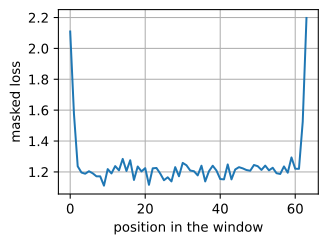
masked accuracy 0.61
loss at position 0: 2.11, at position 63: 2.20, interior mean: 1.20
Flat interior at ~1.1 nats, roughly double at the one-sided edges.
Predictions you can read
'the time _raveller for so it will be con'... -> 't' 0.72, 'g' 0.05, 'f' 0.05
'the time trave_ler for so it will be con'... -> 'l' 0.96, ' ' 0.02, 'r' 0.01
'the time traveller for so it w_ll be con'... -> 'e' 0.46, 'i' 0.40, 'o' 0.09
Only the right context pins down “trave_ler”.
Scaled up — subwords, sentence pairs, gigabytes — this is BERT (2018). ModernBERT (2024) refits the same wiring with this chapter’s block: RoPE, gated FFN, local–global attention, 8k context.
A task whose alignment we know
Machine translation gives no ground truth for its attention. Reversal does: target t must copy source n-1-t, and content only flows through cross-attention.
source 'fainddapflek' -> target 'kelfpaddniaf'Random strings = unlimited fresh data — no memorization possible.
The decoder block: one more sublayer
Causal self-attention → cross-attention (queries: target stream; keys/values: encoder output) → FFN. Self-attention masked, cross-attention not — the source is fully known.
class DecoderBlock(nnx.Module):
    """Pre-norm decoder block: causal self-attention, cross-attention,
    FFN."""
    def __init__(self, num_hiddens, num_heads, rngs=None):
        rngs = nnx.Rngs(0) if rngs is None else rngs
        self.norm1 = nnx.RMSNorm(num_hiddens, rngs=rngs)
        self.norm2 = nnx.RMSNorm(num_hiddens, rngs=rngs)
        self.norm3 = nnx.RMSNorm(num_hiddens, rngs=rngs)
        self.self_attention = d2l.MultiHeadAttention(num_hiddens, num_heads,
                                                     dropout=0, rngs=rngs)
        self.cross_attention = d2l.MultiHeadAttention(
            num_hiddens, num_heads, dropout=0, rngs=rngs)
        self.ffn = d2l.FeedForward(num_hiddens, rngs=rngs)

    def __call__(self, X, enc):
        B, T = X.shape[:2]
        causal = jnp.tile(jnp.arange(1, T + 1), (B, 1))
        Y = self.norm1(X)
        X = X + self.self_attention(Y, Y, Y, causal)[0]
        Y2, cross_weights = self.cross_attention(self.norm2(X), enc, enc,
                                                 None)
        X = X + Y2
        return X + self.ffn(self.norm3(X)), cross_weights
Three masks, two primitives
A ragged real batch composes every mask from a padding mask and the causal triangle (§10.2): source padding for encoder self-attention, causal ∧ target padding for decoder self-attention, source padding again for cross-attention:
src_len, tgt_len = jnp.array([3, 5]), jnp.array([3, 4])
S, T_dec = int(src_len.max()), int(tgt_len.max())
src_valid = (jnp.arange(S)[None, :] < src_len[:, None])[:, None, :]
tgt_valid = (jnp.arange(T_dec)[None, :] < tgt_len[:, None])[:, None, :]
causal = (jnp.arange(T_dec)[None, :]
          <= jnp.arange(T_dec)[:, None])[None]          # (1, T, T)
B = len(src_len)
enc_self = jnp.broadcast_to(src_valid, (B, S, S))   # source padding
dec_self = causal & tgt_valid              # (B, T, T): causal AND padding
cross = jnp.broadcast_to(src_valid, (B, T_dec, S))  # source padding
for name, m in (('encoder self', enc_self), ('decoder self', dec_self),
                ('cross', cross)):
    print(f'{name}-attention mask, sequence 0 (1 = may attend):')
    print(m[0].astype(int))
encoder self-attention mask, sequence 0 (1 = may attend):
[[1 1 1 0 0]
[1 1 1 0 0]
[1 1 1 0 0]
[1 1 1 0 0]
[1 1 1 0 0]]
...
[1 1 1 0]]
cross-attention mask, sequence 0 (1 = may attend):
[[1 1 1 0 0]
[1 1 1 0 0]
[1 1 1 0 0]
[1 1 1 0 0]]Train it, decode it
One encoder block, one decoder block, 600 steps of on-line batches:
loss at step 100/200/400/600: 0.002/0.001/0.000/0.000exact match on 1000 fresh strings: 1.000
source 'mpajamgfccab' -> predicted 'baccfgmajapm'Reading the alignment
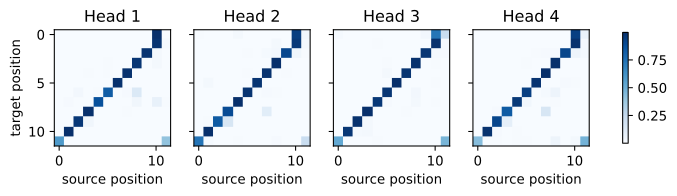
head-averaged argmax hits the true source position on 92% of rows; mean weight there 0.87The anti-diagonal, learned — and verifiable, because the task fixes the answer. Deeper, more-headed models solve the task with delocalized maps (exercise): readable attention is the exception.
Cross-attention as interface
A query can be a learned parameter. M latents read a length-N input:
O(MN) to read, O(M^2) to think — the N^2 term never appears (Perceiver, 2021).
A minimal Perceiver
class PerceiverEncoder(nnx.Module):
    """M learned latents cross-attend into the input, then process among
    themselves."""
    def __init__(self, num_latents, num_hiddens, num_heads=4, num_blks=2,
                 rngs=None):
        rngs = nnx.Rngs(0) if rngs is None else rngs
        self.latents = nnx.Param(
            0.02 * jax.random.normal(rngs.params(),
                                     (num_latents, num_hiddens)))
        self.norm_q = nnx.RMSNorm(num_hiddens, rngs=rngs)
        self.cross_attention = d2l.MultiHeadAttention(
            num_hiddens, num_heads, dropout=0, rngs=rngs)
        self.blks = nnx.List([
            d2l.TransformerBlock(num_hiddens, num_heads, rngs=rngs)
            for _ in range(num_blks)])
        self.norm = nnx.RMSNorm(num_hiddens, rngs=rngs)

    def __call__(self, X):
        Z = jnp.broadcast_to(self.latents[...],
                             (X.shape[0],) + self.latents.shape)
        Z = Z + self.cross_attention(self.norm_q(Z), X, X, None)[0]  # O(MN)
        for blk in self.blks:
            Z = blk(Z)                                               # O(M^2)
        return self.norm(Z)

perceiver = PerceiverEncoder(num_latents=64, num_hiddens=256)
perceiver.eval()
X = jax.random.normal(jax.random.key(0), (1, 4096, 256))
print('input', X.shape, '-> latent summary', perceiver(X).shape)
input (1, 4096, 256) -> latent summary (1, 64, 256)The cost curve
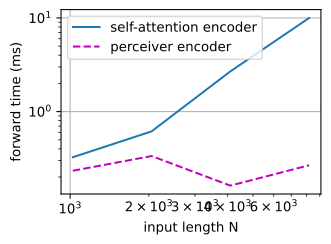
N= 1024: self-attention   0.33 ms, perceiver  0.23 ms
N= 2048: self-attention   0.62 ms, perceiver  0.34 ms
N= 4096: self-attention   2.69 ms, perceiver  0.16 ms
N= 8192: self-attention  10.00 ms, perceiver  0.27 ms
Self-attention: about 4× per doubling of N. The Perceiver grows more slowly and is over an order of magnitude faster by N = 8192; at short inputs its fixed latent-processing overhead removes this advantage.
Which wiring when
- Encoder-only — the product is the representation: embeddings, retrieval, classification (BERT descendants, ModernBERT).
- Encoder–decoder — input fully known, own tower worth it: T5 text-to-text, Whisper speech recognition.
- Decoder-only — autoregressive generation and prompt-conditioned tasks: one stack and a next-token objective.
Perceiver descendants live on inside multimodal models: Flamingo’s resampler, BLIP-2’s Q-Former, DETR’s object queries.
Recap
- Three wirings, one block: bidirectional / causal / both + cross.
- Masked prediction trains encoders; both-sides context cuts the loss roughly in half vs. one side.
- Cross-attention verified: the reversal task’s anti-diagonal appears in the learned map.
- Learned queries turn attention into an interface: O(MN), flat cost curve, Perceiver → resampler → Q-Former.
- The appropriate wiring depends on whether the output is a representation, a sequence conditioned on a separate input, or an autoregressive continuation.