%matplotlib inline
from d2l import jax as d2l
from flax import linen as nn
import jax
from jax import numpy as jnp
import mathRecurrent Neural Network Implementation from Scratch
RNNs from Scratch
A character-level language model on The Time Machine, with nothing but tensor ops. Four pieces:
- RNN cell — the recurrence \mathbf{h}_t = \tanh(\mathbf{W}_{xh} \mathbf{x}_t + \mathbf{W}_{hh} \mathbf{h}_{t-1} + \mathbf{b}).
- LM wrapper — one-hot tokens, project hidden states to vocab logits.
- Gradient clipping — keep BPTT gradients bounded.
- Training + decoding to generate continuations.
Char-level keeps the vocab tiny (~30 tokens) — embedding- free models that fit in a notebook.
The RNN cell
Parameters: \mathbf{W}_{xh}, \mathbf{W}_{hh}, \mathbf{b}. Initialize randomly, scaled to keep activations sensible:
E0524 02:49:35.971119 12206 cuda_executor.cc:1206] [0] Failed to allocate device memory: INTERNAL: [0] Failed to allocate 9.41GiB (10100251136 bytes) of ...
E0524 02:49:35.971521 12206 cuda_executor.cc:1206] [0] Failed to allocate device memory: INTERNAL: [0] Failed to allocate 8.47GiB (9090225152 bytes) of ...
class RNNScratch(nn.Module):
"""The RNN model implemented from scratch."""
num_inputs: int
num_hiddens: int
sigma: float = 0.01
def setup(self):
self.W_xh = self.param('W_xh', nn.initializers.normal(self.sigma),
(self.num_inputs, self.num_hiddens))
self.W_hh = self.param('W_hh', nn.initializers.normal(self.sigma),
(self.num_hiddens, self.num_hiddens))
self.b_h = self.param('b_h', nn.initializers.zeros, (self.num_hiddens,))Forward, unrolled
Walk a length-T input one step at a time, carrying the hidden state forward:
@d2l.add_to_class(RNNScratch)
def __call__(self, inputs, state=None):
    if state is not None:
        state, = state
    outputs = []
    for X in inputs:  # Shape of inputs: (num_steps, batch_size, num_inputs)
        state = d2l.tanh(d2l.matmul(X, self.W_xh) + (
            d2l.matmul(state, self.W_hh) if state is not None else 0)
                         + self.b_h)
        outputs.append(state)
return outputs, stateE0524 02:49:38.435383 12206 cuda_blas.cc:196] failed to create cublas handle: the resource allocation failed
E0524 02:49:38.435418 12206 cuda_blas.cc:199] Failure to initialize cublas may be due to OOM (cublas needs some free memory when you initialize it, and your ...
E0524 02:49:38.860147 12206 cuda_blas.cc:196] failed to create cublas handle: the resource allocation failed
E0524 02:49:38.860183 12206 cuda_blas.cc:199] Failure to initialize cublas may be due to OOM (cublas needs some free memory when you initialize it, and your ...Sanity check on output shapes:
def check_len(a, n):
    """Check the length of a list."""
    assert len(a) == n, f'list\'s length {len(a)} != expected length {n}'

def check_shape(a, shape):
    """Check the shape of a tensor."""
    assert a.shape == shape, \
            f'tensor\'s shape {a.shape} != expected shape {shape}'

check_len(outputs, num_steps)
check_shape(outputs[0], (batch_size, num_hiddens))
check_shape(state, (batch_size, num_hiddens))
Wrapping as a language model
Add a vocab-sized output projection on top of the RNN’s hidden states. This is the LM wrapper we’ll train:
class RNNLMScratch(d2l.Classifier):
    """The RNN-based language model implemented from scratch."""
    rnn: nn.Module
    vocab_size: int
    lr: float = 0.01

    def setup(self):
        self.W_hq = self.param('W_hq', nn.initializers.normal(self.rnn.sigma),
                               (self.rnn.num_hiddens, self.vocab_size))
        self.b_q = self.param('b_q', nn.initializers.zeros, (self.vocab_size))

    def training_step(self, params, batch, state):
        value, grads = jax.value_and_grad(
            self.loss, has_aux=True)(params, batch[:-1], batch[-1], state)
        l, _ = value
        self.plot('ppl', d2l.exp(l), train=True)
        return value, grads

    def validation_step(self, params, batch, state):
        l, _ = self.loss(params, batch[:-1], batch[-1], state)
        self.plot('ppl', d2l.exp(l), train=False)
Training objective
At every time step, the model predicts the next character. Flatten batch and time, apply cross-entropy, and average:
\mathcal{L} = \frac{1}{BT}\sum_{b,t} -\log P(x_{b,t+1} \mid x_{b,\le t}).
Perplexity is \exp(\mathcal{L}); lower means fewer effective choices for the next character.
Inputs as one-hot vectors
Tokens come in as integer ids; the RNN expects vectors. One-hot encoding is the simplest input embedding:
Array([[1., 0., 0., 0., 0.],
[0., 0., 1., 0., 0.]], dtype=float32)Output projection
Gather hidden states across all time steps and project through the head:
@d2l.add_to_class(RNNLMScratch)
def output_layer(self, rnn_outputs):
    outputs = [d2l.matmul(H, self.W_hq) + self.b_q for H in rnn_outputs]
    return d2l.stack(outputs, 1)

@d2l.add_to_class(RNNLMScratch)
def forward(self, X, state=None):
    embs = self.one_hot(X)
    rnn_outputs, _ = self.rnn(embs, state)
    return self.output_layer(rnn_outputs)
Smoke test — input shape (batch, num_steps), output shape (batch, num_steps, vocab):
E0524 02:49:39.806481   12206 cuda_blas.cc:196] failed to create cublas handle: the resource allocation failed
E0524 02:49:39.806507 12206 cuda_blas.cc:199] Failure to initialize cublas may be due to OOM (cublas needs some free memory when you initialize it, and your ...
Gradient clipping
The recurrence multiplies the gradient by \mathbf{W}_{hh} once per time step — a single explosion-prone factor. Clip before each step so its norm stays bounded:
\mathbf{g} \leftarrow \min\!\left(1, \frac{\theta}{\|\mathbf{g}\|}\right)\mathbf{g}.
@d2l.add_to_class(d2l.Trainer)
def clip_gradients(self, grad_clip_val, grads):
    grad_leaves, _ = jax.tree_util.tree_flatten(grads)
    norm = jnp.sqrt(sum(jnp.vdot(x, x) for x in grad_leaves))
    clip = lambda grad: jnp.where(norm < grad_clip_val,
                                  grad, grad * (grad_clip_val / norm))
    return jax.tree_util.tree_map(clip, grads)
Training
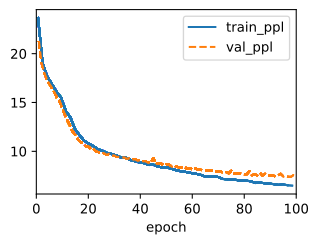
~32 character window, batch 1024, ~30 epochs. Gradient clipping keeps the loss from going NaN:
Decoding (text generation)
Feed in a prompt, then sample the model’s predictions for the next character at each step:
@d2l.add_to_class(RNNLMScratch)
def predict(self, prefix, num_preds, vocab, params):
    state, outputs = None, [vocab[prefix[0]]]
    for i in range(len(prefix) + num_preds - 1):
        X = d2l.tensor([[outputs[-1]]])
        embs = self.one_hot(X)
        rnn_outputs, state = self.rnn.apply({'params': params['rnn']},
                                            embs, state)
        if i < len(prefix) - 1:  # Warm-up period
            outputs.append(vocab[prefix[i + 1]])
        else:  # Predict num_preds steps
            Y = self.apply({'params': params}, rnn_outputs,
                           method=self.output_layer)
            outputs.append(int(d2l.reshape(d2l.argmax(Y, axis=2), ())))
return ''.join([vocab.idx_to_token[i] for i in outputs])perplexity 7.4, 'time traveller the this the this t'Output is recognizably English-shaped — but at this size the model hasn’t learned much beyond character-level statistics.
Recap
- Char-level RNN LM: hand-rolled cell + one-hot input + linear head + cross-entropy.
- Gradient clipping is mandatory for stable RNN training.
- Training is truncated BPTT — backprop only through
num_stepsof unrolled history per batch. - The same scaffold takes any cell (LSTM, GRU) — only the recurrence changes. Coming next.