Gated Recurrent Units (GRU)
Gated Recurrent Units
LSTMs work, but they’re heavy: three gates, an input node, a separate cell state. Cho et al. (2014) asked whether the gating idea could be kept while collapsing the bookkeeping.
GRU = two gates, no separate cell state, a single hidden state. Often matches LSTM quality at lower compute.
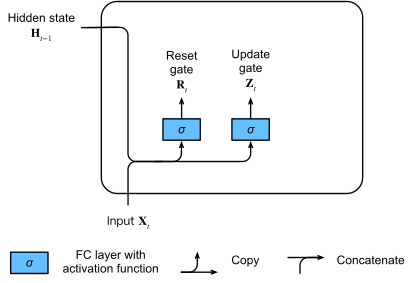
Reset gate \mathbf{R}_t — how much of the past to mix into the candidate hidden state.Update gate \mathbf{Z}_t — convex blend between old hidden state and new candidate.
Setup
from d2l import jax as d2lfrom flax import linen as nnimport jaxfrom jax import numpy as jnp
The gates are sigmoid heads of X_t and H_{t-1} :
\mathbf{R}_t = \sigma(\mathbf{X}_t \mathbf{W}_{xr} + \mathbf{H}_{t-1} \mathbf{W}_{hr} + \mathbf{b}_r),\quad
\mathbf{Z}_t = \sigma(\mathbf{X}_t \mathbf{W}_{xz} + \mathbf{H}_{t-1} \mathbf{W}_{hz} + \mathbf{b}_z).
Computing the reset and update gates.
Candidate hidden state
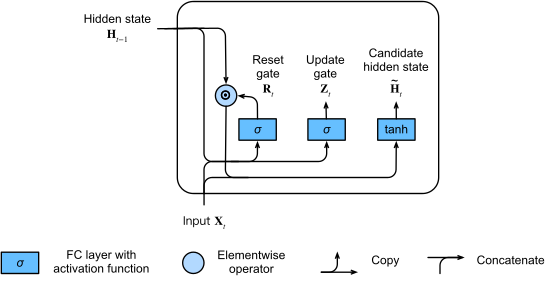
Like a vanilla RNN cell, but \mathbf{H}_{t-1} is filtered by \mathbf{R}_t before entering the recurrence:
\tilde{\mathbf{H}}_t = \tanh(\mathbf{X}_t \mathbf{W}_{xh} + (\mathbf{R}_t \odot \mathbf{H}_{t-1}) \mathbf{W}_{hh} + \mathbf{b}_h).
Computing the candidate hidden state \tilde{\mathbf{H}}_t .
Final hidden state
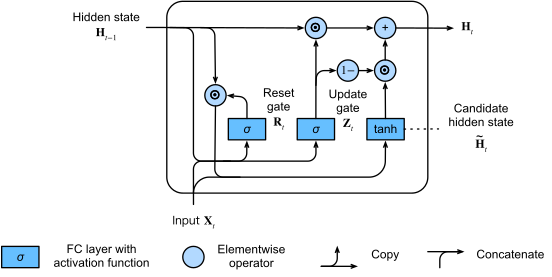
Convex combination of old state and candidate, ruled by \mathbf{Z}_t :
\mathbf{H}_t = \mathbf{Z}_t \odot \mathbf{H}_{t-1} + (1 - \mathbf{Z}_t) \odot \tilde{\mathbf{H}}_t.
\mathbf{Z}_t \to 1 : skip this step. \mathbf{Z}_t \to 0 : fully replace with the candidate. \mathbf{R}_t \to 1 recovers a vanilla RNN.
Computing the hidden state \mathbf{H}_t .
From scratch: parameters
Nine matrices and three biases, grouped by gate:
class GRUScratch(d2l.Module):int int float = 0.01 def setup(self ):= lambda name, shape: self .param(name,self .sigma),= lambda name : (f'W_x { name} ' , (self .num_inputs, self .num_hiddens)),f'W_h { name} ' , (self .num_hiddens, self .num_hiddens)),self .param(f'b_ { name} ' , nn.initializers.zeros, (self .num_hiddens)))self .W_xz, self .W_hz, self .b_z = triple('z' ) # Update gate self .W_xr, self .W_hr, self .b_r = triple('r' ) # Reset gate self .W_xh, self .W_hh, self .b_h = triple('h' ) # Candidate hidden state
Forward pass
One step computes \mathbf{Z}_t , \mathbf{R}_t , the candidate, and the convex blend — five matmuls per time step versus eight in an LSTM.
def forward(self , inputs, H= None ):# Use lax.scan primitive instead of looping over the # inputs, since scan saves time in jit compilation def scan_fn(H, X):= d2l.sigmoid(d2l.matmul(X, self .W_xz) + d2l.matmul(H, self .W_hz) + self .b_z)= d2l.sigmoid(d2l.matmul(X, self .W_xr) + self .W_hr) + self .b_r)= d2l.tanh(d2l.matmul(X, self .W_xh) + * H, self .W_hh) + self .b_h)= Z * H + (1 - Z) * H_tildereturn H, H # return carry, y if H is None := inputs.shape[1 ]= jnp.zeros((batch_size, self .num_hiddens))else := H# scan takes the scan_fn, initial carry state, xs with leading axis to be scanned = jax.lax.scan(scan_fn, carry, inputs)return outputs, carry
Training
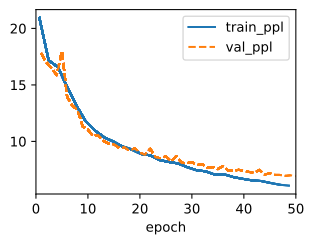
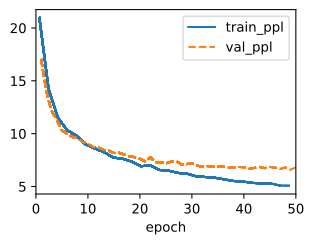
Same RNNLMScratch head, same Trainer. Often converges to the same perplexity as the LSTM with fewer parameters.
= d2l.TimeMachine(batch_size= 1024 , num_steps= 32 )= GRUScratch(num_inputs= len (data.vocab), num_hiddens= 32 )= d2l.RNNLMScratch(gru, vocab_size= len (data.vocab), lr= 4 )= d2l.Trainer(max_epochs= 50 , gradient_clip_val= 1 , num_gpus= 1 )
Concise: nn.GRU
Library cell drops into the same RNN scaffold:
class GRU(d2l.RNN):int @nn.compact def __call__ (self , inputs, H= None , training= False ):if H is None := inputs.shape[1 ]= nn.GRUCell(features= self .num_hiddens).initialize_carry(0 ), (batch_size, self .num_hiddens))= nn.scan(nn.GRUCell, variable_broadcast= "params" ,= 0 , out_axes= 0 , split_rngs= {"params" : False })= GRU(features= self .num_hiddens)(H, inputs)return outputs, H
Train it:
= GRU(num_hiddens= 32 )= d2l.RNNLM(gru, vocab_size= len (data.vocab), lr= 4 )
Decode:
'it has' , 20 , data.vocab, trainer.state.params)
'it has of the travell the '
Recap
GRU = LSTM with one gate fewer and no separate cell state.
Reset gate gates the past before the recurrence; update gate convex-blends old vs. new.
Recovers vanilla RNN (\mathbf{R}_t = 1 , \mathbf{Z}_t = 0 ) and identity (\mathbf{Z}_t = 1 ) as limit cases.
Roughly 25 % fewer parameters than LSTM at the same width; comparable perplexity on most LM tasks.