Adam

Dive into Deep Learning · §9.6

Per-coordinate learning rates and the modern default
AdaGrad → RMSProp → Adam · a tiny transformer testbed · where Adam wins

One learning rate is not enough

Motivation

Momentum fixed the direction; the step size per coordinate is still one global \eta.

  • Rare features (rare words, rare users) get meaningful gradients rarely; by the time they arrive, a decayed \eta is too small to use them.
  • The ill-conditioned valley: the ideal fix is a preconditioner, one step size per direction. Curvature is unaffordable; the gradient’s own history is not.

AdaGrad (Duchi, Hazan & Singer, 2011): decay each coordinate by its own activity,

\mathbf{s}_t = \mathbf{s}_{t-1} + \mathbf{g}_t^2,\qquad \mathbf{x}_{t+1} = \mathbf{x}_t - \frac{\eta}{\sqrt{\mathbf{s}_t + \epsilon}} \odot \mathbf{g}_t.

AdaGrad on the valley

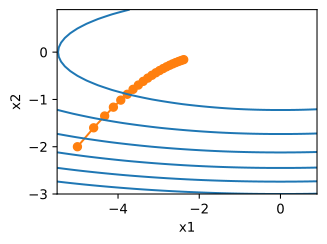
Same quadratic as the momentum section, \eta = 0.4 — smooth, no oscillation, but the accumulated \mathbf{s}_t grinds the steps down:

def adagrad_2d(x1, x2, s1, s2):
    eps = 1e-6
    g1, g2 = 0.2 * x1, 4 * x2
    s1 += g1 ** 2
    s2 += g2 ** 2
    x1 -= eta / math.sqrt(s1 + eps) * g1
    x2 -= eta / math.sqrt(s2 + eps) * g2
    return x1, x2, s1, s2

def f_2d(x1, x2):
    return 0.1 * x1 ** 2 + 2 * x2 ** 2

eta = 0.4
d2l.show_trace_2d(f_2d, d2l.train_2d(adagrad_2d))

epoch 20, x1: -2.382563, x2: -0.158591

The scaling is adaptive, so a formerly unthinkable \eta = 2 is safe:

eta = 2
d2l.show_trace_2d(f_2d, d2l.train_2d(adagrad_2d))
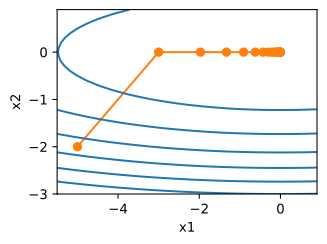
epoch 20, x1: -0.002295, x2: -0.000000

RMSProp: forgetting on purpose

AdaGrad never forgets: \mathbf{s}_t grows forever, steps decay like t^{-1/2} by construction — right for convex problems, wrong for deep nets that need to move late in training.

RMSProp (Hinton, 2012): same rule, leaky average instead of sum,

\mathbf{v}_t = \beta_2 \mathbf{v}_{t-1} + (1-\beta_2)\, \mathbf{g}_t^2,

with memory \approx 1/(1-\beta_2) steps. The learning rate becomes an independent knob (→ schedules).

def rmsprop_2d(x1, x2, v1, v2):
    g1, g2, eps = 0.2 * x1, 4 * x2, 1e-6
    v1 = beta2 * v1 + (1 - beta2) * g1 ** 2
    v2 = beta2 * v2 + (1 - beta2) * g2 ** 2
    x1 -= eta / math.sqrt(v1 + eps) * g1
    x2 -= eta / math.sqrt(v2 + eps) * g2
    return x1, x2, v1, v2

eta, beta2 = 0.4, 0.9
d2l.show_trace_2d(f_2d, d2l.train_2d(rmsprop_2d))
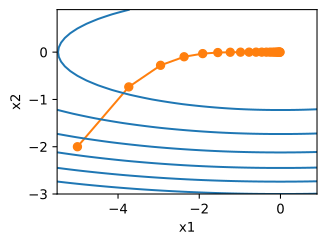
epoch 20, x1: -0.010599, x2: 0.000000

Adam = both moments, debiased

\mathbf{m}_t = \beta_1 \mathbf{m}_{t-1} + (1-\beta_1)\,\mathbf{g}_t, \qquad \mathbf{v}_t = \beta_2 \mathbf{v}_{t-1} + (1-\beta_2)\,\mathbf{g}_t^2,

\hat{\mathbf{m}}_t = \frac{\mathbf{m}_t}{1-\beta_1^t},\quad \hat{\mathbf{v}}_t = \frac{\mathbf{v}_t}{1-\beta_2^t},\qquad \mathbf{x}_{t+1} = \mathbf{x}_t - \eta\, \frac{\hat{\mathbf{m}}_t}{\sqrt{\hat{\mathbf{v}}_t} + \epsilon}.

  • Defaults \beta_1 = 0.9, \beta_2 = 0.999: direction averaged over ~10 steps, scale over ~1000.
  • Bias correction is exact: \mathbb{E}[\mathbf{v}_t] carries the fraction 1-\beta_2^t of the true scale; division cancels it at every t. After 10 steps, \mathbf{v}_t holds ~1% of its stationary value — uncorrected Adam takes its biggest steps on its worst estimates.

From scratch

Two buffers per parameter plus a step counter:

def init_adam_states(feature_dim):
    m_w, m_b = jnp.zeros((feature_dim, 1)), jnp.zeros(1)
    v_w, v_b = jnp.zeros((feature_dim, 1)), jnp.zeros(1)
    return [(m_w, v_w), (m_b, v_b)]

def adam(params, grads, states, hyperparams):
    beta1, beta2, eps = 0.9, 0.999, 1e-6
    for i, (p, (m, v), g) in enumerate(zip(params, states, grads)):
        m = beta1 * m + (1 - beta1) * g
        v = beta2 * v + (1 - beta2) * jnp.square(g)
        m_hat = m / (1 - beta1 ** hyperparams['t'])
        v_hat = v / (1 - beta2 ** hyperparams['t'])
        params[i] = p - hyperparams['lr'] * m_hat / (jnp.sqrt(v_hat) + eps)
        states[i] = (m, v)
    hyperparams['t'] += 1
    return params[0], params[1]
d2l.train_ch11(adam, init_adam_states(feature_dim),
               {'lr': 0.01, 't': 1}, data_iter, feature_dim);
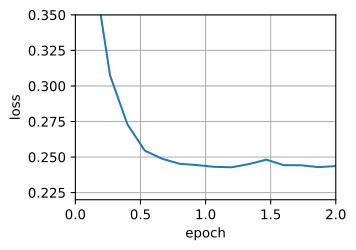
loss: 0.244, 0.717 sec/epoch

A tiny language model

The differences that matter show on language models. TinyLM: a decoder-only transformer (subject of ch. 10 — here, a black box), on the character-level Time Machine from ch. 8.

class TinyLM(nnx.Module):
    """A small decoder-only transformer language model."""
    def __init__(self, vocab_size, d_model=128, num_heads=2, num_blks=2,
                 max_len=64, rngs=None):
        rngs = nnx.Rngs(0) if rngs is None else rngs
        self.num_heads = num_heads
        self.token_emb = nnx.Embed(vocab_size, d_model, rngs=rngs)
        self.pos_emb = nnx.Embed(max_len, d_model, rngs=rngs)
        self.blks = nnx.List([nnx.Dict(
            norm1=nnx.LayerNorm(d_model, rngs=rngs),
            qkv=nnx.Linear(d_model, 3 * d_model, rngs=rngs),
            proj=nnx.Linear(d_model, d_model, rngs=rngs),
            norm2=nnx.LayerNorm(d_model, rngs=rngs),
            mlp1=nnx.Linear(d_model, 4 * d_model, rngs=rngs),
            mlp2=nnx.Linear(4 * d_model, d_model, rngs=rngs))
            for _ in range(num_blks)])
        self.norm = nnx.LayerNorm(d_model, rngs=rngs)
        self.head = nnx.Linear(d_model, vocab_size, rngs=rngs)

    def attention(self, blk, X):
        B, T, D = X.shape
        q, k, v = jnp.split(blk['qkv'](X), 3, axis=-1)
        q, k, v = (u.reshape(B, T, self.num_heads, -1) for u in (q, k, v))
        Y = jax.nn.dot_product_attention(q, k, v, is_causal=True)
        return blk['proj'](Y.reshape(B, T, D))

    def __call__(self, X):
        H = self.token_emb(X) + self.pos_emb(jnp.arange(X.shape[1]))
        for blk in self.blks:
            H = H + self.attention(blk, blk['norm1'](H))
            H = H + blk['mlp2'](jax.nn.gelu(blk['mlp1'](blk['norm2'](H))))
        return self.head(self.norm(H))

A differentiable function with a particular census of parameters — the census, not the mechanism, is what optimization sees.

The parameter census

Three populations — later sections treat them differently (decay exclusions, matrix vs. non-matrix preconditioning):

parameter              shape            count
blks.0.mlp1.bias       (512,)             512
blks.0.mlp1.kernel     (128, 512)       65536
blks.0.mlp2.bias       (128,)             128
blks.0.mlp2.kernel     (512, 128)       65536
blks.0.norm1.bias      (128,)             128
...
pos_emb.embedding      (64, 128)         8192
token_emb.embedding    (28, 128)         3584
                           embeddings   11776
                             matrices  396800
                              vectors    3612
                                total  412188
  • embeddings: rows update only when their token occurs
  • matrices: ~96% of all parameters
  • vectors: LayerNorm scales and biases

The race: tuned SGD vs. tuned Adam

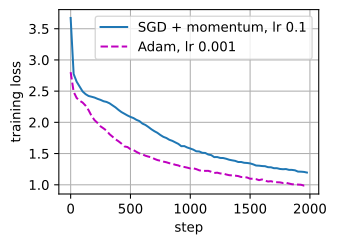
Symmetric protocol: same model, same init, same 2,000 steps, constant learning rate, four-point grid each, best final training loss wins.

On the language model:

final perplexity: SGD 3.34, Adam 2.70
  • SGD’s best lr sits one grid point below divergence; Adam’s optimum is interior.
  • The gap opens early and no rate in our grid closes it.

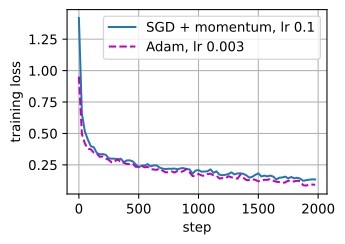
Same race, same harness, on a CNN

test accuracy: SGD 0.919, Adam 0.920
  • Curves nearly coincide; test accuracy within a point or two, either way.
  • This is why SGD carried computer vision for a decade — and why “which optimizer wins” depends on the model, not just the tuning.

Why: heterogeneity

Live research, but the threads agree (Kunstner et al. 2023, 2024; Zhang et al. 2024):

  • Not minibatch noise: the gap persists full-batch; Adam tracks sign descent (\sqrt{\hat{\mathbf{v}}} \approx |\hat{\mathbf{m}}| → step \approx \eta\,\mathrm{sign}(\hat{\mathbf{m}})).
  • Language is heavy-tailed: GD stalls on rare tokens; Adam keeps moving on all of them.
  • Transformer blocks have wildly different curvature; CNN blocks look alike. One global \eta must serve the stiffest block and starve the rest.

Recap

  • Adam = per-coordinate scaling (AdaGrad) + forgetting (RMSProp) + momentum + exact bias correction.
  • Cost: two state buffers per parameter — 3× parameter memory.
  • Wins big on transformers (heterogeneity), little on CNNs — at matched tuning.
  • \epsilon is a step ceiling \eta/\epsilon, not just a numerical guard; AMSGrad/Yogi patch the variance estimate (exercises).