import collections
from d2l import jax as d2l
import jax
from jax import numpy as jnp
import math
import numpy as np
import os
import randomThe Dataset for Pretraining Word Embeddings
word2vec Data
Data pipeline for word2vec. Three classical tricks make skip-gram tractable on large corpora:
- Subsampling — drop frequent words (“the”, “a”) with probability rising with their frequency.
- Center / context window — each token contributes a few (center, context) pairs.
- Negative sampling — train a binary classifier with K random negatives per positive; \mathcal{O}(|V|) \to \mathcal{O}(K).
Output: minibatches of (center, context+, context-) ready for the next deck’s skip-gram model.
Setup
PTB corpus
Standard small-corpus NLP benchmark. Stream as a list of sentences, each a list of tokens:
d2l.DATA_HUB['ptb'] = (d2l.DATA_URL + 'ptb.zip',
                       '319d85e578af0cdc590547f26231e4e31cdf1e42')


def read_ptb():
    """Load the PTB dataset into a list of text lines."""
    data_dir = d2l.download_extract('ptb')
    # Read the training set
    with open(os.path.join(data_dir, 'ptb.train.txt')) as f:
        raw_text = f.read()
    return [line.split() for line in raw_text.split('\n')]

sentences = read_ptb()
f'# sentences: {len(sentences)}'
'# sentences: 42069'Subsampling frequent words
Drop word w with probability 1 - \sqrt{t / f(w)}, where f(w) is its corpus frequency. Common words get aggressively dropped, rare ones almost never:
def subsample(sentences, vocab):
    """Subsample high-frequency words."""
    # Exclude unknown tokens ('<unk>')
    sentences = [[token for token in line if vocab[token] != vocab.unk]
                 for line in sentences]
    counter = collections.Counter([
        token for line in sentences for token in line])
    num_tokens = sum(counter.values())

    # Return True if `token` is kept during subsampling
    def keep(token):
        return(random.uniform(0, 1) <
               math.sqrt(1e-4 / counter[token] * num_tokens))

    return ([[token for token in line if keep(token)] for line in sentences],
            counter)

subsampled, counter = subsample(sentences, vocab)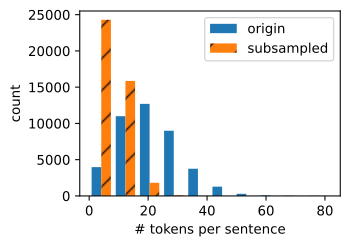
Subsampling effect
Compare counts before / after — frequent words shrink, rare words mostly survive. The target is not a smaller corpus for its own sake; it is a less dominated training signal for content words:
'# of "the": before=50770, after=2095'Center + context windows
For each center token, sample a window size up to max_window_size and take the surrounding tokens as context:
def get_centers_and_contexts(corpus, max_window_size):
    """Return center words and context words in skip-gram."""
    centers, contexts = [], []
    for line in corpus:
        # To form a "center word--context word" pair, each sentence needs to
        # have at least 2 words
        if len(line) < 2:
            continue
        centers += line
        for i in range(len(line)):  # Context window centered at `i`
            window_size = random.randint(1, max_window_size)
            indices = list(range(max(0, i - window_size),
                                 min(len(line), i + 1 + window_size)))
            # Exclude the center word from the context words
            indices.remove(i)
            contexts.append([line[idx] for idx in indices])
return centers, contextsdataset [[0, 1, 2, 3, 4, 5, 6], [7, 8, 9]]
center 0 has contexts [1]
center 1 has contexts [0, 2, 3]
center 2 has contexts [0, 1, 3, 4]
center 3 has contexts [2, 4]
center 4 has contexts [3, 5]
center 5 has contexts [3, 4, 6]
center 6 has contexts [5]
center 7 has contexts [8, 9]
center 8 has contexts [7, 9]
center 9 has contexts [7, 8]Negative sampling
Sample K negative context words per positive pair from P(w) \propto f(w)^{0.75} — the empirical-frequency distribution dampened by an exponent (the original word2vec choice):
class RandomGenerator:
    """Randomly draw among {1, ..., n} according to n sampling weights."""
    def __init__(self, sampling_weights):
        # Exclude
        self.population = list(range(1, len(sampling_weights) + 1))
        self.sampling_weights = sampling_weights
        self.candidates = []
        self.i = 0

    def draw(self):
        if self.i == len(self.candidates):
            # Cache `k` random sampling results
            self.candidates = random.choices(
                self.population, self.sampling_weights, k=10000)
            self.i = 0
        self.i += 1
return self.candidates[self.i - 1][3, 2, 3, 3, 3, 3, 2, 3, 3, 3]def get_negatives(all_contexts, vocab, counter, K):
"""Return noise words in negative sampling."""
# Sampling weights for words with indices 1, 2, ... (index 0 is the
# excluded unknown token) in the vocabulary
sampling_weights = [counter[vocab.to_tokens(i)]**0.75
for i in range(1, len(vocab))]
all_negatives, generator = [], RandomGenerator(sampling_weights)
for contexts in all_contexts:
negatives = []
while len(negatives) < len(contexts) * K:
neg = generator.draw()
# Noise words cannot be context words
if neg not in contexts:
negatives.append(neg)
all_negatives.append(negatives)
return all_negatives
all_negatives = get_negatives(all_contexts, vocab, counter, 5)Padding into minibatches
Different centers have different numbers of context + negative tokens. Pad to the batch max, store a mask so loss only counts real positions:
def batchify(data):
    """Return a minibatch of examples for skip-gram with negative sampling."""
    max_len = max(len(c) + len(n) for _, c, n in data)
    centers, contexts_negatives, masks, labels = [], [], [], []
    for center, context, negative in data:
        cur_len = len(context) + len(negative)
        centers += [center]
        contexts_negatives += [context + negative + [0] * (max_len - cur_len)]
        masks += [[1] * cur_len + [0] * (max_len - cur_len)]
        labels += [[1] * len(context) + [0] * (max_len - len(context))]
    return (d2l.reshape(d2l.tensor(centers), (-1, 1)), d2l.tensor(
contexts_negatives), d2l.tensor(masks), d2l.tensor(labels))centers = [[1]
[1]]
contexts_negatives = [[2 2 3 3 3 3]
[2 2 2 3 3 0]]
masks = [[1 1 1 1 1 1]
[1 1 1 1 1 0]]
labels = [[1 1 0 0 0 0]
[1 1 1 0 0 0]]Reusable loader
The final factory returns the same pieces the skip-gram loss expects: centers, contexts+negatives, masks, and labels.
def _pad_ptb(all_centers, all_contexts, all_negatives):
    """Pre-pad all skip-gram examples to the global max length.

    Returns four NumPy arrays: centers (N,), contexts_negatives (N, L),
    masks (N, L), labels (N, L), where L = max(len(c) + len(n))."""
    import numpy as _np
    n = len(all_centers)
    max_len = max(len(c) + len(neg)
                  for c, neg in zip(all_contexts, all_negatives))
    centers = _np.asarray(all_centers, dtype=_np.int64)
    contexts_negatives = _np.zeros((n, max_len), dtype=_np.int64)
    masks = _np.zeros((n, max_len), dtype=_np.float32)
    labels = _np.zeros((n, max_len), dtype=_np.float32)
    for i, (c, neg) in enumerate(zip(all_contexts, all_negatives)):
        cur_len = len(c) + len(neg)
        contexts_negatives[i, :cur_len] = c + neg
        masks[i, :cur_len] = 1.
        labels[i, :len(c)] = 1.
    return centers, contexts_negatives, masks, labels
def load_data_ptb(batch_size, max_window_size, num_noise_words):
"""Download the PTB dataset and then load it into memory."""
sentences = read_ptb()
vocab = d2l.Vocab(sentences, min_freq=10)
subsampled, counter = subsample(sentences, vocab)
corpus = [vocab[line] for line in subsampled]
all_centers, all_contexts = get_centers_and_contexts(
corpus, max_window_size)
all_negatives = get_negatives(
all_contexts, vocab, counter, num_noise_words)
centers, cn, masks, labels = _pad_ptb(
all_centers, all_contexts, all_negatives)
centers = centers.reshape(-1, 1)
n = len(centers)
class PTBDataIter:
def __len__(self):
return math.ceil(n / batch_size)
def __iter__(self):
import numpy as _np
idx = _np.random.permutation(n)
for i in range(0, n, batch_size):
b = idx[i:i + batch_size]
yield (jnp.asarray(centers[b]), jnp.asarray(cn[b]),
jnp.asarray(masks[b]), jnp.asarray(labels[b]))
return PTBDataIter(), vocabRecap
- Subsample frequent words, sample dynamic-size context windows, draw K negatives per pair.
- Pad to batch-max with a binary mask — same trick as variable-length sequence batching elsewhere.
- This loader feeds the skip-gram model in the next deck; same pattern still used by fastText / GloVe-style pretraining.