from d2l import jax as d2l
import jax
from jax import numpy as jnp
from flax import nnx
import optax
import numpy as npNatural Language Inference: Using Attention
Decomposable Attention
Decomposable Attention (Parikh et al., 2016) — a small, fast NLI model that beat much more complex recurrence-based architectures on SNLI in 2016. No recurrence, no convolution — pure attention + MLPs.
Three steps: Attend → Compare → Aggregate.
Pipeline
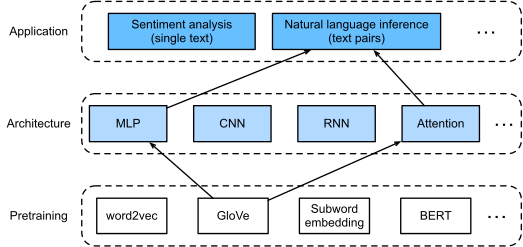
GloVe → attend → compare → aggregate → 3-way classifier.
The decomposable attention model
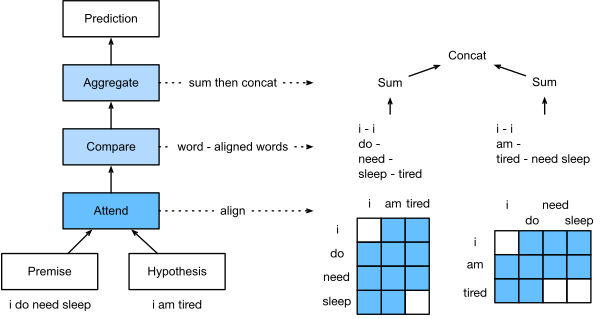
Align premise/hypothesis tokens, then compare and aggregate.
Setup
Step 1: Attend
Compute alignment weights between every premise word and every hypothesis word. Use them to build aligned context vectors:
class MLP(nnx.Module):
    def __init__(self, num_inputs, num_hiddens, flatten, rngs=None):
        rngs = nnx.Rngs(params=0, dropout=1) if rngs is None else rngs
        self.dropout1 = nnx.Dropout(0.2, rngs=rngs)
        self.dense1 = nnx.Linear(num_inputs, num_hiddens, rngs=rngs)
        self.dropout2 = nnx.Dropout(0.2, rngs=rngs)
        self.dense2 = nnx.Linear(num_hiddens, num_hiddens, rngs=rngs)
        self.flatten = flatten

    def __call__(self, x):
        x = nnx.relu(self.dense1(self.dropout1(x)))
        if self.flatten:
            x = x.reshape((x.shape[0], -1))
        x = nnx.relu(self.dense2(self.dropout2(x)))
        if self.flatten:
            x = x.reshape((x.shape[0], -1))
        return x
class Attend(nnx.Module):
def __init__(self, embed_size, num_hiddens, rngs=None):
self.f = MLP(embed_size, num_hiddens, flatten=False, rngs=rngs)
def __call__(self, A, B):
# Shape of `A`/`B`: (`batch_size`, no. of tokens in sequence A/B,
# `embed_size`)
# Shape of `f_A`/`f_B`: (`batch_size`, no. of tokens in sequence A/B,
# `num_hiddens`)
f_A = self.f(A)
f_B = self.f(B)
# Shape of `e`: (`batch_size`, no. of tokens in sequence A,
# no. of tokens in sequence B)
e = jnp.matmul(f_A, f_B.transpose(0, 2, 1))
# Shape of `beta`: (`batch_size`, no. of tokens in sequence A,
# `embed_size`), where sequence B is softly aligned with each token
# (axis 1 of `beta`) in sequence A
beta = jnp.matmul(jax.nn.softmax(e, axis=-1), B)
# Shape of `alpha`: (`batch_size`, no. of tokens in sequence B,
# `embed_size`), where sequence A is softly aligned with each token
# (axis 1 of `alpha`) in sequence B
alpha = jnp.matmul(jax.nn.softmax(e.transpose(0, 2, 1), axis=-1), A)
return beta, alphaStep 2: Compare
For each premise word a_i, run an MLP on [a_i, \beta_i] where \beta_i is the soft-aligned hypothesis context. Same for hypothesis words:
class Compare(nnx.Module):
    def __init__(self, embed_size, num_hiddens, rngs=None):
        self.g = MLP(2 * embed_size, num_hiddens, flatten=False, rngs=rngs)

    def __call__(self, A, B, beta, alpha):
        V_A = self.g(jnp.concatenate([A, beta], axis=2))
        V_B = self.g(jnp.concatenate([B, alpha], axis=2))
        return V_A, V_B
Step 3: Aggregate
Sum the per-token compared vectors → concat the two sentence summaries → final MLP → 3-way logits:
class Aggregate(nnx.Module):
    def __init__(self, num_hiddens, num_outputs, rngs=None):
        rngs = nnx.Rngs(params=0, dropout=1) if rngs is None else rngs
        self.h = MLP(2 * num_hiddens, num_hiddens, flatten=True, rngs=rngs)
        self.output = nnx.Linear(num_hiddens, num_outputs, rngs=rngs)

    def __call__(self, V_A, V_B):
        # Sum up both sets of comparison vectors
        V_A = V_A.sum(axis=1)
        V_B = V_B.sum(axis=1)
        # Feed the concatenation of both summarization results into an MLP
        Y_hat = self.output(self.h(jnp.concatenate([V_A, V_B], axis=1)))
        return Y_hat
Putting it together
The final module wires the three stages into one classifier. Inputs are premise IDs and hypothesis IDs; output is 3 logits for entailment, contradiction, and neutral.
class DecomposableAttention(nnx.Module):
    def __init__(self, vocab_size, embed_size, num_hiddens, rngs=None):
        rngs = nnx.Rngs(params=0, dropout=1) if rngs is None else rngs
        self.embedding = nnx.Embed(vocab_size, embed_size, rngs=rngs)
        self.attend = Attend(embed_size, num_hiddens, rngs=rngs)
        self.compare = Compare(embed_size, num_hiddens, rngs=rngs)
        self.aggregate = Aggregate(num_hiddens, 3, rngs=rngs)

    def __call__(self, premises, hypotheses):
        A = self.embedding(premises)
        B = self.embedding(hypotheses)
        beta, alpha = self.attend(A, B)
        V_A, V_B = self.compare(A, B, beta, alpha)
        # There are 3 possible outputs: entailment, contradiction, and neutral
        Y_hat = self.aggregate(V_A, V_B)
        return Y_hat
Loading data + model
SNLI examples are padded premise/hypothesis pairs. Initialize the model with GloVe embeddings, then train all MLP stages end-to-end:
read 549367 examples
read 9824 examplesTraining
Loss should fall quickly: there is no recurrence, so every token-pair alignment and every MLP comparison is fully parallelizable.
lr, num_epochs = 0.001, 4
net.embedding.embedding[...] = jnp.array(embeds)
optimizer = nnx.Optimizer(net, optax.adam(lr), wrt=nnx.Param)
train_net = nnx.view(net, deterministic=False)
eval_net = nnx.view(net, deterministic=True)

@nnx.jit
def train_step(net, optimizer, premises, hypotheses, labels):
    def loss_fn(model):
        logits = model(premises, hypotheses)
        return optax.softmax_cross_entropy_with_integer_labels(
            logits, labels).mean()
    loss, grads = nnx.value_and_grad(loss_fn)(net)
    optimizer.update(net, grads)
    return loss

@nnx.jit
def eval_step(net, premises, hypotheses, labels):
    logits = net(premises, hypotheses)
    return (logits.argmax(axis=-1) == labels).sum()

timer = d2l.Timer()
for epoch in range(num_epochs):
    batch_losses, n_train = [], 0
    for batch in train_iter:
        premises, hypotheses, labels = batch[0], batch[1], batch[2]
        batch_losses.append(train_step(
            train_net, optimizer, premises, hypotheses, labels))
        n_train += len(labels)
    # Synchronize once per epoch, rather than once per minibatch.
    train_loss = float(jnp.stack(batch_losses).mean())
    # Evaluate on test set
    batch_correct, n_test = [], 0
    for batch in test_iter:
        premises, hypotheses, labels = batch[0], batch[1], batch[2]
        batch_correct.append(eval_step(
            eval_net, premises, hypotheses, labels))
        n_test += len(labels)
    n_correct = int(jnp.stack(batch_correct).sum())
    print(f'epoch {epoch + 1}, loss {train_loss:.4f}, '
          f'test acc {n_correct / n_test:.4f}')
print(f'{num_epochs * n_train / timer.stop():.1f} examples/sec')
epoch 1, loss 0.8543, test acc 0.7414
epoch 2, loss 0.6290, test acc 0.7910
epoch 3, loss 0.5628, test acc 0.8029
epoch 4, loss 0.5267, test acc 0.8184
937.5 examples/secPredict
Read the examples semantically: “he is good” follows from “he is great”, while “he is bad” contradicts it. The model’s label mapping should reflect that ordering.
def predict_snli(net, vocab, premise, hypothesis):
    """Predict the logical relationship between the premise and hypothesis."""
    premise = jnp.array(vocab[premise]).reshape((1, -1))
    hypothesis = jnp.array(vocab[hypothesis]).reshape((1, -1))
    label = jnp.argmax(nnx.view(net, deterministic=True)(premise, hypothesis),
                       axis=1)
    return 'entailment' if label == 0 else 'contradiction' if label == 1 \
else 'neutral'Recap
- Decomposable Attention does NLI in three small MLP stages: attend, compare, aggregate.
- No recurrence — completely parallelizable; trains fast even before GPU acceleration was abundant.
- A precursor to the cross-attention machinery that BERT (next deck) does end-to-end inside one Transformer encoder.